


If your interest in sex has dropped off and you can’t pinpoint why, you’re not imagining it, and you’re not alone. Desire rises and falls for reasons that have nothing to do with a relationship going wrong or a body failing you.
Sometimes it’s stress. Sometimes it’s a hormone shift you can’t see on a calendar. Sometimes it’s a documented medical condition with an actual name and actual treatments.
Low sexual desire rarely traces back to one cause. Hormones, brain chemistry, and relationship issues can all play a role. The treatment that works is the one that matches what’s actually driving the change, not a single fix applied to everyone.
What Counts As Low Libido, and When It Becomes a Medical Concern
Every woman’s desire for sex shifts over time. A demanding stretch at work, a new baby, a run of bad sleep, or a rough patch with a partner can all turn the dial down for weeks or months. That kind of dip is normal, and it usually resolves once the circumstance behind it does.
What turns a normal dip into something worth raising with a doctor is distress. If lower desire bothers you, creates tension with a partner, or chips away at your confidence, that feeling is what makes this a medical concern rather than a passing phase.
Two women can report the same drop in desire, and only one of them has something a clinician would treat, because the distress is the part that counts.
This distinction changes what the right next step looks like. A temporary dip calls for patience and maybe a conversation with a partner. A persistent, distressing change calls for a conversation with a healthcare provider who can help you figure out what’s going on.
Distress is the diagnostic threshold, not desire alone. If you feel content with where your desire sits, there’s nothing to fix. If it troubles you, that feeling is the signal worth acting on.
What Is HSDD, and How Is It Different From a Low-Desire Phase?
Hypoactive sexual desire disorder, or HSDD, is a specific, named condition, not a catchall for “not feeling like it.” Roughly 10% of adult women experience it. HSDD is defined by persistent low sexual desire along with the personal distress that comes with it.
That’s a meaningful share of women living with a diagnosable, treatable condition, and most never hear the term from a doctor.
The clinical definition draws a tight circle. To meet the criteria for acquired, generalized HSDD:
- Your low desire has to have developed after a period of normal desire.
- It has to show up regardless of the partner or situation
- It can’t be better explained by a relationship problem, another medical or psychiatric condition, or a medication side effect.
A thorough evaluation matters here. A provider needs to rule out those other explanations before HSDD becomes the working diagnosis.
The Hormonal Factor: Estrogen, Testosterone, and Perimenopause
Desire is partly a hormone story. Estrogen and testosterone both influence sexual interest, and both shift throughout a woman’s reproductive life in ways that can move desire without any change in a relationship or mental state.
Perimenopause is where this shows up most sharply. Estrogen becomes erratic rather than simply declining, and testosterone, which plays a bigger role in female desire than most people realize, tends to drift downward gradually, often starting years before perimenopause even begins.
The combination can bring on vaginal dryness, sleep disruption, and mood changes that compound the direct effect on libido, so a woman in her late forties dealing with low desire is often dealing with several linked issues at once rather than one isolated symptom.
Some women want to address hormone balance without a prescription, and that’s where supplement-based support enters the picture. DIM200 is formulated around diindolylmethane, a compound studied for its role in estrogen metabolism.
The Neurochemical Factor: How Prescription Options Like PT-141 Work
Not every treatment for low desire works on blood flow. Sildenafil and similar drugs for men increase blood flow to genital tissue, but that vascular approach doesn’t reliably translate to female sexual desire, since desire in women is driven more by the brain than by circulation alone.
Bremelanotide, sold as Vyleesi and known more broadly as PT-141, takes a different route. It’s a melanocortin receptor agonist, meaning it activates receptors in the central nervous system tied to sexual response, rather than acting on blood vessels.
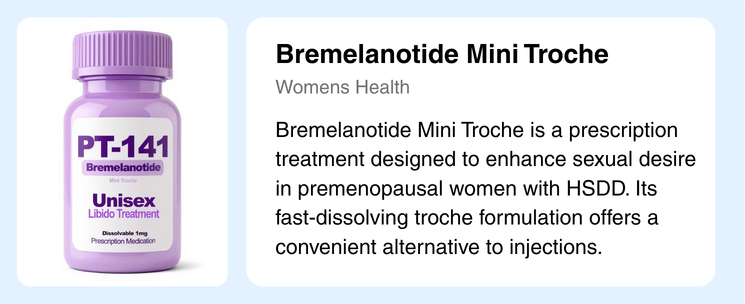
The FDA approved bremelanotide in 2019 for premenopausal women with HSDD, characterized by low sexual desire causing marked distress that isn’t better explained by a relationship problem, another condition, or a medication.
Across two Phase 3 studies, women treated with bremelanotide reported a statistically significant improvement in desire scores compared to placebo, along with a meaningful drop in the distress tied to low desire.
However, some trial participants stopped treatment early due to side effects like nausea.
The FDA-approved version comes as a self-administered injection, taken as needed at least 45 minutes before anticipated sexual activity. Some women prefer a compounded troche instead, a lozenge dissolved under the tongue rather than injected.
If that fits your preferences better than an injection, you’ll find that option here.
Bremelanotide isn’t the only prescription approach to HSDD, and it won’t be right for every woman. For a full side-by-side against flibanserin (Addyi), the other FDA-approved option, read Vyleesi vs. Addyi: Comparing “Female Viagras.”
Lower-Commitment Options: Where to Start If You’re Not Ready for a Prescription
A prescription doesn’t have to be your first move. If you want to address low desire without a formal HSDD diagnosis or an injection routine, a few lower-commitment options are worth trying first.
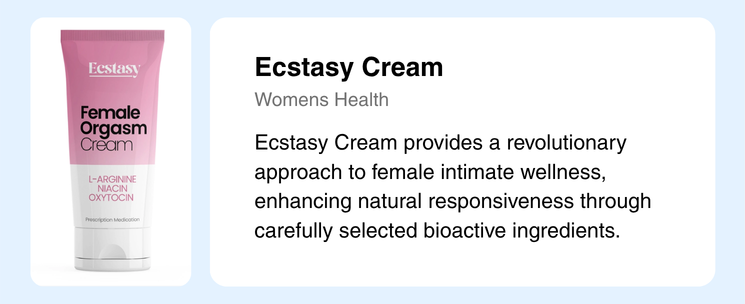
Ecstasy Cream is a topical formulation designed to increase sensitivity and blood flow in intimate areas, applied directly rather than taken systemically. It’s a reasonable starting point if your concern is more about physical responsiveness than desire itself, and it skips the commitment of a daily supplement or an injectable prescription.
V for Women takes a supplement approach instead, combining ingredients marketed to support arousal and desire from within. Treat it as an accessible starting point rather than a guaranteed fix. It’s a wellness product, not a clinically studied pharmaceutical. The V for Women product page has the specifics.
Low Libido vs HSDD vs Menopausal Changes
| HSDD | Situational Low Desire | Perimenopausal Changes | |
|---|---|---|---|
| Typical Cause | Neurochemical; not explained by relationship, other condition, or medication | Stress, life circumstance, relationship context | Fluctuating estrogen and declining testosterone |
| Duration | Persistent, 6 months or longer | Temporary, resolves with the circumstance | Ongoing through the menopause transition |
| Treatment Approach | Prescription options (bremelanotide, flibanserin), clinical evaluation | Addressing the underlying stressor; may not need medical treatment | Hormone-focused support, lifestyle changes, possible prescription options |
Buy Women’s Low Libido Products Online with eDrugstore
If you’re struggling with a low sex drive, eDrugstore makes it easy to explore your options from the privacy of home. Complete a free online consultation with a U.S.-licensed physician to find out whether a prescription treatment, supplement, or topical product may be right for you.
Your order will ship free in discreet packaging, so you can get the care you need with confidence. Get started with eDrugstore today.
Your relationship will thank you for it.
Disclaimer: This article provides general information about health and related topics but is not intended as a substitute for professional medical advice, diagnosis, or treatment.
Always seek the advice of your physician or other qualified health provider with any questions you may have regarding a medical condition.

Paula Clark worked in the healthcare industry for 17 years before becoming a full-time freelance health and medical writer. Her clients appreciate her ability to convey complex information in terms laypeople can understand. Paula prides herself on the depth and accuracy of her research. Her goal is to add authority to your site in words that will delight both Google and your readers.