
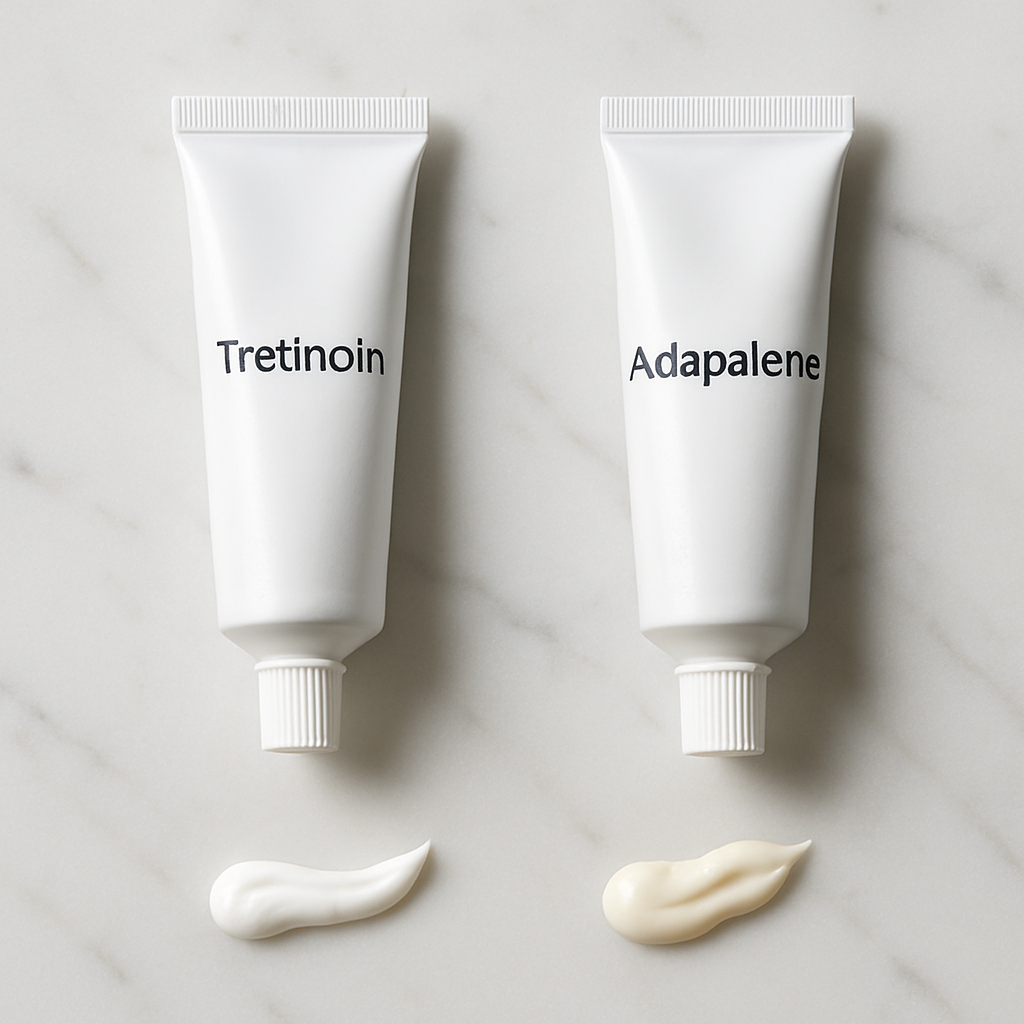

If you’ve been comparing tretinoin vs adapalene for fine lines, you’re already ahead of most people who just grab whatever retinol the drugstore is selling. Both are real retinoids. Both have decades of clinical data behind them. But they aren’t interchangeable, and the one that’s right for your face depends on your skin type, your patience, and how much irritation you’re willing to tolerate.
Here’s the short version up front: tretinoin has more wrinkle data, adapalene has fewer side effects. The longer version is more interesting, and it might change which one you ask your doctor about.
Tretinoin (the active ingredient in Retin-A and Renova) is FDA-approved for treating fine wrinkles, mottled hyperpigmentation, and roughness. Adapalene was originally developed for acne and is technically used off-label for wrinkles, even though clinical evidence increasingly supports it.
How tretinoin and adapalene actually work
Both drugs belong to the retinoid family, which means they bind to retinoic acid receptors in skin cells and tell those cells to behave more like young, healthy ones. Faster turnover. More collagen. Less clumping of pigment. Thicker dermis over time.
Tretinoin is retinoic acid itself. It binds directly. No conversion needed. That’s part of why it works fast and why it stings.
Adapalene is a third-generation synthetic retinoid. It targets a narrower set of receptors (mainly RAR-beta and RAR-gamma), which is the reason it tends to be gentler. Same family, different personality.
Tretinoin vs adapalene: the wrinkle evidence
This is where the comparison gets honest. Tretinoin has been studied for photoaging since the late 1980s, and the NIH summarizes decades of trials showing measurable improvement in fine lines, skin texture, and pigmentation after 6 to 12 months of consistent use. It’s the gold standard. Dermatologists reach for it first when wrinkles are the primary concern.
Adapalene’s wrinkle data is newer but real. A 2018 split-face study published in the Journal of Cosmetic Dermatology found that adapalene 0.3% produced statistically significant improvements in fine lines, pigmentation, and skin smoothness after 9 months, with noticeably less irritation than tretinoin 0.05%.
So when we line up tretinoin vs adapalene for anti-aging:
- Tretinoin: more robust evidence, faster visible results (often by 12 weeks), stronger on deeper wrinkles
- Adapalene: solid evidence at higher strengths, slower to show change, much better tolerated
- Both: require months of consistent nightly use, and both demand daily sunscreen
If you’ve shopped around for other comparison articles like our piece on adapalene vs benzoyl peroxide for acne, you’ll notice a theme: adapalene tends to be the gentler option in almost every head-to-head it’s in.
Side effects and the "retinoid uglies"
Anyone who’s started a retinoid knows the first six weeks can be rough. Redness. Peeling. Stinging when you put on moisturizer. Breakouts that seem to come out of nowhere. Dermatologists call this the retinization period.
Tretinoin causes more of this. In clinical trials, roughly 50 to 80 percent of patients report some peeling or irritation in the first month. With adapalene, that number drops to closer to 20 to 30 percent, and the irritation tends to be milder when it does happen.
Common side effects of both:
- Dryness and flaking, especially around the nose and mouth
- Increased sun sensitivity (non-negotiable sunscreen territory)
- Temporary worsening of acne in the first 4 to 6 weeks
- Mild burning or stinging on application
Less common but worth knowing: contact dermatitis, hyperpigmentation in darker skin tones if irritation isn’t managed, and an occasional rebound flare if you stop suddenly. MedlinePlus has a clear patient summary on tretinoin precautions worth reading before you start.
Neither retinoid is considered safe in pregnancy. Stop both if you’re trying to conceive, pregnant, or breastfeeding, and talk to your prescriber about alternatives like azelaic acid.
Which one should you actually ask about?
The honest answer is, it depends on your skin and your goals.
Pick tretinoin if: you have moderate to deep wrinkles, you’ve used retinoids before without major irritation, you want results within 3 to 6 months, and you have access to a prescriber. It’s still prescription-only in the US.
Pick adapalene if: you have sensitive or rosacea-prone skin, you’re new to retinoids, you also deal with adult acne, or you want something you can buy over the counter. Adapalene 0.1% gel has been available without a prescription since 2016.
There’s also a middle path worth mentioning. A lot of dermatologists will start a sensitive patient on adapalene for 6 to 12 months, let the skin adapt, then transition to tretinoin if more wrinkle improvement is the goal. It’s the same logic behind picking the gentler option first in a lot of head-to-heads. We see the same pattern in comparisons like cetirizine vs levocetirizine for allergies, where the milder cousin often gets tried first.
Cost and access
Generic tretinoin runs roughly $20 to $60 per tube with insurance, sometimes more without. Brand-name Renova and Retin-A Micro can run well over $200. Adapalene 0.1% gel over the counter is typically $12 to $25, and adapalene 0.3% prescription strength is comparable to generic tretinoin pricing.
If cost is shaping your decision, compare prices on generic tretinoin or adapalene at edrugstore.com before you fill at a chain pharmacy. The price gap surprises people, the same way it does with options like generic sildenafil vs tadalafil costs.
How to start either one without wrecking your face
A few practical points that matter more than which molecule you pick:
- Start two or three nights a week, not nightly
- Apply a pea-sized amount to dry skin, not damp
- Moisturize 15 to 20 minutes after application
- Wear SPF 30 or higher every single morning
- Give it at least 12 weeks before judging results
The American Academy of Dermatology has a good public-facing guide on this that’s worth bookmarking.
The bottom line on tretinoin vs adapalene
For pure wrinkle reduction, tretinoin still has the stronger evidence and the faster results. For tolerability, lower cost, and easier access, adapalene is the more practical choice for a lot of people, and the data for tretinoin vs adapalene at higher adapalene strengths is closing the gap. Talk to your dermatologist or pharmacist about your skin type, your goals, and whether starting gentle or going straight to the gold standard makes more sense for you.
This article is for informational purposes only and is not medical advice. Always consult a licensed pharmacist or physician before starting, stopping, or changing any medication.
References
- FDA prescribing information for tretinoin (Renova), official approved indications and safety data.
- NIH/PMC review of topical retinoids for photoaging, summarizes long-term tretinoin clinical evidence.
- MedlinePlus tretinoin patient information, plain-language precautions and usage.
- American Academy of Dermatology guide on retinoids, patient-facing usage and expectations.

Dr Steven Schlosser
Dr. Schlosser graduated from Lafayette College Phi Beta Kappa and attended Georgetown Medical School. He had 4 years of medical residency training at Tufts University in Boston in both Gynecology and Internal Medicine. He has had a spotless medical career for the past 40+ years and is Board Certified. Learn More