


Highlights
- Using gender pronouns is one of many ways to express your gender identity.
- Some people use binary gender pronouns, while others use gender-neutral or nonbinary pronouns.
- Common pronoun mistakes include misgendering others, being dismissive of others’ gender pronouns, and not correcting misgendering.
- Normalizing correct pronoun usage can help to create safe and inclusive spaces for people of all gender identities.
People have used gender pronouns to refer to themselves and others for centuries. Respecting gender pronouns is important to creating safe and inclusive environments as gender diversity becomes more visible in the United States.
Gender Pronouns and Gender Identity
Gender pronouns are the words people use to refer to a person’s gender. Your gender pronouns may or may not align with the sex you were assigned at birth. Many people consider gender pronouns to be an important part of gender expression.
Gender pronouns aren’t just for transgender or gender-nonconforming people. We all use gender pronouns, whether we realize their importance or not. For example, many cisgender people use gender pronouns that align with the male-female gender binary.
Some people use pronouns that don’t align with the gender binary. Some people may use more than one set of gender pronouns. Regardless of the pronouns a person uses, using correct gender pronouns is a simple yet powerful way to affirm a person’s gender identity.
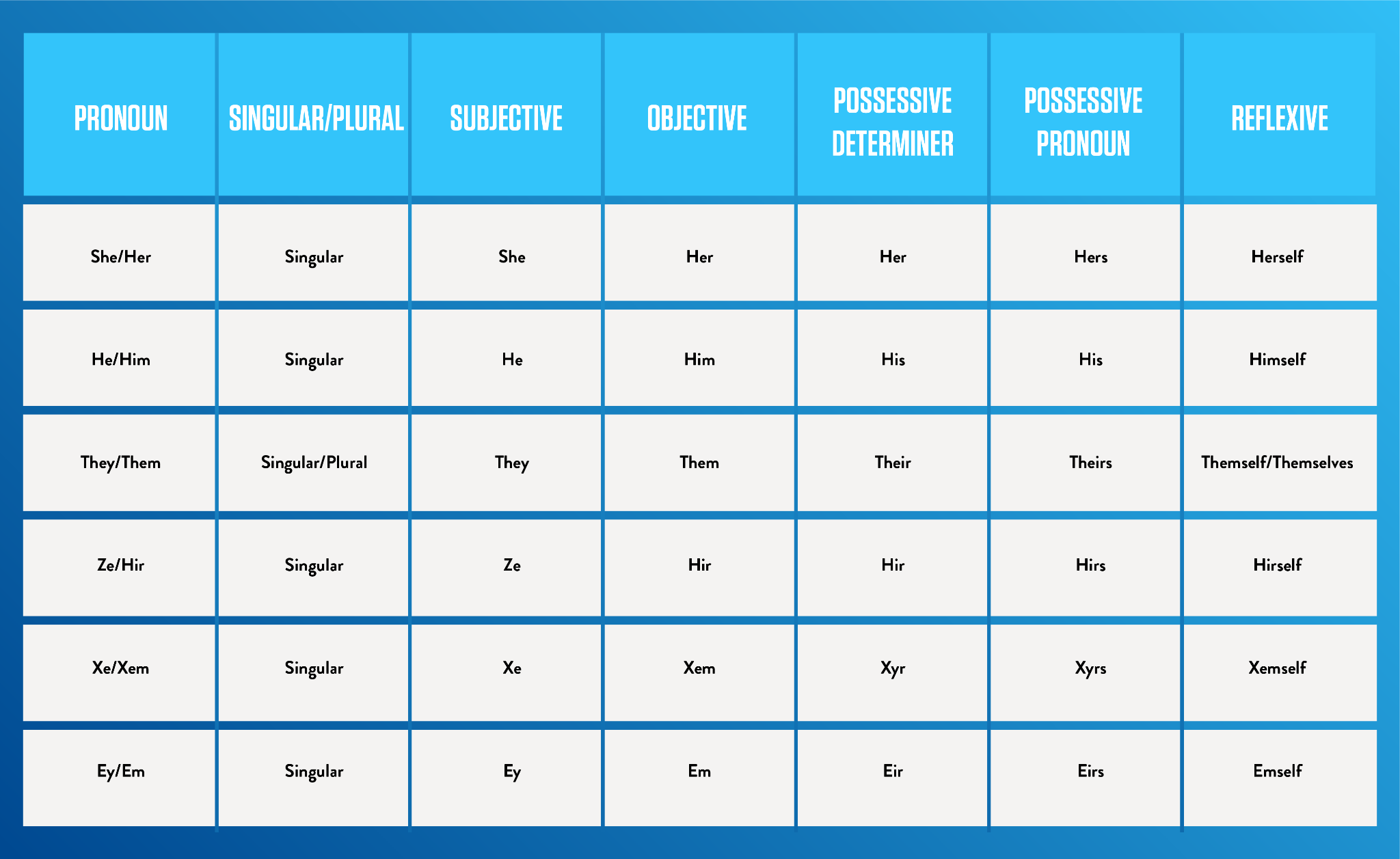
You might be most familiar with “traditional” gender pronouns — she/her and he/him. However, there are many other pronouns people may choose to use. Here are some of the most common examples:
Who Uses Which Pronouns?
There are no hard and fast rules as to which pronouns a person “should” or “shouldn’t” use. Generalizing pronoun usage is challenging, since gender identity is uniquely personal and nuanced. At the end of the day, the only way to know which pronouns a person uses is to ask.
Some people use binary pronouns, while others use gender-neutral pronouns. Some people use one set of pronouns, while others use multiple sets. And some people don’t use pronouns; they simply use their name instead.
Binary Pronouns
Most people are familiar with the traditional male-female gender binary. Binary pronouns include “she/her” and “he/his” pronouns.
Some people refer to binary pronouns as “feminine” and “masculine” pronouns. However, many people avoid these labels, because these terms are misleading. These labels also reinforce common gender stereotypes.
Not everyone who uses binary pronouns will identify with feeling “masculine” or “feminine.” Using “masculine” and “feminine” labels also excludes people who are nonbinary or gender diverse.
Gender-neutral Pronouns
Gender-neutral pronouns are pronouns that don’t indicate a gender. Gender-neutral pronouns are sometimes called nonbinary pronouns, inclusive pronouns, or neopronouns.
Common gender-neutral pronouns include, but aren’t limited to:
- They/them
- Xe/xem
- Ze/hir
- Ey/em
Many people who are nonbinary or gender nonconforming use gender-neutral pronouns. However, people of any gender may also use these pronouns.
Transgender Pronouns
Transgender people can use a variety of pronouns, just like cisgender and gender-nonconforming people. Many trans people use binary pronouns that match their gender identity. Some trans people use gender-neutral pronouns or a mix of pronouns.
A common first step for trans people during social transition is to publicly use pronouns that align with their gender identity. However, this isn’t the case for everyone.
Rolling Pronouns
Some people use more than one set of pronouns. This is sometimes referred to as “rolling pronouns.” For example, someone may use “she/they” or “he/they” pronouns.
Some people use their rolling pronouns interchangeably. Some people have preferences for which pronouns are used, depending on the setting. This can shift over time or change from day to day.
Pronoun Etiquette

The language we use to describe gender is ever evolving. This includes the way some cultures use pronouns. Fortunately, there are a few principles of etiquette that can help you create a more inclusive environment for people of all genders.
Ask, Don’t Assume
Don’t assume someone’s gender based on their appearance or behavior. Gender expression is only one complex component of gender identity. The best way to know which pronouns a person uses is to ask.
When you’re meeting a new person, you can start by introducing yourself and including your pronouns. This helps to normalize sharing pronouns and often prompts others to share their pronouns as well.
You can also ask directly. For example, you might ask, “Are you comfortable sharing your pronouns?” If they aren’t comfortable sharing their pronouns, then you still shouldn’t assume their gender identity.
Use the Correct Pronouns
Use a person’s pronouns correctly and consistently once you know them. This is one simple way to affirm someone’s gender identity. If you make a mistake in conversation, simply correct yourself and move forward.
Respect Other’s Pronouns
Each person is the expert on their own gender identity. Everyone’s pronouns should be respected, regardless of the pronouns they use. This means you shouldn’t dismiss a person’s pronouns just because you find them unfamiliar or unexpected.
For example, some people may use pronouns others consider “nontraditional.” And some people may use pronouns that others wouldn’t assume. Their gender identity and personal pronouns are valid, regardless of others’ perceptions or opinions.
Practice Using Pronouns
You might feel uncomfortable when you start to use unfamiliar gender pronouns. You will likely make mistakes along the way. With practice, however, it will feel more natural to use them in your daily life.
Don’t Use Disrespectful Language
It’s never okay to use disrespectful language to refer to another person. For example, referring to someone as “it” or “he-she” is inappropriate and offensive.
Common Pronoun Mistakes
Everyone makes mistakes from time to time. It’s especially easy to make mistakes when you’re getting used to using pronouns. The most important thing to do is to acknowledge your mistake and do better moving forward.
Addressing mistakes with grace and empathy can help create a more supportive and inclusive environment.
Misgendering Someone
Using the wrong pronouns for a person is known as misgendering. For example, referring to a person with he/him pronouns as “her” is misgendering.
Misgendering someone can be intentional or unintentional. It may happen between strangers, close friends, colleagues, or loved ones. Regardless of the intent, misgendering can be hurtful and invalidating.
The best way to prevent misgendering someone is to ask for their pronouns and practice using them consistently. The best way to respond when you’ve misgendered someone is to apologize, correct yourself, and move forward.
If you’ve misgendered someone, you might say, “I’m so sorry. I meant ‘they,’ not ‘he.’” Don’t spend time discussing how bad you feel or making a spectacle of your apology. This can make the person you’ve misgendered feel even more uncomfortable.
Saying “Preferred Pronouns”
It was once normalized to use the term “preferred pronouns.” Advocates have spoken out against the use of the term, because this implies that gender identity is a choice or preference. Instead, advocates support using “personal pronouns” or “correct pronouns.”
Pressuring Someone to Disclose
It’s polite to ask for someone’s pronouns. It isn’t polite to keep asking if someone declines to share their pronouns.
Some people may feel unsafe disclosing their pronouns to others. For example, they may not want to “out” themselves in certain settings or they may not feel comfortable sharing their pronouns with new people. Respect their decision not to disclose their pronouns and move on.
If someone isn’t comfortable sharing their pronouns, you can refer to them by their name or with gender-neutral pronouns.
Dismissing Someone’s Pronouns
It’s disrespectful to refuse to use a person’s pronouns. It’s also dismissive to assume someone who uses one set of gender-neutral pronouns is comfortable with using all sets of gender-neutral pronouns.
For example, a person might use “xe/xem” pronouns, but be uncomfortable using “they/them” pronouns. You shouldn’t use “they/them” pronouns to refer to them just because it’s gender-neutral. You should only use the pronouns they’ve shared as their personal pronouns when you refer to them.
Not Correcting Others
It can be uncomfortable to own up to our own mistakes. It can also be uncomfortable to acknowledge someone else’s. Being a good ally means being willing to speak out to correct mistakes.
Correct someone if you hear them use the wrong pronouns for another person. Let them know which pronouns the person uses and encourage them to use the correct pronouns moving forward.
Pronoun Awareness

There’s still more work to do if we want to create supportive and inclusive environments for people of all genders. One of the simplest steps to do this is to respect each and every person’s pronouns.
Respecting pronouns may seem like a small step, but it’s still essential for:
- Showing support. By using someone’s correct pronouns, you help to make them feel more welcome and accepted.
- Shifting culture. Respecting pronouns helps to normalize gender diversity. It also helps others be more conscious of the language they use to describe gender and how they refer to others.
- Reducing harm. When you use the correct pronouns and encourage others to do the same, you help to reduce mistakes and misgendering. Misgendering can cause severe distress and harm for the people who are misgendered.
- Supporting mental health. Transgender and other gender diverse people are at higher-risk for self-harm. Accepting and respecting a person’s gender identity can help to support their mental health and wellbeing.
Happier and Healthier Relationships with eDrugstore
At eDrugstore, we’re committed to supporting happier and healthier relationships for people of all gender identities. We work to provide you with the information and treatments you need to make that happen.
Take advantage of our free blog and our free medical consultations for erectile dysfunction, sexual health, and other intimate concerns.

Dan is a long-time freelance writer focusing on technology, science, health, and medicine, with a lifelong interest in physics, biology, and medicine. His work has taken a particular focus on scientific studies “beyond the headlines,” reading the study to more closely examine the results.