
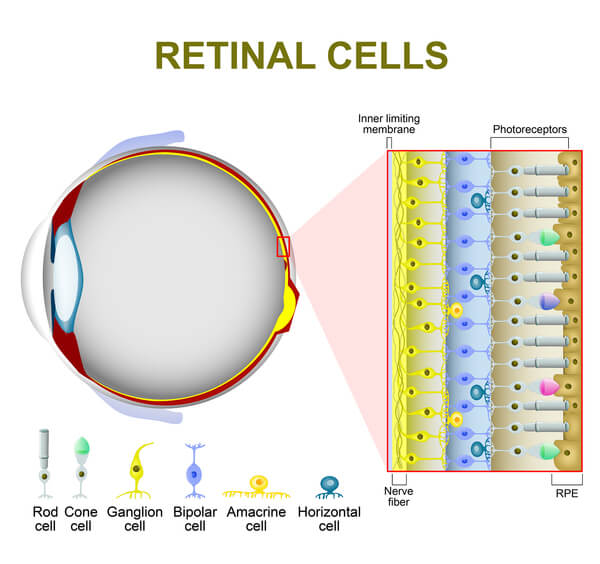

 Addyi, the first prescription medication approved to treat female sexual dysfunction, has hardly set the world on fire in its first year on the market. However, ophthalmic researchers at Casey Eye Institute in Portland, Oregon, have uncovered evidence that flibanserin, Addyi’s active ingredient, could be helpful in the treatment of hereditary retinal diseases, which account for about 5 percent of blindness.
Their findings were based on an animal study led by Mark Pennesi, M.D., director of the ophthalmic genetics fellowship at Casey, which is part of the Oregon Health & Science University. Earlier, he and his colleagues had been studying the effects of a similar drug known as ketanserin, which like flibanserin affects the levels and activities of serotonin. Serotonin, a neurotransmitter, has been found to play a key role in the health and function of the retina, which is part of the central nervous system.
How Flibanserin Works
In the drug Addyi, flibanserin tends to reduce brain levels of serotonin, which in turn depresses sexual desire, while increasing levels of the neurotransmitters dopamine and norepinephrine, both of which are believed to fire up the libido. However, unlike ketanserin, which has serious adverse side effects and has not been approved by the FDA for use in humans, flibanserin, at least in its Addyi formulation, has already won FDA approval.
In an interview with Portland’s KATU-TV, Dr. Pennesi said the similarity between the names of the two drugs was what first caught his attention. “It was sort of serendipity to make that connection, and it was a really nice example of how you can get a cross-pollination in science,” he said. Dr. Pennesi went on to say that it took roughly eight months of experimentation to confirm that flibanserin worked as well as ketanserin. “So we were very excited about that.”
Inherited Retinal Degenerations
One of the primary focuses of Dr. Pennesi’s research at Casey Eye Institute has been inherited retinal degenerations, such as retinitis pigmentosa. The goal of his research is to develop treatments for these retinal disorders, and his preliminary study on flibanserin indicates that it could be useful if its effects on laboratory animals can eventually be replicated in clinical trials on humans.
 Although flibanserin first went on the market in October 2015 under the brand name Addyi, the compound had been under study for several years as a possible treatment for hypoactive sexual desire disorder (HSDD), the most common form of female sexual dysfunction. It was first researched in 2005 by German drugmaker Boehringer Ingelheim as an antidepressant. Boehringer Ingelheim’s researchers found that unlike most antidepressants, which tend to tamp down the libido, flibanserin seemed to have the opposite effect on women.
First Petition Rejected
In 2009 the German pharmaceuticals giant petitioned the FDA for approval to market flibanserin as a treatment for HSDD. In June 2010, an FDA advisory panel unanimously recommended that the FDA reject Boehringer Ingelheim’s application on the grounds that the drug worked little better than a placebo and also had some questionable side effects. In October 2010, Boehringer Ingelheim announced that it was abandoning its campaign to get flibanserin approved. Had the FDA cleared the drug, Boehringer Ingelheim had planned to market it under the brand name Girosa.
In 2011, the rights to flibanserin were purchased by Sprout Pharmaceuticals, a small North Carolina start-up that was founded primarily to pursue FDA approval for its newly purchased property. Perhaps because flibanserin was its only product, Sprout proved much more persistent in its drive to win approval for the drug, which it proposed to market as Addyi.
New Petition Filed with FDA
In June 2013, Sprout filed a new petition with the FDA seeking the regulatory agency’s approval to market flibanserin. Once again, an FDA advisory panel recommended that the FDA reject the drug, noting that its modest benefits were outweighed by adverse side effects such as dizziness, fainting, fatigue, nausea, and sleepiness. Sprout appealed this rejection and was given some fairly specific suggestions about what it could do in terms of further studies to improve the drug’s chances of approval.
Sprout followed the FDA’s guidance and in February 2015 resubmitted its petition for flibanserin. Its application was accompanied by the documented findings from additional studies it had conducted at the direction of FDA advisers. On August 18, 2015, the FDA gave its approval, albeit with several conditions attached, for the marketing of flibanserin as Addyi, and two months later, the drug hit the market. Thus far, its sales have been well below those originally projected. Whether that’s a result of adverse side effects, disappointing positive effects, FDA conditions, or a combination thereof is not yet clear.
The Oregon research into the drug’s potential as a possible treatment for genetic or age-related retinal disorders could open another avenue for sale of flibanserin. Thus far, however, the study has been limited to animal subjects.
 Albino Mice Picked as Subjects
Because of the relationship between these retinal disorders and overexposure to light, Dr. Pennesi and his colleagues selected albino mice for their animal model of retinal damage, because these mice by their very nature are super-sensitive to light. To simulate advanced retinal disorders, these mice were eventually placed in a specially constructed light box and subjected to intense light — measured at roughly 10,000 lux — for a period of one hour.
Prior to their exposure to intense light, the laboratory animals were housed in a room that alternated 12-hour periods of light and dark. During the light periods, the light was at extremely low levels, approximately 15 lux. Dr. Pennesi and his colleagues subjected the test animals to two studies of varying length. One was conducted over the course of five days, while the other lasted only a single day.
Mice Injected Prior to Light Box
In preparation for the five-day test, mice were injected intraperitoneally with varying strengths of flibanserin — ranging from a low of 0.75 milligrams per kilogram of body weight to 15 mg/kg — or with a simple saline solution. The injections were performed roughly midway through the 12-hour dark cycle in the room where the mice were housed. Mice in the five-day test were injected at the following intervals: 48 hours prior to intense light exposure, 24 hours prior, immediately prior, 24 hours after their time in the light fox, and 48 hours after.
In evaluating the effects on mice subjected to the five-day test, researchers found that those injected with saline solution or low levels of flibanserin (0.75-1.5 mg/kg) suffered significant retinal damage. Those that received higher doses of flibanserin exhibited little or no retinal damage.
Results from One-Day Test
For the single-day test, laboratory mice were injected with a saline solution or a flibanserin solution ranging in strength from 3 mg/kg to 15 mg/kg. Animals that received saline solution or low levels (3 mg/kg) of flibanserin sustained measureable retinal damage, while the retinas of those that got higher levels of flibanserin (6 mg/kg to 15 mg/kg) seemed well protected.
This preliminary animal study at Casey Eye Institute lays the groundwork for further animal testing, ideally on animals that have been genetically engineered to have retina-related eye disorders. If flibanserin’s neuroprotective properties can be demonstrated in this secondary level of animal testing, a logical next step would be clinical testing in humans with these genetic retinal disorders.
If you would like to stay abreast of the latest developments on the consumer health front, check out our blog.

We specialize in providing our over 1,000,000 customers with relevant product and condition information created by our professional editorial staff which includes our team of medical writers, medical practitioners, and health educators. eDrugStore.com Staff on Facebook