
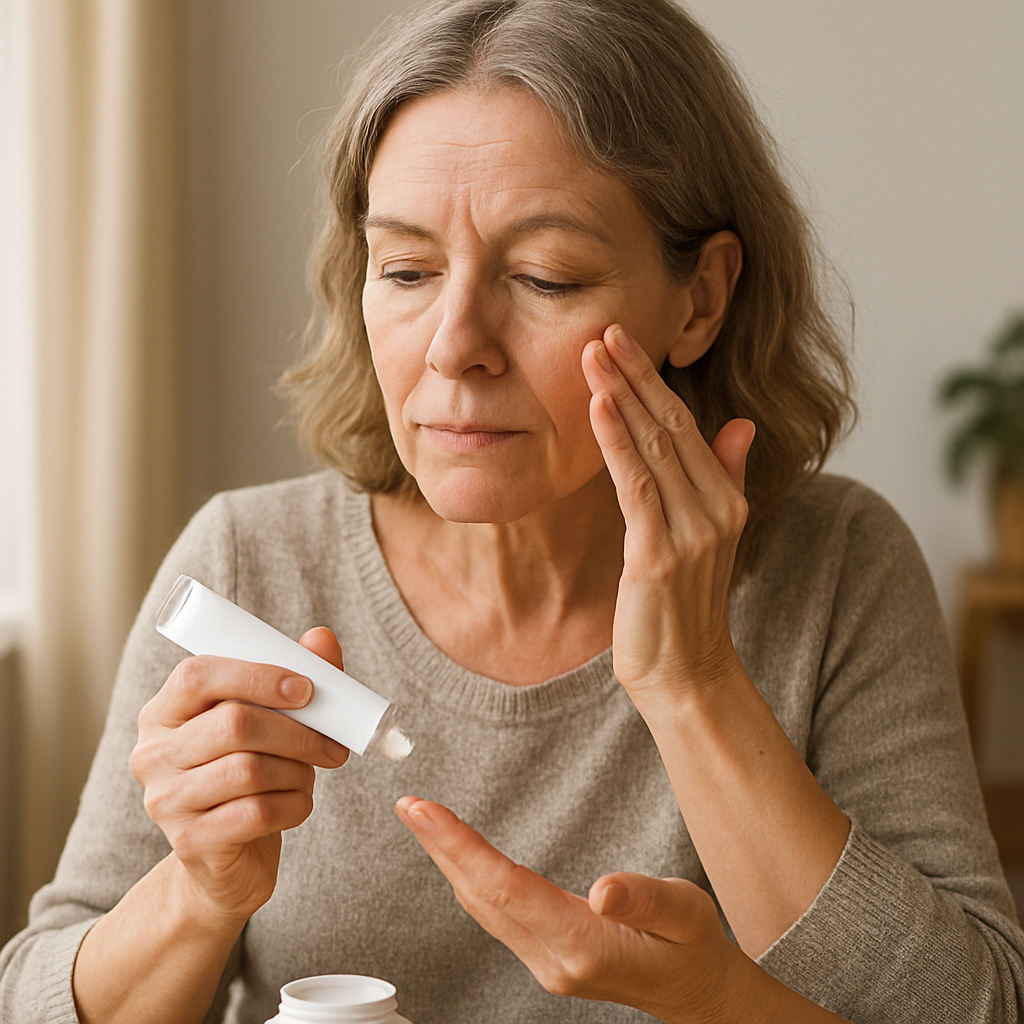

If you’ve been comparing tretinoin vs adapalene for wrinkles, you’ve probably noticed something frustrating: most of the research, most of the FDA labeling, and most of the dermatology guidance is about acne. Anti-aging often shows up as a footnote.
But the question is fair. Both are topical retinoids. Both speed up cell turnover. And both have decent evidence behind them. The honest answer to which works better depends on your skin, your patience, and how much irritation you’re willing to put up with.
Here’s how the two actually compare when the goal is fewer fine lines, not fewer pimples.
How Retinoids Work on Wrinkles
Retinoids are vitamin A derivatives that bind to retinoic acid receptors in skin cells. That binding triggers a cascade: faster keratinocyte turnover, more collagen production, less matrix metalloproteinase activity (the enzymes that break collagen down), and a more even distribution of melanin.
In practical terms, after several months of consistent use, you typically see softer fine lines, more even tone, smoother texture, and fewer of those crepey patches around the eyes and mouth. According to the National Institute on Aging, topical retinoids are among the few interventions with reasonable evidence for improving photoaged skin.
The catch: results take 12 to 24 weeks. People who quit at week six because "nothing’s happening" are quitting right before the curve bends.
Tretinoin vs Adapalene: The Core Difference
Tretinoin (the active form of vitamin A, sold as Retin-A, Renova, and Refissa) has been studied for photoaging since the late 1980s. It’s the only topical retinoid the FDA has specifically approved for treating fine wrinkles, mottled hyperpigmentation, and roughness from sun damage. That label matters. It means the wrinkle data was strong enough to convince regulators.
Adapalene (Differin) is a synthetic retinoid originally developed for acne. It binds more selectively to certain retinoic acid receptors, which is why it’s less irritating. It became available over the counter in 2016 at the 0.1% strength, which made it the first OTC retinoid in the US.
When patients ask me about tretinoin vs adapalene for wrinkles, the short version is this: tretinoin has more anti-aging data, adapalene has better tolerability, and a small but growing body of research suggests adapalene does help with photoaging, just less dramatically.
What the Studies Actually Show
A 2018 split-face study published in the Journal of Cosmetic Dermatology compared adapalene 0.3% gel to tretinoin 0.05% cream over 24 weeks. Both improved fine wrinkles and hyperpigmentation. Tretinoin edged out adapalene on wrinkle scores, but adapalene caused noticeably less redness and peeling.
Earlier work from the late 1990s and 2000s consistently showed tretinoin 0.05% and 0.1% reducing fine wrinkles by measurable amounts on the Glogau and Griffiths scales. Adapalene’s wrinkle data is thinner but trending positive.
Side Effects and Who Tolerates What
This is where adapalene tends to win the practical argument. Tretinoin’s irritation profile is well known: redness, flaking, stinging, and a "retinization" phase that can last four to eight weeks.
Common complaints with tretinoin:
- Visible peeling, especially around the nose and mouth
- Burning when applied near the eyes
- Increased sun sensitivity
- Flare of dormant acne in the first month
- Dryness that no moisturizer seems to fully fix
Adapalene tends to be gentler on all of those fronts. If you’ve struggled with sensitive skin, rosacea-prone redness, or eczema, adapalene is usually the better starting point. Many of the same tolerability themes show up in our breakdown of adapalene compared with tazarotene for acne irritation, and the pattern carries over to anti-aging use.
If you do start tretinoin and run into trouble, knowing the warning signs that your skin needs a break from tretinoin can save you weeks of misery and unnecessary peeling.
Which Should You Choose?
A few rules of thumb from clinical practice.
Choose tretinoin if:
- You have resilient, non-sensitive skin
- You’ve used retinoids before without issues
- You want the strongest evidence base for wrinkle reduction
- You’re willing to push through 4 to 8 weeks of retinization
Choose adapalene if:
- You’re new to retinoids
- Your skin is sensitive, dry, or rosacea-prone
- You also have some adult acne (it treats both)
- You want something you can buy without a prescription
Pregnancy is a hard stop for both. The FDA classifies topical retinoids as not recommended during pregnancy. If you’re trying to conceive or breastfeeding, talk to your prescriber before starting either.
For cost, generic tretinoin 0.025% and 0.05% are inexpensive with most insurance, and adapalene 0.1% gel is on shelves for around $15 to $25. You can compare prescription tretinoin pricing at edrugstore.com if you want to see what your out-of-pocket would actually run.
How to Use Either One Without Wrecking Your Skin
A few practical pointers that apply to both:
- Start two or three nights a week, then build up. Nightly use is the goal, not the starting point.
- Pea-sized amount for the entire face. More is not better.
- Apply to dry skin. Damp skin amplifies irritation.
- Always use sunscreen the next morning. Retinoids thin the stratum corneum temporarily and increase UV sensitivity.
- Pair with a bland moisturizer (ceramides, hyaluronic acid). Skip strong acids and scrubs on retinoid nights.
If you’re layering other actives or prescription topicals, your dermatologist or pharmacist can flag interactions. Benzoyl peroxide, for instance, can inactivate tretinoin if applied at the same time but is fine with adapalene.
Bottom Line
The tretinoin vs adapalene for wrinkles question doesn’t have one clean winner. Tretinoin has the deeper anti-aging evidence and the FDA wrinkle indication. Adapalene is gentler, easier to tolerate, and increasingly looks like a respectable second-place option, especially for sensitive skin or first-time retinoid users.
If you’re young, sensitive, or just starting out, adapalene is a smart entry point. If you’ve used retinoids before and want maximum collagen-stimulating effect, tretinoin still leads. Either way, give it at least four months before judging results, and pair it with daily sunscreen. Talk to your pharmacist or dermatologist about which retinoid fits your skin type, your other medications, and your goals before you start.
This article is for informational purposes only and is not medical advice. Always consult a licensed pharmacist or physician before starting, stopping, or changing any medication.
References
- FDA Renova (tretinoin) prescribing information, official label confirming tretinoin’s wrinkle indication.
- National Institute on Aging, Skin Care and Aging, overview of evidence-based interventions for photoaged skin.
- FDA Consumer Updates, Treating Acne, guidance on topical retinoid safety, including pregnancy considerations.

Dr Steven Schlosser
Dr. Schlosser graduated from Lafayette College Phi Beta Kappa and attended Georgetown Medical School. He had 4 years of medical residency training at Tufts University in Boston in both Gynecology and Internal Medicine. He has had a spotless medical career for the past 40+ years and is Board Certified. Learn More