

Restore Your Testosterone. Energy. Strength. Vitality.
Doctor-prescribed testosterone support delivered discreetly to your door.
Physicians
Private
Delivery

Sermorelin Acetate
Peptide therapy to support natural hormone production.
- Supports Natural HGH
- Boosts Energy & Recovery
- Physician-Prescribed

Enclomiphene Flex-Dose
Raises natural testosterone without shutting down production.
- Boosts Natural Testosterone
- Preserves Fertility
- Flexible Daily Dosing

DHEA Testosterone Support
Foundational hormone support for energy and drive.
- Supports Healthy Hormones
- Improves Energy & Mood
- Once-Daily Capsule
If you’ve been prescribed testosterone replacement therapy, the testosterone cypionate vs enanthate question probably came up at your first appointment, and your doctor may have shrugged and picked one. That shrug isn’t laziness. Clinically, these two esters are close cousins, and for most men on TRT, the practical difference is smaller than the internet suggests.
Still, "close cousins" doesn’t mean identical. Half-life, cost, availability in the US, and how your body handles the peak-and-trough cycle can all nudge the decision one way or the other.
Here’s what actually matters when you’re comparing the two, based on how they behave in real patients rather than how they look on a pharmacology chart.
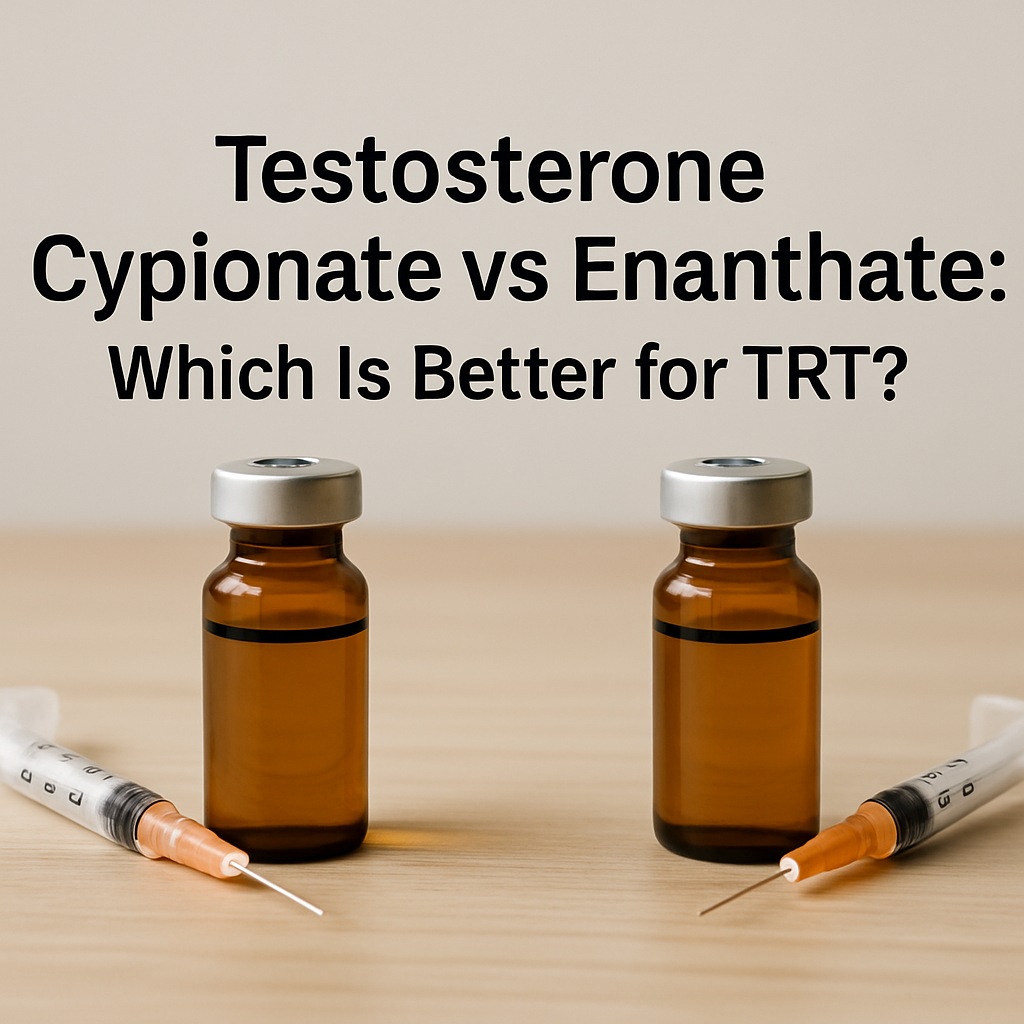
What Testosterone Cypionate and Enanthate Actually Are
Both are injectable forms of testosterone bonded to a fatty acid ester. That ester slows how quickly testosterone releases from the injection site into your bloodstream, which is why you can inject once a week instead of daily. Cypionate uses an eight-carbon ester; enanthate uses a seven-carbon ester. One carbon of difference.
The FDA has approved both formulations for treating men with clinically low testosterone confirmed by lab work and symptoms. Neither is approved for age-related low T alone, athletic performance, or general "feeling tired," despite how they get marketed online.
In the US, cypionate is far more common. Enanthate exists but is prescribed less often here, largely for supply and formulary reasons rather than clinical superiority.
Testosterone Cypionate vs Enanthate: Half-Life and Dosing
This is where people get hung up, usually more than they need to.
- Cypionate half-life: roughly 8 days
- Enanthate half-life: roughly 4.5 to 7 days
On paper, cypionate lasts slightly longer. In practice, both are typically dosed once weekly, and some protocols split the dose into twice-weekly injections to smooth out peaks and troughs. That splitting matters more for symptom stability than the ester choice does.
What I tell patients: if you’re feeling great on day 3 after your shot and dragging by day 6, switching from enanthate to cypionate probably won’t fix that. Splitting your weekly dose into two smaller injections almost certainly will. The Endocrine Society’s clinical practice guideline supports individualized dosing based on trough levels and symptom response.
Your prescriber will determine the right dose and injection schedule based on your total testosterone levels, symptoms, and how you tolerate the peak.
Side Effects: Are They Actually Different?
Not meaningfully. The side effect profile tracks with testosterone itself, not the ester.
Both can cause:
- Elevated hematocrit (thicker blood), which requires periodic monitoring
- Acne or oily skin, especially in the first few months
- Fluid retention
- Suppressed natural testosterone production and fertility
- Mood changes, usually improvements but occasionally irritability at peak
- Injection site soreness or, rarely, sterile abscess
Some patients report slightly more post-injection soreness with cypionate because the oil base (cottonseed oil in the US) is different from enanthate’s typical sesame oil base. If you have a seed oil allergy, that matters. Otherwise, it’s usually a coin flip.
Hematocrit elevation is the one I watch most closely. The American Urological Association’s testosterone guideline recommends checking hematocrit at baseline, 3 to 6 months, and annually thereafter, with dose adjustment or therapy pause if it climbs above 54%.
Cost and Availability in the US
Here’s where testosterone cypionate vs enanthate gets practical.
Cypionate is widely stocked at US pharmacies, and generic versions have kept the price reasonable for most patients. A typical 10 mL vial of generic cypionate runs anywhere from about $40 to $120 cash price, depending on the pharmacy and concentration.
Enanthate is often harder to find at retail pharmacies here and sometimes has to be sourced through compounding pharmacies, which can raise the price. If your insurance covers one but not the other, that’s usually the tiebreaker.
You can compare pricing on generic testosterone cypionate at edrugstore.com if cost is a factor, especially for patients paying cash or navigating high deductibles.
Some men on TRT eventually wonder whether injections are the right delivery method at all. Our comparison of testosterone gel versus injections and long-term safety covers when a topical might make more sense, and the piece on testosterone pellets versus injections is worth reading if you’re tired of the weekly needle.
Which One Do Most Prescribers Choose?
In the US, cypionate wins by default. Not because it’s clinically superior, but because it’s stocked, cheap, familiar, and covered by most insurance plans. If a US doctor writes "testosterone injectable" without specifying, you’re almost always getting cypionate.
Enanthate is more common in Europe and among patients who report better tolerance to sesame oil than cottonseed oil, or who prefer the slightly shorter half-life for perceived peak-management reasons.
The honest answer on testosterone cypionate vs enanthate: pick whichever your insurance covers, whichever your pharmacy stocks reliably, and whichever oil base your body tolerates. Then focus on the variables that actually drive TRT success, injection frequency, dose titration, and lab monitoring.
For men also managing other men’s health concerns alongside TRT, our guides on tadalafil side effects and warning signs and finasteride side effects for BPH cover common overlap areas your prescriber may bring up.
The Bottom Line
Testosterone cypionate vs enanthate is one of those decisions where the clinical evidence says "either works," and the practical decision comes down to cost, availability, and personal tolerance. Both are FDA-approved, both are dosed similarly, and both carry the same class-wide risks that require monitoring. If you’re already on one and doing well with stable labs and improved symptoms, there’s rarely a good reason to switch.
Ask your prescriber to review your trough testosterone levels, hematocrit, and PSA at your next visit, and bring up any peak-and-trough symptoms you’re noticing. That conversation will do more for your TRT than the ester on the label.
This article is for informational purposes only and is not medical advice. Always consult a licensed pharmacist or physician before starting, stopping, or changing any medication.
References
- FDA Testosterone Information, regulatory background and approved indications for testosterone products.
- Endocrine Society Clinical Practice Guideline on Testosterone Therapy, dosing, monitoring, and patient selection recommendations.
- American Urological Association Testosterone Deficiency Guideline, lab monitoring intervals and safety thresholds for TRT.

Dr Steven Schlosser
Dr. Schlosser graduated from Lafayette College Phi Beta Kappa and attended Georgetown Medical School. He had 4 years of medical residency training at Tufts University in Boston in both Gynecology and Internal Medicine. He has had a spotless medical career for the past 40+ years and is Board Certified. Learn More