


Highlights
- Newer BPH treatments, like UroLift, Rezum, holmium laser enucleation of the prostate (HoLEP), and prostatic artery embolization (PAE), may be better options than TURP for many men.
- TURP is the gold standard of BPH treatments, but newer procedures can be just as effective, have longer-lasting results, and cause fewer side effects.
- TURP still has an advantage over other procedures because it yields tissue that doctors can screen for prostate cancer.
Transurethral resection of the prostate (TURP) has long been the gold standard of benign prostatic hyperplasia (BPH) treatment. However, newer treatments, like the holmium laser enucleation of the prostate (HoLEP), UroLift, water vapor therapy (Rezum), and prostatic artery embolization (PAE), compare favorably with TURP in terms of effectiveness while promising shorter hospital stays, fewer complications, and longer-lasting results.
Comparing New BPH Treatments with TURP
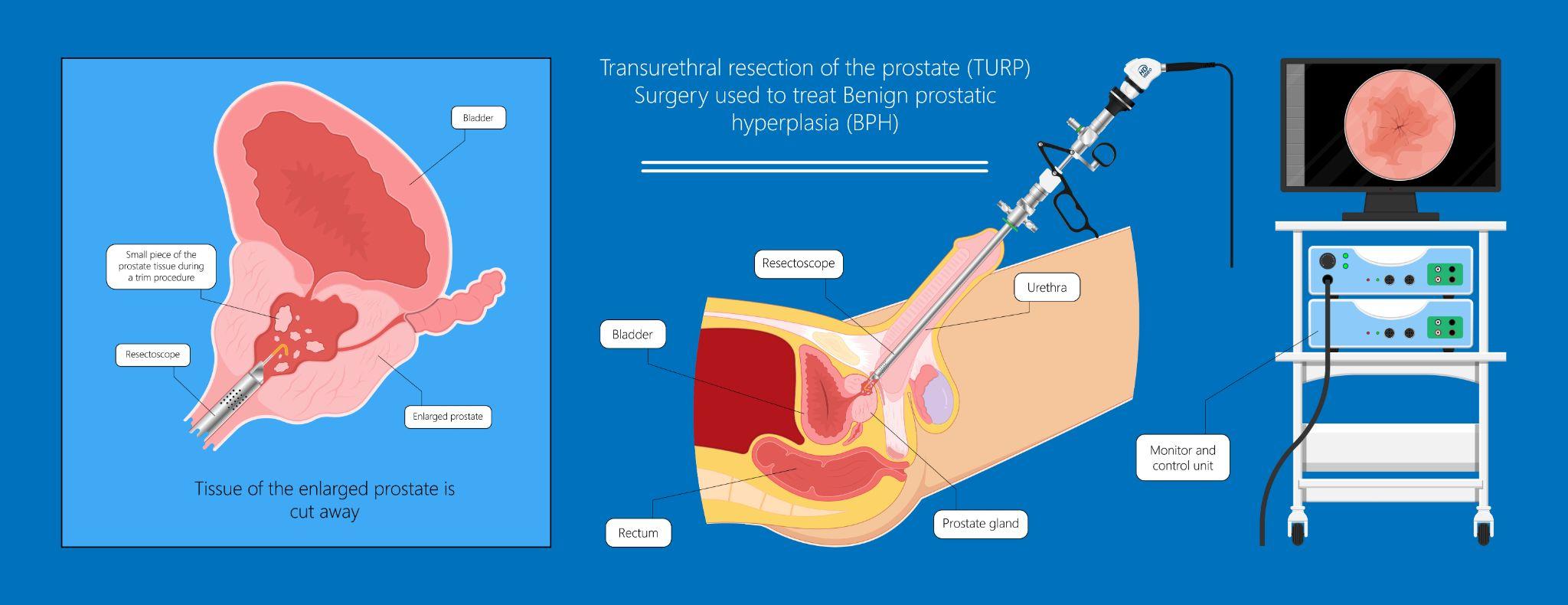
TURP had its run as the top option for surgically alleviating BPH symptoms. It works, and it’s less invasive than its traditional alternative, open prostatectomy. Technological advances have created alternatives to TURP, however, and the former gold standard may soon become obsolete. Has that time come already?
HoLEP vs. TURP
The HoLEP procedure
A TURP procedure requires researchers to insert a camera and a cutting instrument (electrical loop) through the urethra of BPH patients. With it, they cut away the excess prostate tissue that blocks urine flow.
The HoLEP procedure uses a laser as a cutting instrument, eliminating bleeding. Doctors use a separate instrument to cut up and remove the resulting tissue.
In 2015, researchers predicted that HoLEP would replace TURP as the gold standard of BPH surgery. They reasoned that HoLEP could produce superior results with fewer complications.
Compared to TURP, HoLEP produces better self-reported outcomes in patients. It also improves maximum urinary flow to a higher degree than TURP.
Researchers noted that, unlike TURP, HoLEP creates lasting results. It was the only BPH treatment in the study that did not lead to re-operation with the same problem within five years. Around 18% of TURP patients require repeat surgery within a five-year period.
A HoLEP procedure requires a longer operating time than a TURP, but HoLEP results in less bleeding during the operation, less time spent in the hospital, less time with a catheter, and fewer blood transfusions than TURP.
Based on this data, researchers concluded that HoLEP is superior to TURP for the treatment of BPH.
UroLift vs. TURP
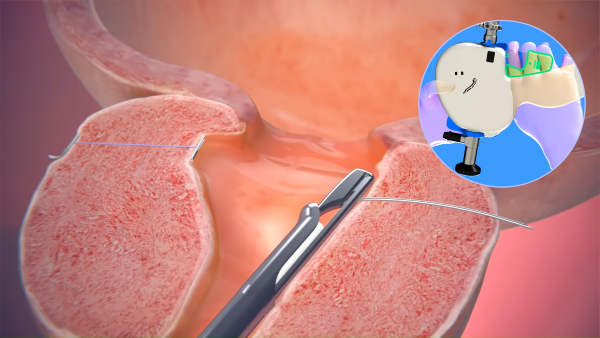
UroLift procedure
Unlike TURP and other “classic” BPH surgical solutions, UroLift does not destroy prostate tissue. Instead, it compresses the obstructive tissue, pushing it aside and freeing the urethra.
To achieve its goals, UroLift uses tiny implants that work like curtain tiebacks to keep the prostate tissue from obstructing the urethra.
UroLift is a permanent solution to BPH. During the procedure, the surgeon manually dilates the urethra and carefully introduces the implants. Because it’s minimally invasive, UroLift causes fewer side effects than other BPH treatment options.
The benefits UroLift offers compared to TURP are:
- Lasting results
- Few side effects
- Simplicity
- No damage to the prostate tissue
- Local anesthesia
- Single-session operation
Simple, quick, and straightforward, a UroLift procedure may still cause short-term side effects. These problems usually resolve within two to four weeks without further interventions. Some possible side effects are:
- Painful or burning urination
- Bloody urine
- Incontinence
- Pelvic or lower abdominal pain
Notably, erectile dysfunction and orgasm-related problems are not among UroLift’s side effects. TURP, on the other hand, may cause both.
TURP’s possible side effects are:
- Urinary tract infection
- Low blood sodium
- Incontinence
- Erectile dysfunction
- Heavy bleeding
- “Dry orgasm” — orgasm without ejaculation
- Temporary difficulty urinating
UroLift’s success rate after five years is around 87%. The procedure does not suit all prostate shapes and sizes, so it is not a solution for all BPH sufferers.
Rezum vs. TURP

Rezum, or transurethral water vapor therapy, is another minimally invasive BPH treatment, suitable for smaller prostates.
Doctors performing a Rezum treatment insert an instrument through the urethra until it reaches the area where the prostate tissue restricts urination. Through it, they release sterile water vapor into the enlarged prostate tissue, damaging it. Over time, the body absorbs the damaged tissue, freeing up the urethra.
Rezum treatments are simple to perform. The steam release lasts for nine seconds, and your doctor can treat you in the office without general anesthesia.
Unlike other BPH treatment options like UroLift, Rezum is not a single-treatment solution. Your doctor will determine how many treatments you need.
Rezum’s benefits stem from its minimally invasive nature. Rezum:
- Does not involve cutting or burning of prostate tissue
- Does not require a permanent implant
- Preserves sexual and urinary function
- Is safe and effective
- Has low rates of bleeding
- Is cost-effective
If BPH symptoms return after TURP, patients can undergo Rezum to deal with them.
Rezum’s disadvantages are also due to its minimal invasiveness. Surgical procedures that cut and extract prostate tissue allow for testing for prostate cancer. Because Rezum does not remove any tissue, it can’t be used for diagnostic testing.
Rezum’s side effects include:
- Painful urination
- Urinary tract infection
- Ejaculation problems
- Incomplete emptying of the bladder
- Bloody urine or semen
PAE vs. TURP
Prostatic artery embolization
Prostatic artery embolization is one of the newest BPH treatment options. It is a cutting-edge approach involving a small incision in the upper thigh or wrist. Through this incision, doctors introduce a catheter. Once they reach the artery that feeds blood to the prostate, they partially block it with tiny particles called microspheres.
Deprived of blood, the enlarged parts of the prostate die off, and the body turns them into scar tissue. The procedure has an immediate effect, and the tissue continues to shrink over time. Over six months, PAE can reduce the size of an enlarged prostate by 20-40%.
The advantages of PAE are:
- Low risk of complications
- No cutting or cauterization involved
- No bleeding
- Low risk of incontinence, ejaculation problems, and erectile dysfunction
- Less pain and discomfort
- Short recovery
- Outpatient procedure
PAE’s risks are few and not very likely. They include:
- Blood flow blockage to the rectum or bladder
- Pelvic pain
- Frequent urination
- Nausea
- Fever
- Vomiting
PAE is less likely than TURP to cause erectile problems. However, the PAE procedure does not yield tissue samples doctors could use to test for prostate cancer.
Let eDrugstore Help
If BPH or BPH surgery damages your ability to get an erection, FDA-approved medications like Viagra and Cialis can help. We carry FDA-approved medications that can help you defeat erectile dysfunction.
Our U.S.-licensed doctors can help you decide the best course of ED treatment and provide you with the prescriptions you need. When you order with eDrugstore, we deliver your prescriptions quickly and discreetly, and shipping is always free.

James West is a seasoned health and wellness writer with a focus on topics related to physiology, sleep, and men’s health. He has contributed articles on a range of subjects, from erectile dysfunction treatments and sleep aids to hair loss, providing well-researched insights to help readers make informed health decisions.