


Effective ED Treatment. Private. Convenient. Trusted.
Doctor-prescribed ED medication delivered discreetly to your door.
Physicians
Private
Delivery

ED3 Max Dissolvable ED Pills
Long-lasting results up to 36 hours.
- Up to 36 Hour Window
- Improved Confidence
- Works When You Need It

Sildenafil 25mg
Proven effective treatment.
- Starts Working in 30–60 Min
- Effective, As Needed
- Trusted & Reliable
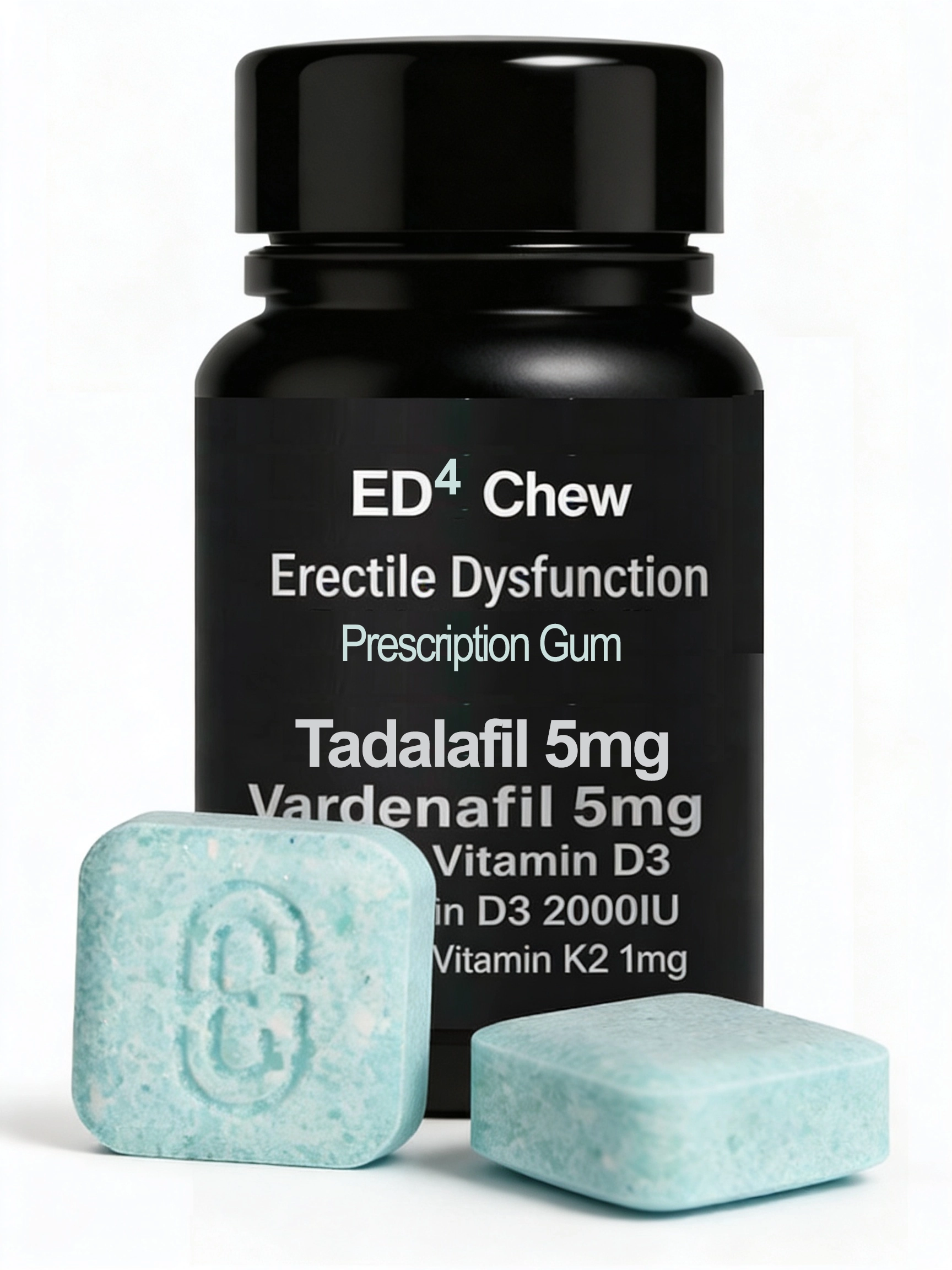
ED4 Chew Gum
Low daily dose for continuous readiness.
- Taken Once Daily
- Continuous Readiness
- Improves Confidence

In less than two decades, a new family of impotence medications has dramatically transformed the way in which men treat erection problems. For countless thousands, these drugs have provided a path toward resumption of a normal sex life.
However, to fully understand how medical science brought us to where we are today in terms of treating erection problems, it’s necessary to look back at a daring show-and-tell demonstration that took place at a 1983 symposium of the Urodynamics Society.
That demonstration and the studies that followed in its wake refocused the study of impotence and its treatment on blood flow and its key role in the erection process.
Mental Factors Blamed
Up until the time of that memorable meeting in Las Vegas, most medical professionals believed that impotence was primarily a manifestation of psychological problems. Treatment for erection problems was confined to psychotherapy and penile implants, which had been in use for roughly a decade at that point.
By dramatically dropping his pants at a scantily attended lecture, British physiologist Dr. Giles Brindley not only gave the scientific community something to talk about, but he also offered a new way to look at the physiological origin of impotence.
As what may have been a portent of what was to come, attendees at the lecture recall being somewhat surprised at the casual nature of Dr. Brindley’s attire — a warm-up suit — because the lecture was to be followed almost immediately by the conference’s formal reception.
Drug Injected Surreptitiously
Moments before he stepped to the rostrum, Dr. Brindley disappeared briefly into the privacy of a stall in the lecture hall’s bathroom. In that fleeting moment of privacy, Dr. Brindley injected his penis with a drug designed to relax the smooth muscles lining the blood vessels that supply the penis. As these muscles relax, blood floods into the spongy erectile tissue of the penis and creates an erection.
Taking the lecture stage, Dr. Brindley launched into a recital of his experiments with vasoactive drugs, illustrating the effects of these injections with photographic slides of his penis in various stages of arousal in reaction to the various medications he had used during his experiments.
However, to more convincingly demonstrate what this most recent drug could do, Dr. Brindley dropped his pants to show exactly how his penis had reacted to the injection. The reason for the good doctor’s loose-fitting attire was immediately apparent, as Dr. Brindley proudly displayed his chemically induced erection in all its glory.
Check It Out!
For those who might still be doubtful of his erection’s authenticity, Dr. Brindley invited members of the audience to verify by touch how durable an erection the injected drugs had produced. Shrieks from a handful of women in the audience made the physiologist think better of this invitation, and he summarily pulled up his pants and continued with the lecture.
Dr. Brindley’s shocking demonstration marked an important turning point in the direction of research into the causes of — and possible treatments for — impotence. The penile injection therapy researched by the British physiologist remains a viable mode of treatment for erection problems, although it does have some drawbacks. Once the penis has been injected, an erection follows more or less automatically. To take advantage of it, the injectee needs to act quickly.
Optimizing Blood Flow
Perhaps more importantly, Dr. Brindley’s research showed that it was possible to facilitate the erection process by optimizing blood flow to the penis. Subsequent study established a fairly clear-cut relationship between certain physical ailments characterized by compromised blood flow and impotence.
Suddenly, it became easier to understand why a man who was a heavy smoker — a recognized cause of cardiovascular problems, such as clogged arteries — might also be experiencing erection problems.
Although it would be another 15 years before another, easier way to optimize blood flow to the penis became available to men with erection problems, Brindley’s pioneering research certainly helped to pave the way.
New Avenues for Research
It encouraged pharmaceutical researchers to look at ways that the same goals might be accomplished through a medication taken orally. However, as so often happens in the story of scientific progress, the key to this puzzle was discovered pretty much by accident.
Drug researchers testing a medication known as sildenafil for possible use in treating angina and high blood pressure discovered that the drug almost always caused male test subjects to have an erection. Even more impressive was the drug’s apparent ability to restore erectile function in men who had lost it.
Although sildenafil was ultimately rejected as a candidate for angina treatment, researchers for Pfizer decided to pursue the medication’s serendipitously discovered ability to help impotent men achieve an erection.
Viagra Gets FDA’s Nod
In 1998 the U.S. Food and Drug Administration gave Pfizer the green light to market sildenafil under the trade name Viagra as an impotence medication. Viagra was the first in a series of drugs known collectively as PDE5 inhibitors, all of which treat erection problems in essentially the same way. Others include Levitra (vardenafil), Cialis (tadalafil), Staxyn (an orally soluble form of vardenafil), and Stendra (avanafil).
Although each of these drugs differs somewhat from the others in terms of chemical structure, they all attack the problem of impotence by temporarily stimulating blood flow to the penis. They do this by blocking the effects of an enzyme known as phosphodiesterase-5, thus earning their name as PDE5 inhibitors.
The initial impetus for erection originates in the brain as feelings of sexual desire. These feelings signal the brain to dispatch a chemical messenger known as nitric oxide toward the pelvic region. This flood of nitric oxide in turn sets off secondary chemical reactions, one of which creates a substance known as cyclic guanosine monophosphate, or cGMP.
What cGMP Does
Much like the chemical Dr. Brindley injected into his penis, cGMP relaxes the smooth muscles that line the blood vessels that supply the penis. As these muscles relax, fresh blood rushes in, engorging the spongy erectile tissue of the penis and creating an erection.
However, without the help of the PDE5 inhibitors, the resulting erection may not be strong enough or long lasting enough in men whose circulatory systems are already compromised because of other underlying health problems. In such cases, the PDE5 enzyme, which is responsible for breaking down cGMP, may kill off enough of the substance to make it difficult or even possible to achieve an erection.
The PDE5 inhibitors generally hold the offending enzyme at bay for four or more hours, allowing men who take these drugs to get a strong erection that lasts sufficiently long to allow sexual activity.
Don Amerman is a freelance author who writes extensively about a wide array of nutrition and health-related topics.

We specialize in providing our over 1,000,000 customers with relevant product and condition information created by our professional editorial staff which includes our team of medical writers, medical practitioners, and health educators. eDrugStore.com Staff on Facebook