

“Male pattern baldness” may sound like a single type of hair loss, but in fact it can take many forms. All, however, are caused by hair follicle response to a hormone called DHT.
Did you know that 35 million American men are affected by Male Patterned Hair Loss, (also known as androgenetic alopecia)? That’s a pretty staggering statistic! And you can thank your parents for that, since heredity is the number one cause of baldness in men. Though it is completely normal to lose an average of 70 to 85 hairs per day, baldness ensues when that number is far surpassed and new hairs do not grow in their place.
So, why don’t new hairs grow for some men, but they do for others? Genetic programming (which can be passed from either the mother or father’s side) determines how hair follicles respond to a hormone called DHT, which bonds to receptor sites on the follicles and interrupts (or blocks) hair growth. In this case, the blood supply to the hair follicles is reduced and the hair becomes short and thin, then ceases to grow at all.
Since MPHL is so common, it has an entire classification system (called the Norwood classification) all to itself. Here, a look at 6 common patterns of male baldness.
1. Receding Hairline (aka The Widow’s Peak)

Since hair loss in men tends to start at the front and side of the scalp, this is the earliest stage of male patterned baldness. Receding hairlines can start as young as the teenage years. Even Hollywood Heartthrobs like Jude Law are not immune.
2. Generalized Frontal Thinning

In addition to the “Widow’s Peak,” some of the frontal hair begins to fall out and cease growing.
3. Frontal Area and Crown Balding
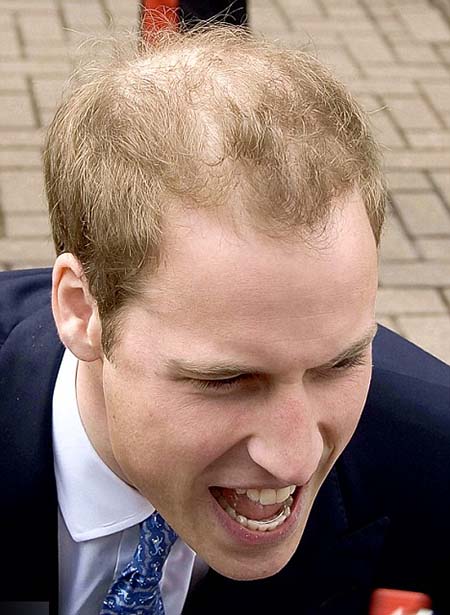
In this stage, the frontal area continues to thin, and the crown (also called the vertex) begins to show signs of loss.
4.Top of Scalp and Crown Balding
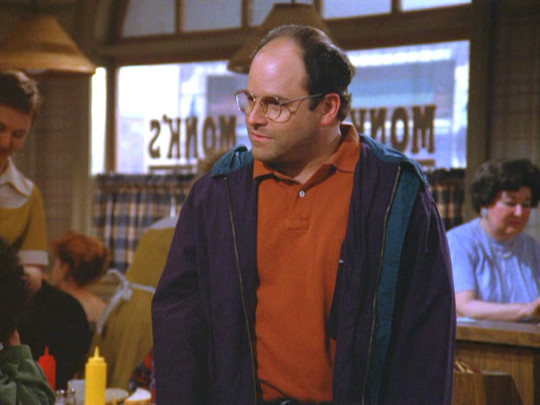
The receding hairline has now pushed far back and threatens to combine with the frontal and crown balding. Only a thin (but solid) band of hair separates the front and vertex (hello, George Costanza!).
5. Extensive Hair Loss
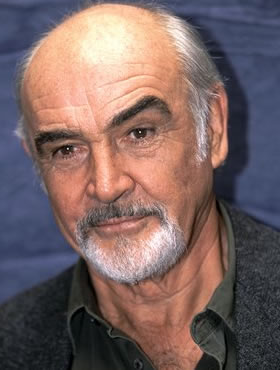
The once solid band of hair bridging between the frontal and crown areas becomes even thinner and then disappears in this stage. The hair on the sides of the scalpremains relatively high, however.
6. Severe Hair Loss

Any hair on the front or crown of the head is now gone. All that remains is a rim of hair at the temporal sides and the back of the head. If you are suffering from MPHL, medications like Propecia can help.
If you’re interested in ordering Propecia online, we invite you to visit eDrugstore.com.

We specialize in providing our over 1,000,000 customers with relevant product and condition information created by our professional editorial staff which includes our team of medical writers, medical practitioners, and health educators. eDrugStore.com Staff on Facebook