


When men start paying attention to their hormonal health, testosterone is usually the first thing that comes up. That makes sense. It’s well-studied, widely discussed, and clearly tied to energy, muscle, and sexual function.
But there’s another hormone that quietly sets the stage for testosterone production, declines even faster with age, and barely gets mentioned outside of specialty clinics.
That hormone is DHEA. Your body makes it in the adrenal glands, two small glands that sit above your kidneys, and it acts as a building block for both testosterone and estrogen. Think of it as the raw material your body draws on to keep your sex hormones running. The catch is that DHEA production starts falling in your late 20s and never really levels off.
This article covers what DHEA is, how it connects to sexual function, what the research shows, and who is most likely to benefit from supplementation.
What Is DHEA and Why Does It Decline?
Your body doesn’t use DHEA directly the way it uses testosterone. Instead, it circulates mostly as DHEA-S (the sulfated form), a stable version that your tissues can convert into active hormones as needed. Different parts of your body, including your testes, skin, brain, and fat tissue, each draw on this pool and convert it locally depending on what they need.
That’s what makes DHEA unusual. It’s not a single-target hormone. It feeds into multiple systems, which means when levels drop, the effects can show up in several places at once.
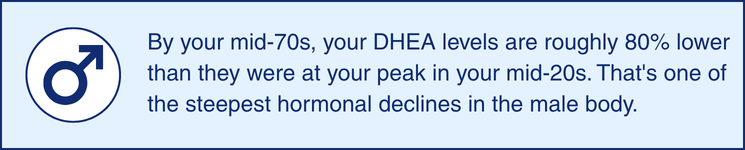
And drop they do. DHEA production starts declining around age 25, and by age 75, plasma levels are roughly 80% lower than they were at their peak. Researchers have a name for this pattern, adrenopause, though it doesn’t get nearly the same cultural attention as menopause does.
For men, this matters more as they get older because the testes also gradually produce less testosterone over time. When both systems are running below their earlier output, the cumulative effect on energy, mood, body composition, and sexual function can be real.
DHEA Testosterone Support: Real Effects in the Right Population
What Is DHEA?
DHEA (dehydroepiandrosterone) is a hormone produced primarily by the adrenal glands. The body converts it into other hormones, including testosterone and estrogen. DHEA levels peak in the mid-20s and decline steadily with age, dropping as much as 80% between ages 25 and 75.
That decline is well documented, and it’s the basis for DHEA supplementation.
What Does the Research Show?
There is solid evidence that DHEA affects testosterone levels. A meta-analysis of 42 randomized controlled trials found that DHEA administration was associated with a statistically significant increase in testosterone, with a weighted mean difference of 28.02 ng/dL across all subgroups. That’s a meaningful signal across a large body of data.
Who Benefits Most?
The testosterone effect from DHEA is more pronounced in certain populations. The same meta-analysis found that older adults with documented hormonal decline showed the strongest response.
A study of healthy young men averaging 23 years old found that DHEA supplementation did not affect serum testosterone or estrogen, and produced no advantage in strength or lean body mass during an 8-week resistance training program compared to placebo.
For men in their 50s and 60s with declining DHEA levels, the evidence is more compelling. Mayo Clinic advises caution for men with any history of or elevated risk for hormone-sensitive cancers, including prostate cancer, and recommends discussing DHEA use with a physician before starting.
Quality control across DHEA supplements also varies, which makes sourcing matter.
A separate meta-analysis of 25 placebo-controlled trials in older men found DHEA was associated with a modest reduction in fat mass, though it showed no significant effect on lipid levels, bone health, sexual function, or quality of life in that population. The picture is real but nuanced: DHEA works best as part of a conversation with your doctor, particularly if you have known hormonal decline.
Sources: Journal of Andrology,| Medscape
How DHEA Affects Sexual Function
To understand why DHEA matters for sexual health, it helps to follow where it goes after your body releases it.
DHEA converts to a hormone called androstenedione, which can then convert to testosterone. This makes DHEA a genuine upstream contributor to testosterone levels, though not a simple or predictable one. The conversion depends on enzyme activity, varies by tissue, and doesn’t happen at a fixed rate.
In men whose DHEA-S levels are well below normal, the pathway becomes more clinically meaningful because the body has less raw material to work with.
Beyond the testosterone connection, DHEA has a second mechanism that’s directly relevant to erections. Research has shown that DHEA triggers nitric oxide production in the cells that line blood vessels, through enhanced expression and stabilization of an enzyme called eNOS (endothelial nitric oxide synthase).
Nitric oxide is the signaling molecule that tells the smooth muscle tissue in the penis to relax and allow blood to flow in. It’s the same basic pathway that medications like sildenafil work on, just at a different point in the chain.
The fact that DHEA acts on this pathway independently of its conversion to testosterone or estrogen suggests it has a direct vascular role that’s worth understanding.
On libido, the picture is more conditional. Some men with low DHEA-S report improved sexual interest alongside supplementation, particularly when reduced sex drive appears to be part of a broader pattern of hormonal decline. The research isn’t strong enough to make confident claims here, but the mechanism is plausible.
What the Research Shows
The most significant early data point connecting DHEA-S to erectile function comes from a large population study that found that men in their 40s through 70s with lower DHEA-S levels were more likely to have ED.
That was an observational finding, not a controlled trial, but it set off a useful line of clinical research.
What the Follow-Up Showed
A follow-up study with 85 men found that those whose ED was linked to high blood pressure, or had no clear physical cause, responded well. Men whose ED was driven by diabetes or neurological issues didn’t see significant improvement.
What We Don’t Know Yet
Most of these studies ran for about six months, so the long-term picture is still unclear. The evidence points in a consistent direction for the right candidates, but it isn’t definitive enough yet to call DHEA a proven treatment.
Also available as part of our 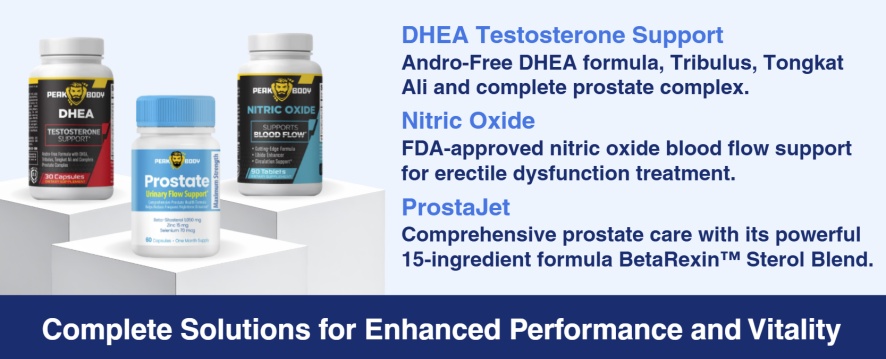 Men’s Health Bundle with Prostate Protection.
Who Is Most Likely to Benefit from DHEA Supplements?
The research paints a fairly clear picture of who tends to see meaningful results.
- Men over 40 with documented DHEA-S decline. A standard blood panel can tell you where your levels stand. Knowing your baseline matters because supplementing without that information is largely guesswork.
- Men with low libido along with other signs of hormonal change. If reduced sex drive is showing up together with fatigue, mood shifts, and changes in body composition, the pattern may point to broader hormonal decline where DHEA is one relevant piece.
- Men combining DHEA with lifestyle changes. For men already working on sexual health through lifestyle changes, or using prescription treatments where appropriate, DHEA may offer an additional mechanism through the nitric oxide pathway. It is not a replacement for medications your doctor has recommended.
Men with normal DHEA-S levels and younger men without any hormonal deficiency have much less reason to expect noticeable benefits. Adding DHEA when your levels are already in a healthy range doesn’t appear to move the needle on sexual function based on the available evidence.
Dosing, Safety, and What to Watch For
Clinical studies have generally used doses between 25 and 100 milligrams per day. The most commonly studied dose in the ED trials above was 50 milligrams daily.
Dose-response relationships haven’t been well established across large populations, so starting on the lower end and working with a healthcare provider is the more sensible approach.
A few practical things to know before you start:
- It’s over the counter in the U.S. DHEA is sold as a dietary supplement without a prescription in the United States. That’s not the case in Canada, the UK, and many other countries, where it requires a prescription or is a controlled substance.
- Watch for androgenic side effects. Because DHEA converts to active androgens, higher doses can cause acne, oily skin, and in some men, increased hair loss. Estrogen conversion is also possible, which is another reason bloodwork is useful.
- Hormone-sensitive conditions are a contraindication. Men with a personal or family history of prostate cancer or other hormone-sensitive conditions should not take DHEA without direct medical supervision.
- Baseline labs make a real difference. Getting your DHEA-S level checked before you start gives you a reference point. It tells you whether supplementation is warranted, lets you track whether your levels respond, and helps you catch any imbalances before they become a problem.
Also available as part of our Men’s Sexual Health Bundle with Prostate Protection.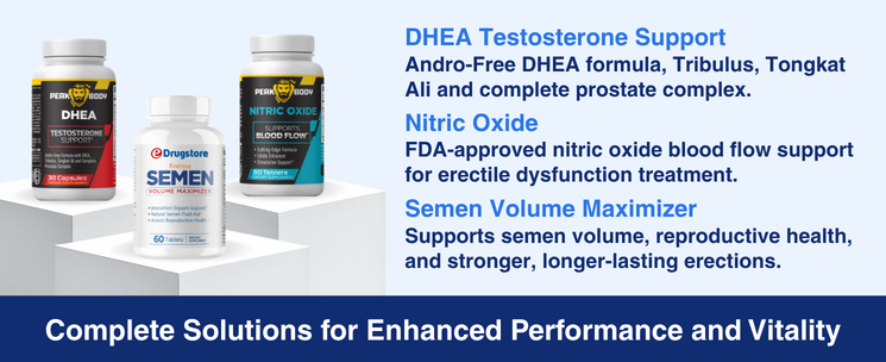 Also available: DHEA + Nitric Oxide + Semen Volume Maximizer at special bundle pricing
Putting It All Together
DHEA isn’t a cure for sexual dysfunction, and it’s not a substitute for addressing the broader factors that affect men’s health as they age. But for men over 40 with documented DHEA-S decline, it represents a legitimate, evidence-backed option worth taking seriously.
The mechanism is real, both through the testosterone pathway and through DHEA’s direct effect on nitric oxide production. The clinical data is consistent enough in men with low baseline levels to justify a closer look. Most men who benefit are starting from a documented deficiency, not just adding a supplement and hoping for the best.
If you’re ready to take that next step, eDrugstore’s DHEA Testosterone Support is available without a prescription, alone or bundled with other proven men’s sexual health supplements. All products ship discreetly, directly to your door.
If you have questions about whether DHEA is right for your situation, eDrugstore’s US-licensed physicians can help you work through that with real lab data in front of you.
Medical Disclaimer: This article provides general information about health and related topics but is not intended as a substitute for professional medical advice, diagnosis, or treatment. Always seek the advice of your physician or other qualified health provider with any questions you may have regarding a medical condition.
References
References
- Feldman HA, Goldstein I, Hatzichristou DG, Krane RJ, McKinlay JB. Impotence and its medical and psychosocial correlates: results of the Massachusetts Male Aging Study. J Urol. 1994;151(1):54–61. https://pubmed.ncbi.nlm.nih.gov/8254833/
- Reiter WJ, Pycha A, Schatzl G, et al. Dehydroepiandrosterone in the treatment of erectile dysfunction: a prospective, double-blind, randomized, placebo-controlled study. Urology. 1999;53(3):590–594. https://pubmed.ncbi.nlm.nih.gov/10096389/
- Reiter WJ, Schatzl G, Mark I, et al. Dehydroepiandrosterone in the treatment of erectile dysfunction in patients with different organic etiologies. World J Urol. 2001;19(3):222–225. https://pubmed.ncbi.nlm.nih.gov/11585284/
- Weiss EP, Villareal DT, Fontana L, et al. Dehydroepiandrosterone (DHEA) replacement decreases insulin resistance and lowers inflammatory cytokines in aging humans. Aging (Albany NY). 2011;3(5):533–542. https://www.ncbi.nlm.nih.gov/pmc/articles/PMC3156603/
- Liu T, et al. Dehydroepiandrosterone modulates endothelial nitric oxide synthesis via direct genomic and nongenomic mechanisms. Endocrinology. 2003;144(8):3449–3455. https://pubmed.ncbi.nlm.nih.gov/12865324/
- Maggio M, et al. A review of age-related dehydroepiandrosterone decline and its association with well-known geriatric syndromes. J Am Geriatr Soc. 2013;61(9):1413–1423. https://pubmed.ncbi.nlm.nih.gov/23647054/
- Friedrich N, Völzke H, Rosskopf D, et al. Reference ranges for serum dehydroepiandrosterone sulfate and testosterone in adult men. J Androl. 2008;29(6):610–617. https://onlinelibrary.wiley.com/doi/full/10.2164/jandrol.108.005561
- Medscape. Dehydroepiandrosterone (DHEA): reference range, interpretation, collection and panels. https://emedicine.medscape.com/article/2088870-overview

Paula Clark worked in the healthcare industry for 17 years before becoming a full-time freelance health and medical writer. Her clients appreciate her ability to convey complex information in terms laypeople can understand. Paula prides herself on the depth and accuracy of her research. Her goal is to add authority to your site in words that will delight both Google and your readers.