


Quick Answer:
Most men know that erections depend on blood flow. What fewer people understand is what actually controls that blood flow at the cellular level. It’s not testosterone, and it’s not anything you’d find on a supplement label. It’s a gas your body makes on its own, in tiny quantities, in the lining of your blood vessels.
That gas is nitric oxide. It’s one of the most important signaling molecules in the body, and without enough of it, the mechanics of an erection simply don’t work the way they should. This article explains what nitric oxide is, how it drives erections step by step, what causes levels to drop, and what you can realistically do about it.
What Is Nitric Oxide?
Nitric oxide (NO) isn’t something you take. It’s something your body makes, produced by the cells lining the inside of your blood vessels. Those cells are called endothelial cells, and the enzyme that makes nitric oxide is called eNOS, short for endothelial nitric oxide synthase.
You don’t need to memorize that. What matters is that eNOS is the engine, and nitric oxide is what it produces.
The job of nitric oxide is simple. It sends a signal to the smooth muscle in your blood vessel walls telling them to relax. When that muscle relaxes, the vessel widens. Wider vessels mean better blood flow, and better blood flow affects almost everything, including your heart, your circulation, and your sexual function.
The catch is that nitric oxide production doesn’t stay constant throughout your life. Research has established that reduced nitric oxide bioavailability and altered activity of nitric oxide synthase enzymes are major contributors to age-related vascular dysfunction, with impaired vascular relaxation in aging closely linked to declining eNOS-derived NO. In plain terms, your blood vessels gradually become less responsive as you get older, and declining nitric oxide is a significant part of why.

How Nitric Oxide Drives an Erection
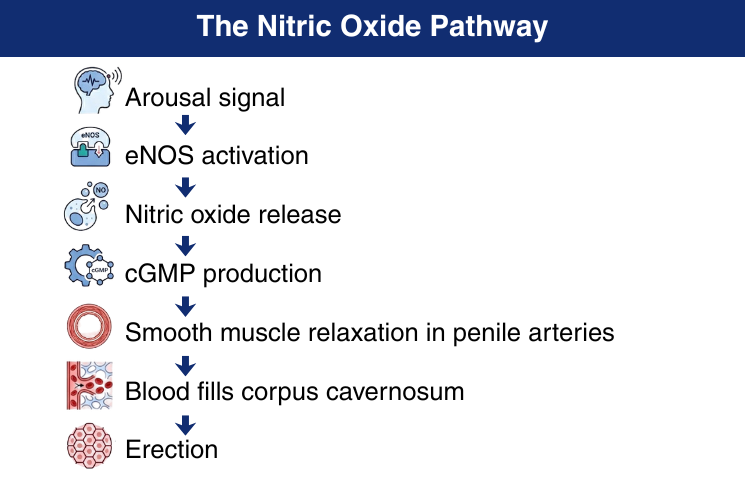
The connection between nitric oxide and erections is mechanical, not hormonal. Here’s the sequence.
Sexual arousal sends a nerve signal to the tissue of the penis. That signal triggers the endothelial cells lining the penile arteries to activate eNOS and release nitric oxide. The nitric oxide then activates a molecule called cGMP (cyclic guanosine monophosphate), which tells the smooth muscle inside the penile arteries to relax.
When that muscle relaxes, the arteries widen, blood rushes into two chambers called the corpus cavernosum, the spongy tissue that runs the length of the penis, pressure builds, and an erection occurs.
The whole process depends on nitric oxide being present. Without enough NO, the cGMP signal is weak, the smooth muscle stays contracted, and blood flow falls short.
This is also why medications like sildenafil (Viagra) and tadalafil (Cialis) work the way they do. They don’t create nitric oxide. They block the enzyme that breaks down cGMP, which extends the signal. But they still need nitric oxide to be present in the first place. If NO levels are very low, these medications have less to work with.
What Happens When Nitric Oxide Levels Drop?
Several things suppress nitric oxide production, and most of them become more common as men get older.
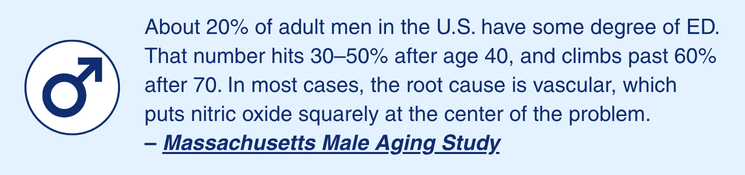
Age is the most consistent factor. Research shows that decreased nitric oxide bioavailability caused by impaired eNOS activity is one of the primary drivers of age-related vascular dysfunction, with vasodilatory responses declining across multiple vascular beds. Beyond age, a few other things directly chip away at NO availability.
Cardiovascular Risk Factors
High blood pressure, high cholesterol, and insulin resistance all damage endothelial cells and reduce their capacity to produce nitric oxide. A study published in Cardiovascular Research found that defective NO activity is thought to play a role in the development of both erectile dysfunction and ischemic heart disease. The two conditions share the same risk factors.
Smoking
Cigarette smoke introduces reactive oxygen species into the bloodstream that bind to nitric oxide and neutralize it before it can reach your blood vessels. Over time, smoking also damages the endothelial cells that produce NO in the first place, so you’re losing ground on both ends.
Chronic Inflammation and Poor Diet
Free radicals neutralize NO quickly, and a diet low in antioxidants gives them free rein. Processed foods, excess sugar, and low vegetable intake create conditions where NO breaks down faster than it’s replenished. Foods rich in antioxidants, like dark berries, leafy greens, and green tea, help protect what your body has already produced.
When NO levels drop for any of these reasons, blood vessels don’t dilate the way they should. Blood flow to the penis falls short, and erections become harder to achieve or maintain. Urologists call this vasculogenic ED, meaning ED with a vascular root cause. It’s the most common type.
This isn’t a character flaw or a sign of permanent damage. It’s physiology, and in many cases it’s addressable.
Can You Boost Nitric Oxide Naturally?
Yes, within limits. The three most evidence-supported approaches are diet, exercise, and targeted supplementation.
Diet
Leafy greens, beets, arugula, and spinach are naturally rich in dietary nitrates. When you eat these foods, the salivary glands actively concentrate the nitrate in saliva, where oral bacteria convert it to nitrite.
That nitrite enters the bloodstream and can be reduced to nitric oxide under the right conditions. This bacterial pathway is a meaningful secondary source of NO alongside what your endothelial cells make directly.
Exercise
When blood moves through vessels at higher speed, it creates physical pressure on the vessel walls called shear stress. That shear stress directly triggers eNOS activity. Regular aerobic exercise essentially trains your endothelial cells to produce more nitric oxide more efficiently over time.
Supplements
Two amino acids have the best clinical support for boosting NO production:
L-arginine. This is the direct raw material your body uses to make nitric oxide. The limitation is that it’s heavily metabolized before it reaches the bloodstream when taken orally, which makes absorption inconsistent.
L-citrulline. This amino acid handles that problem more effectively. L-citrulline bypasses metabolism and is converted to L-arginine in the kidneys. A randomized trial tested this directly. They gave men with mild ED 1.5 grams of L-citrulline daily for one month.
Those taking L-citrulline saw meaningfully improved erection hardness scores compared to the placebo group. The researchers were careful to note the effect was modest and specific to men with mild ED, not a stand-in for prescription treatment, but it was a real, measurable difference.
Antioxidants also matter. Vitamin C and polyphenols found in foods like dark berries and green tea help protect the nitric oxide that’s been produced from being broken down before it can do anything useful.
The Bottom Line
Nitric oxide is the molecule that makes erections physiologically possible. It relaxes the blood vessels in the penis, allows blood to flow in, and sets off the chain of events that leads to an erection. Its production declines with age and is further knocked back by common health conditions and lifestyle factors most men accumulate over time.
You can support NO levels through diet, exercise, and targeted supplementation, particularly with L-citrulline, which has the most reliable absorption of the available NO precursors.
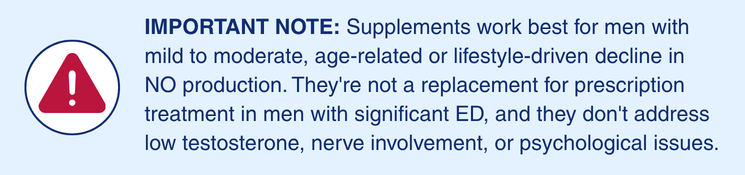
The evidence is solid enough to take seriously for men with mild to moderate erectile function concerns.
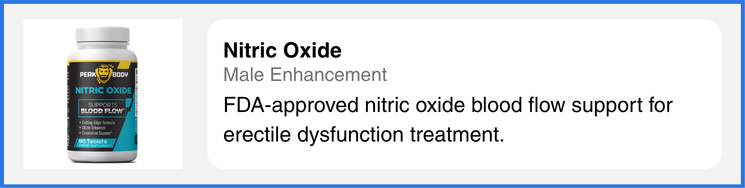
Why Buy Nitric Oxide Online from eDrugstore
When you buy men’s health supplements online from eDrugstore, you’re buying from a trusted US company that’s based in Tempe, Arizona, and has been in business since 1998.
You get scientifically supported products that do what they say they’re going to do, packaged discreetly and sent directly to your door.
Order nitric oxide online today from eDrugstore and take control of your erectile function.
Frequently Asked Questions About Nitric Oxide for Erectile Dysfunction
Is nitric oxide a supplement you can buy?
You can’t buy nitric oxide directly. It can’t be bottled or manufactured for sale. Instead, supplements contain the building blocks your body uses to produce it, primarily L-citrulline and L-arginine.
Will nitric oxide supplements work for severe ED?
Nitric oxide is unlikely to be effective for severe erectile dysfunction. Men in that category may require injections or implants, and anyone experiencing ED should consult a urologist to identify the underlying cause.
Can I take nitric oxide supplements with Viagra or Cialis?
NO-boosting supplements like L-citrulline are generally considered compatible with PDE5 inhibitors. One study found a 34% improvement in erectile firmness when a nitric oxide booster was combined with sildenafil, with no additional side effects compared to sildenafil alone. Talk to your doctor before combining anything.
Are nitric oxide supplements safe to take if I use heart medications?
Avoid nitric oxide supplements if you take nitrates, have unstable heart disease, very low blood pressure, or kidney or liver problems. Talk with a clinician about dosing, interactions, and safer alternatives.
How long does it take for nitric oxide supplements to improve erections?
Many men take NO supplements 30 to 60 minutes before sexual activity. For best results, use them consistently on a daily basis rather than only on demand. Meaningful improvements in clinical trials were observed over one to three months.
Disclaimer: This article provides general information about health and related topics but is not intended as a substitute for professional medical advice, diagnosis, or treatment. Always seek the advice of your physician or other qualified health provider with any questions you may have regarding a medical condition.
References
- Burnett AL. The role of nitric oxide in erectile dysfunction: implications for medical therapy. J Clin Hypertens. 2006;8(12 Suppl 4):53–62. https://onlinelibrary.wiley.com/doi/10.1111/j.1524-6175.2006.06026.x
- Cormio L, De Siati M, Lorusso F, et al. Oral L-citrulline supplementation improves erection hardness in men with mild erectile dysfunction. Urology. 2011;77(1):119–122. https://pubmed.ncbi.nlm.nih.gov/21195829/
- Forstermann U, Sessa WC. Nitric oxide synthases: regulation and function. Eur Heart J. 2012;33(7):829–837. https://www.frontiersin.org/journals/physiology/articles/10.3389/fphys.2012.00218/full
- Kang LS, et al. Age-related changes in eNOS and vasomotor function. Aging Cell. 2009;8(1):71–79. https://www.ncbi.nlm.nih.gov/pmc/articles/PMC4169693/
- Lidder S, Webb AJ. Vascular effects of dietary nitrate via the nitrate-nitrite-nitric oxide pathway. Br J Clin Pharmacol. 2013;75(3):677–696. https://pubmed.ncbi.nlm.nih.gov/27872324/
- Gonzalez AM, et al. Nitric oxide and penile erection: is erectile dysfunction another manifestation of vascular disease? Cardiovasc Res. 1999;43(3):658–665. https://academic.oup.com/cardiovascres/article/43/3/658/321047

Paula Clark worked in the healthcare industry for 17 years before becoming a full-time freelance health and medical writer. Her clients appreciate her ability to convey complex information in terms laypeople can understand. Paula prides herself on the depth and accuracy of her research. Her goal is to add authority to your site in words that will delight both Google and your readers.