
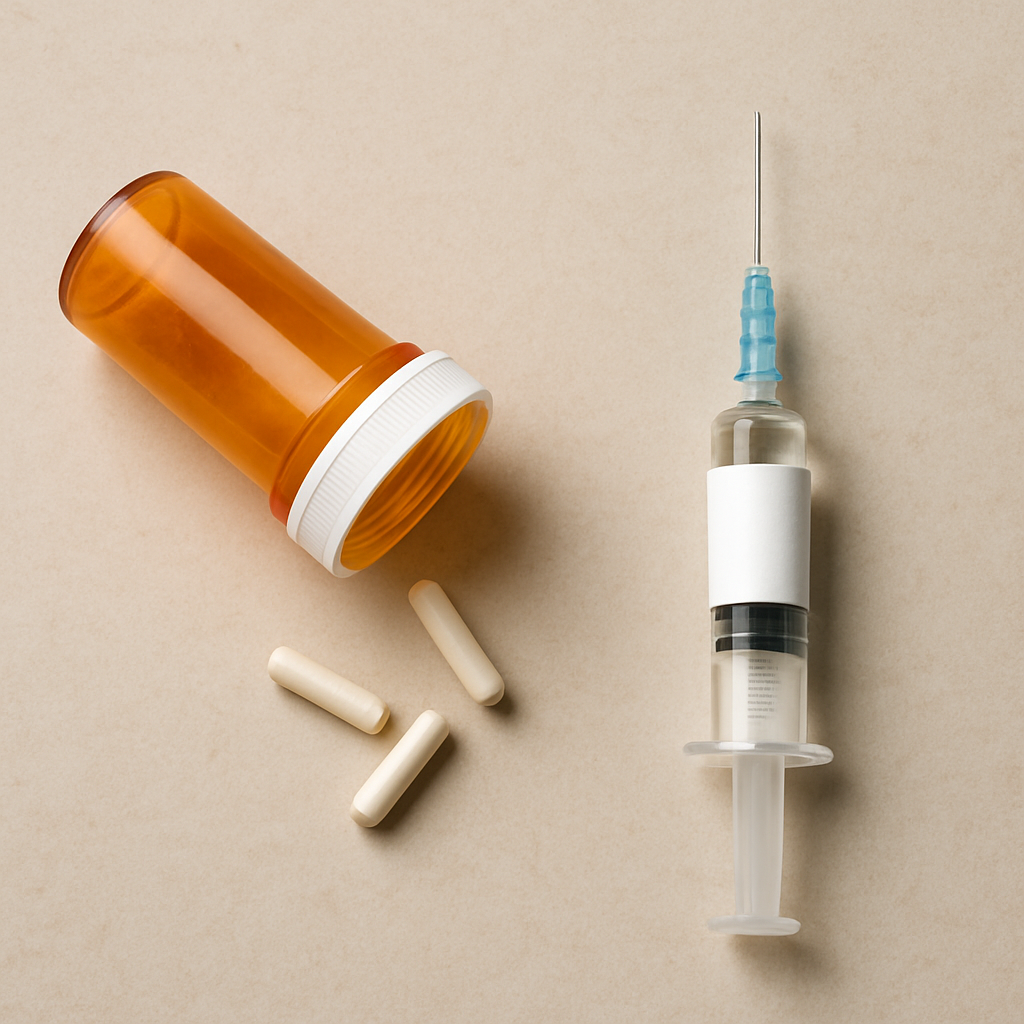

If you’re weighing testosterone pellets vs injections, the core question usually comes down to one thing: how often do you want to think about your testosterone replacement therapy (TRT)? Some men want a quick weekly shot and full control over their dose. Others would rather get a small in-office procedure twice a year and forget about it.
Both are legitimate forms of TRT, and both are FDA-approved approaches to treating clinically low testosterone. The right answer depends on your labs, your lifestyle, your tolerance for needles, and honestly, how your body handles peaks and troughs in hormone levels.
So let’s get into the real differences. Not the marketing version. The version a working clinician would actually walk you through at the counter.
How Each Form of TRT Actually Works
Testosterone injections are typically given as testosterone cypionate or enanthate, dosed once a week or every two weeks into the muscle or under the skin. Levels spike a day or two after the shot, then taper down before your next dose. Some men feel that taper. Some don’t.
Pellets are a different animal. They’re small crystalline cylinders, about the size of a grain of rice, implanted under the skin of the hip or buttock during a brief office procedure. Once in, they release testosterone slowly through diffusion as your body’s blood flow dissolves them. No weekly routine. No syringes at home.
The Cleveland Clinic notes that testosterone therapy comes in several forms because no single delivery method works for every patient. That’s worth holding onto as we compare these two.
Testosterone Pellets vs Injections: Duration Head-to-Head
This is the headline question, so let’s answer it directly.
- Injections (cypionate or enanthate): roughly 7 to 14 days of clinically meaningful effect per dose, depending on the ester and your metabolism.
- Pellets (Testopel and compounded versions): typically 3 to 6 months per implantation, with most men landing around the 4-month mark.
So pellets win on raw duration, and it isn’t close. One pellet procedure can carry you through a season. A shot carries you through a week or two.
But duration isn’t the whole story. Steadier isn’t always better if the dose isn’t quite right, because pellets are much harder to adjust mid-cycle. If you want a deeper look at how injection esters compare to each other, our breakdown of testosterone cypionate vs enanthate and how long each lasts goes into the pharmacokinetics.
Hormone Stability and How You Actually Feel
Here’s where the testosterone pellets vs injections debate gets interesting. Pellets generally produce flatter, more stable serum testosterone levels. No big peaks. No noticeable troughs at day 6 or 7.
Injections, by contrast, create a clear curve. Some men describe feeling great on days 2 through 5 and dragging by day 7. Splitting the weekly dose into two smaller shots (a common clinical adjustment) flattens that curve significantly. Many prescribers now default to twice-weekly subcutaneous dosing for exactly this reason.
What I’d tell a patient: if you’ve tried weekly injections and the day-before-your-next-shot crash is wrecking you, pellets are worth a conversation. If your levels are well-controlled on shots and you don’t mind the routine, switching isn’t necessarily an upgrade.
Side Effects, Risks, and the Stuff Nobody Mentions
Both forms share the standard TRT side effect profile: acne, elevated hematocrit (thicker blood), potential fertility suppression, fluid retention, mood changes, and possible worsening of sleep apnea. The NIH’s MedlinePlus testosterone monograph covers these in detail and is worth reading before you start either.
What differs is the delivery-specific risks.
Injections can cause:
- Post-injection soreness or knots at the site
- Occasional bruising
- Higher peak estradiol levels, which can drive water retention or breast tissue tenderness
- Needle anxiety (real and common)
Pellets can cause:
- Extrusion (a pellet working its way back out through the incision, in roughly 1 to 2 percent of procedures)
- Infection at the implant site
- Bruising or hematoma
- A dose you’re stuck with for months if it turns out to be too high
That last one matters. If your hematocrit climbs too high on pellets, you can’t just skip a dose. You wait it out, donate blood, or have the pellets removed. With injections, your prescriber can drop the dose next week.
Cost, Convenience, and Insurance
Injectable testosterone is one of the cheapest prescription medications in the country, especially in generic cypionate form. A month’s supply often runs $30 to $80 cash without insurance, and many men compare prices on generic testosterone cypionate at edrugstore.com to keep monthly costs predictable.
Pellets are more expensive upfront, often $500 to $1,200 per procedure depending on dose and location, and insurance coverage is inconsistent. Over a year, pellets typically cost more in total than injections, even factoring in syringes and supplies.
Convenience, though, tilts the other way. Two office visits a year versus 52 weekly injections is a real quality-of-life difference, especially for men who travel often or just hate needles.
If you’re already comparing other men’s health treatment routines, our piece on tadalafil daily vs on-demand dosing walks through a similar tradeoff between steady-state and as-needed approaches. And for guys also navigating prostate concerns alongside TRT, the finasteride vs dutasteride comparison for BPH is useful background.
Who Tends to Do Better on Which
A few patterns show up in clinical practice:
- Men with significant needle aversion or unpredictable schedules often prefer pellets.
- Men who want fine-grained control over their dose, or who are also tracking fertility, usually do better on injections.
- Men with a history of polycythemia (high red blood cell counts) are often steered toward injections so the dose can be adjusted quickly.
- Men who’ve tried gels and not absorbed them well sometimes find pellets give them the steady-state levels gels promised but didn’t deliver.
None of this is rigid. Your prescriber will look at your total testosterone, free testosterone, estradiol, hematocrit, PSA, and symptoms before recommending one over the other.
The Bottom Line
In the testosterone pellets vs injections comparison, pellets clearly last longer per dose, often by a factor of 10 or more. But longer isn’t automatically better. Injections give you flexibility, lower cost, and easier dose adjustments. Pellets give you stability and the freedom to forget about TRT for months at a time.
Talk to your prescriber about your labs, your schedule, and how you’ve felt on any previous TRT. Ask specifically whether your hematocrit and estradiol trends favor one delivery method over the other. And whichever route you choose, commit to follow-up bloodwork at the intervals your clinician recommends. That’s the part that actually keeps TRT safe long-term.
This article is for informational purposes only and is not medical advice. Always consult a licensed pharmacist or physician before starting, stopping, or changing any medication.
References
- FDA Testosterone Information, regulatory status and safety communications on testosterone products.
- Cleveland Clinic: Testosterone Therapy, overview of TRT delivery methods and clinical use.
- MedlinePlus: Testosterone Injection, patient-facing summary of testosterone side effects and monitoring.

Dr Steven Schlosser
Dr. Schlosser graduated from Lafayette College Phi Beta Kappa and attended Georgetown Medical School. He had 4 years of medical residency training at Tufts University in Boston in both Gynecology and Internal Medicine. He has had a spotless medical career for the past 40+ years and is Board Certified. Learn More