
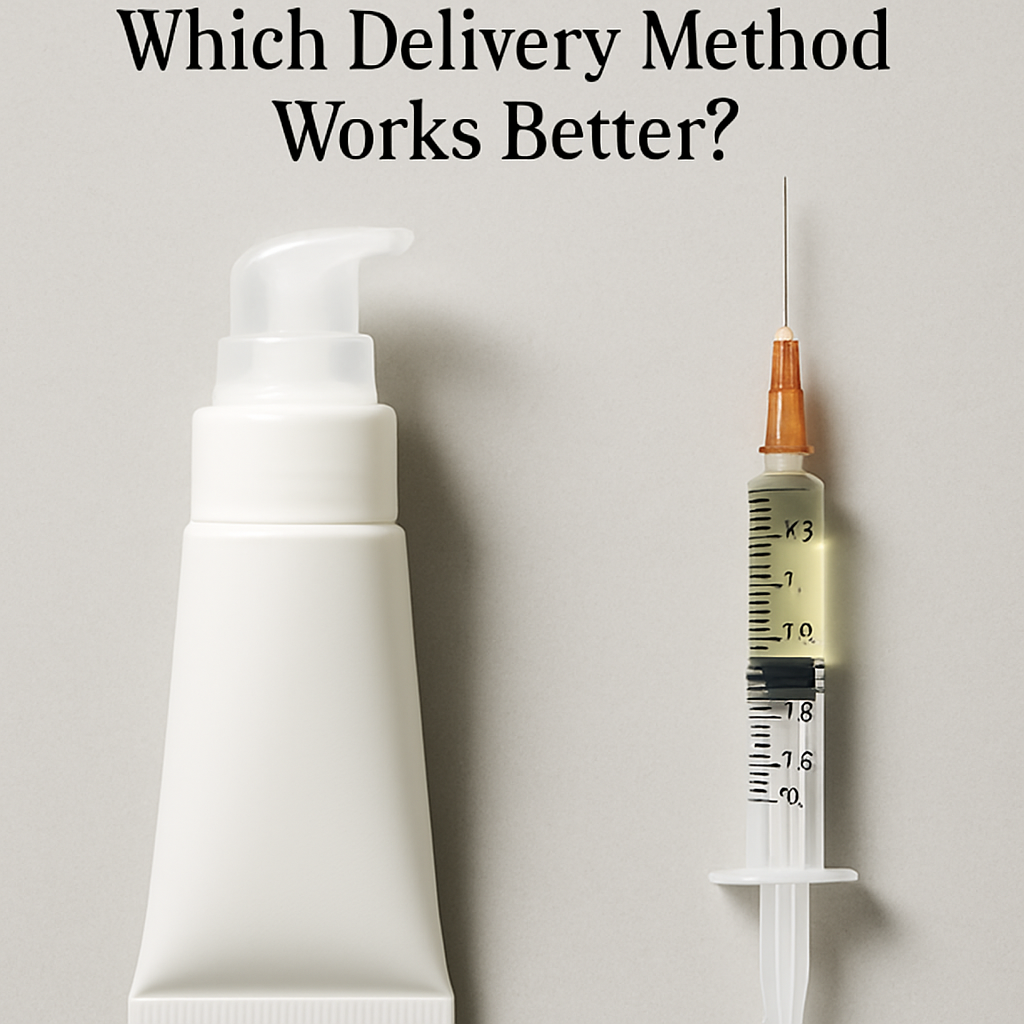

If you’ve been diagnosed with low T and your prescriber hands you a choice, the testosterone gel vs injections question is usually the first thing you want answered. Both deliver the same hormone. Both are FDA-approved. But the experience of using them, day to day, could not be more different.
Most patients walk in assuming injections are "stronger" and gels are "gentler." That’s not really how it works. The honest answer is that each delivery route has a personality, with trade-offs in absorption, blood-level stability, side effects, and how much your insurance is willing to cover. The FDA-approved labeling for testosterone products actually spells a lot of this out, but it’s buried in clinical language most people won’t dig through.
What I tell patients is this: the "better" option is the one you’ll actually use correctly, that keeps your levels steady, and that doesn’t make your partner or kids inadvertently get a dose of it. Let’s break that down.
How Testosterone Gel vs Injections Actually Work in the Body
Testosterone gel is a topical solution (brand names include AndroGel, Testim, and Fortesta) that you rub onto clean, dry skin once a day, usually on the shoulders, upper arms, or abdomen. About 10% of the applied dose gets absorbed through the skin into your bloodstream. The rest, frankly, evaporates or wipes off on your shirt.
Injections are different. Most US patients on testosterone replacement therapy get intramuscular testosterone cypionate or enanthate, typically once a week or once every two weeks. There’s also a longer-acting option, testosterone undecanoate (Aveed), given roughly every 10 weeks in a clinical setting. With injections, the entire dose enters the body at once and slowly releases over days.
That single difference, daily steady absorption versus weekly bolus, drives almost every other comparison point in the testosterone gel vs injections debate.
Blood Level Patterns
Gels produce remarkably stable testosterone levels. Apply daily, absorb daily, levels stay in a tight band. According to Mayo Clinic’s overview of testosterone therapy, this mimics the body’s natural rhythm more closely than injections do.
Injections produce a peak-and-trough pattern. A few days after the shot, levels spike, sometimes well above normal. By day six or seven, they’re sliding back down, and some patients feel that crash as fatigue, irritability, or low mood right before the next dose. Splitting weekly injections into smaller twice-weekly doses smooths this out, and many prescribers now default to that.
Side Effects: Where They Diverge
Both methods share the core risks of testosterone replacement: elevated red blood cell count (erythrocytosis), acne, sleep apnea worsening, potential fertility suppression, and prostate effects. The NIH’s MedlinePlus summary on testosterone covers these in detail.
Where they differ:
Gel-specific concerns:
- Skin irritation at the application site (roughly 5 to 10% of users)
- Transference risk, this is the big one. If a child or partner touches gel-treated skin before it dries, they can absorb testosterone. There are FDA black-box warnings about virilization in children from accidental contact.
- Inconsistent absorption in patients who sweat heavily, swim, or shower soon after applying
Injection-specific concerns:
- Higher peak levels can drive hematocrit up faster, sometimes requiring therapeutic phlebotomy
- Post-injection mood swings in some patients
- Injection site pain, occasional sterile abscess
- The hassle factor of self-injecting, or driving to a clinic, on a schedule
We’ve covered the injection side in more depth in our breakdown of testosterone injection side effects you should watch for, which is worth reading if your prescriber is leaning that direction.
Cost and Insurance Reality
Here’s where the testosterone gel vs injections math gets uncomfortable.
Generic testosterone cypionate injections are cheap. A 10 mL vial often runs $40 to $80 cash, and that can last one to three months depending on your dose. Most insurance plans cover it without much fuss.
Testosterone gels, even generic AndroGel, are dramatically more expensive, often $300 to $500 per month without insurance. Coverage varies wildly, and prior authorizations are common. If cost is a real concern, this alone pushes many patients toward injections. You can compare pricing on generic testosterone cypionate at edrugstore.com to get a realistic sense of what you’d pay.
Convenience and Lifestyle Fit
This is where personal preference legitimately matters more than clinical data.
Gel wins on:
- No needles, ever
- Easy to travel with
- No clinic visits required
- Steady mood and energy
Injections win on:
- Lower monthly cost
- No daily routine to forget
- No transfer risk to family
- Predictable absorption regardless of skin or sweating
Patients with young kids at home, in particular, often steer away from gel because the transference issue is real. Patients with needle phobia, or who travel constantly, often steer toward gel and accept the cost.
What About Other Options?
Worth mentioning: gels and injections aren’t the only choices. Subcutaneous testosterone pellets (Testopel) get implanted every three to six months. Nasal testosterone gel (Natesto) is applied to the nostrils three times daily. Patches exist but are less commonly used now.
And for some men, particularly those still trying to preserve fertility, testosterone replacement isn’t the right first step at all. Our comparison of clomiphene versus testosterone for low T walks through when an alternative makes more sense. If low T is showing up alongside erectile dysfunction, the broader picture in our piece on hormone, needle, and pump therapies for ED may be useful context.
So Which One Actually Works Better?
The testosterone gel vs injections question doesn’t have a universal winner. For steady levels and zero needles, gel wins, if you can afford it and you don’t have small kids at home. For affordability, predictability, and a simpler weekly routine, injections win, if you’re comfortable with the peak-and-trough pattern (or splitting doses to flatten it).
What I’d encourage you to do: bring your specific situation, your insurance plan, your household, your lifestyle, to your prescriber and ask them to walk through the testosterone gel vs injections decision with those facts in front of them. Get a baseline total testosterone, free testosterone, hematocrit, PSA, and estradiol drawn before you start. Recheck at six to twelve weeks. Adjust from there.
This article is for informational purposes only and is not medical advice. Always consult a licensed pharmacist or physician before starting, stopping, or changing any medication.
References
- FDA Testosterone Drug Safety Information, Official labeling, warnings, and transference risk guidance.
- Mayo Clinic: Testosterone Therapy, Clinical overview of benefits, risks, and delivery comparisons.
- MedlinePlus: Testosterone, NIH patient drug information covering side effects and monitoring.

Dr Steven Schlosser
Dr. Schlosser graduated from Lafayette College Phi Beta Kappa and attended Georgetown Medical School. He had 4 years of medical residency training at Tufts University in Boston in both Gynecology and Internal Medicine. He has had a spotless medical career for the past 40+ years and is Board Certified. Learn More