
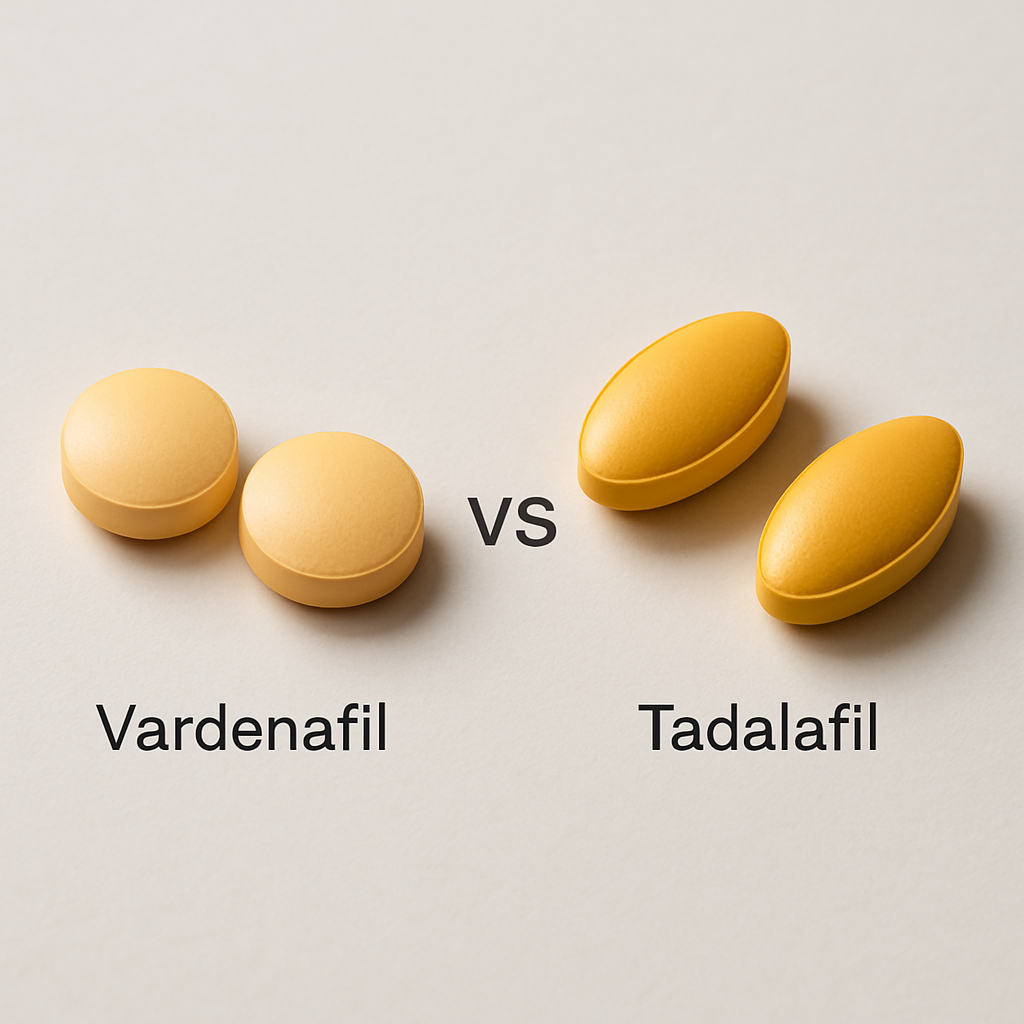

If you’ve landed on a vardenafil vs tadalafil comparison, you probably already know both treat erectile dysfunction. What you actually want to know is the cardiac question: which one is gentler on a heart that’s already had some miles put on it.
Most men over 50 who ask about ED meds have at least one cardiovascular flag on their chart. High blood pressure. A stent. Statins. Maybe an old MI. The good news is that PDE5 inhibitors as a class have a reassuring cardiac safety record when used appropriately, and recent data has even hinted at possible cardiovascular benefit. The nuance is that vardenafil and tadalafil are not interchangeable when it comes to how they interact with the cardiovascular system.
Here’s what actually matters when you and your doctor are picking between them.
How Vardenafil and Tadalafil Work in the Body
Both drugs block phosphodiesterase type 5 (PDE5), which lets blood vessels relax and improves blood flow. That mechanism is also why they nudge blood pressure down a bit, even in men without ED, and why nitrate medications are an absolute contraindication.
The difference shows up in pharmacokinetics. Vardenafil has a half-life of around 4 to 5 hours, similar to sildenafil. Tadalafil has a famously long half-life of about 17.5 hours, which is why it earned the "weekend pill" nickname and why daily low-dose dosing is even an option.
That duration gap is the single biggest factor in the cardiac conversation. A short-acting drug clears your system fast if something goes wrong. A long-acting drug stays on board, for better and worse.
Blood Pressure Effects: The Vardenafil vs Tadalafil Difference
Both drugs lower blood pressure modestly. In healthy men, that drop is usually around 5 to 8 mmHg systolic, which most people never notice. The question is what happens when you stack a PDE5 inhibitor on top of antihypertensives, alpha-blockers, or other vasoactive drugs.
Vardenafil’s shorter window means the BP dip is concentrated into a few hours, then it’s gone. Tadalafil produces a smaller peak drop, but the effect lingers for more than a day. For a patient on stable, well-controlled blood pressure medication, either is usually fine. For a patient on an alpha-blocker like tamsulosin or doxazosin, both drugs require caution, and prescribers typically start at the lowest dose. If you take alpha-blockers for prostate symptoms, our piece on whether ED pills are safe with alpha-blockers walks through the timing rules.
What I tell patients is this: if you have labile blood pressure or symptomatic orthostatic hypotension, the short, predictable window of vardenafil is often easier to manage. If your pressure is rock-steady and you want spontaneity, tadalafil’s longer tail is usually well tolerated.
The QT Interval Question
Here’s where vardenafil vs tadalafil splits more sharply. Vardenafil has a documented modest effect on the QT interval, the part of the heart’s electrical cycle that, when prolonged, can theoretically increase risk of certain arrhythmias. The FDA labeling for vardenafil specifically cautions against use in patients with congenital long QT syndrome or those taking Class IA or Class III antiarrhythmics like quinidine, sotalol, or amiodarone.
Tadalafil does not carry that same QT signal. For a patient with a known arrhythmia history, or on a QT-prolonging medication (and there are dozens, from certain antibiotics to some antidepressants), tadalafil is often the safer pick by default.
This is a real-world distinction, not a theoretical one. It comes up most often with men who are on antiarrhythmics after AFib ablation, or who take methadone, or who’ve had QT issues flagged on a prior ECG.
Heart Failure, Coronary Disease, and Recent Cardiac Events
Both medications are reasonable in stable coronary artery disease, provided the patient can tolerate moderate exertion (think climbing two flights of stairs without chest pain). Neither should be used within roughly 90 days of an MI, with unstable angina, or with severe heart failure (NYHA class III or IV) without a cardiologist’s blessing.
Interestingly, research published over the last several years suggests PDE5 inhibitors may be associated with lower cardiovascular mortality in men with diabetes or prior MI. Our summary of recent data on PDE5 inhibitors and heart failure outcomes covers what’s actually been shown and what hasn’t. Don’t interpret that as a green light to self-prescribe. It’s a signal that this class isn’t the cardiac risk it was once feared to be.
In practice, for men with stable heart failure who are cleared to use a PDE5 inhibitor, tadalafil is often chosen because it’s also FDA-approved for pulmonary arterial hypertension under the brand Adcirca. That tells you something about its cardiopulmonary safety profile in carefully selected patients.
Side Effect Profiles Side by Side
Both share the class side effects: headache, flushing, nasal congestion, indigestion. Tadalafil is more likely to cause back and muscle pain, thought to be from PDE11 cross-inhibition. Vardenafil tends to cause slightly more visual brightness changes than tadalafil, though less than sildenafil.
Quick comparison points worth knowing:
- Onset: vardenafil around 30 to 60 minutes, tadalafil 30 to 45 minutes
- Duration: vardenafil 4 to 6 hours, tadalafil up to 36 hours
- Food effect: high-fat meals delay vardenafil more than tadalafil
- Daily dosing option: tadalafil only
- Generic availability: both available, generic tadalafil is generally cheaper
If cost matters and you’re comparing options, you can compare generic vardenafil and tadalafil pricing at edrugstore.com against retail pharmacies. Many patients save meaningfully on the generic.
For a broader side effect comparison, our tadalafil vs avanafil side effects breakdown is a useful next read, and the sildenafil vs vardenafil duration article covers the timing question more thoroughly.
So Which Is Easier on Your Heart?
The honest answer is: it depends on which part of your heart you’re worried about.
- If your concern is QT prolongation or you take antiarrhythmics, tadalafil is generally easier on the heart
- If your concern is unpredictable blood pressure or you want a drug that clears quickly, vardenafil offers a shorter, more contained effect
- If you have stable coronary disease and want flexibility, either is reasonable
- If you have pulmonary hypertension or significant heart failure, tadalafil has more supporting data
Your prescriber will weigh your specific medications, ECG history, blood pressure pattern, and exercise tolerance before recommending one. Don’t pick based on a single article, including this one.
The Bottom Line
In the vardenafil vs tadalafil decision, neither drug is universally "safer" for the heart. Vardenafil is a cleaner short-acting choice when blood pressure unpredictability is the issue, while tadalafil tends to win on QT safety and has more robust cardiopulmonary data. Both require honest conversation with your prescriber about every medication you take, including over-the-counter ones. Bring your full med list to that appointment and ask specifically about cardiac safety in your situation, not in the average patient’s.
This article is for informational purposes only and is not medical advice. Always consult a licensed pharmacist or physician before starting, stopping, or changing any medication.
References
- FDA Postmarket Drug Safety Information, official safety communications for PDE5 inhibitors.
- FDA Vardenafil Prescribing Information, labeling on QT effects and contraindications.
- PubMed: PDE5 inhibitors and cardiovascular outcomes, peer-reviewed evidence on cardiovascular mortality associations.

Dr Steven Schlosser
Dr. Schlosser graduated from Lafayette College Phi Beta Kappa and attended Georgetown Medical School. He had 4 years of medical residency training at Tufts University in Boston in both Gynecology and Internal Medicine. He has had a spotless medical career for the past 40+ years and is Board Certified. Learn More