
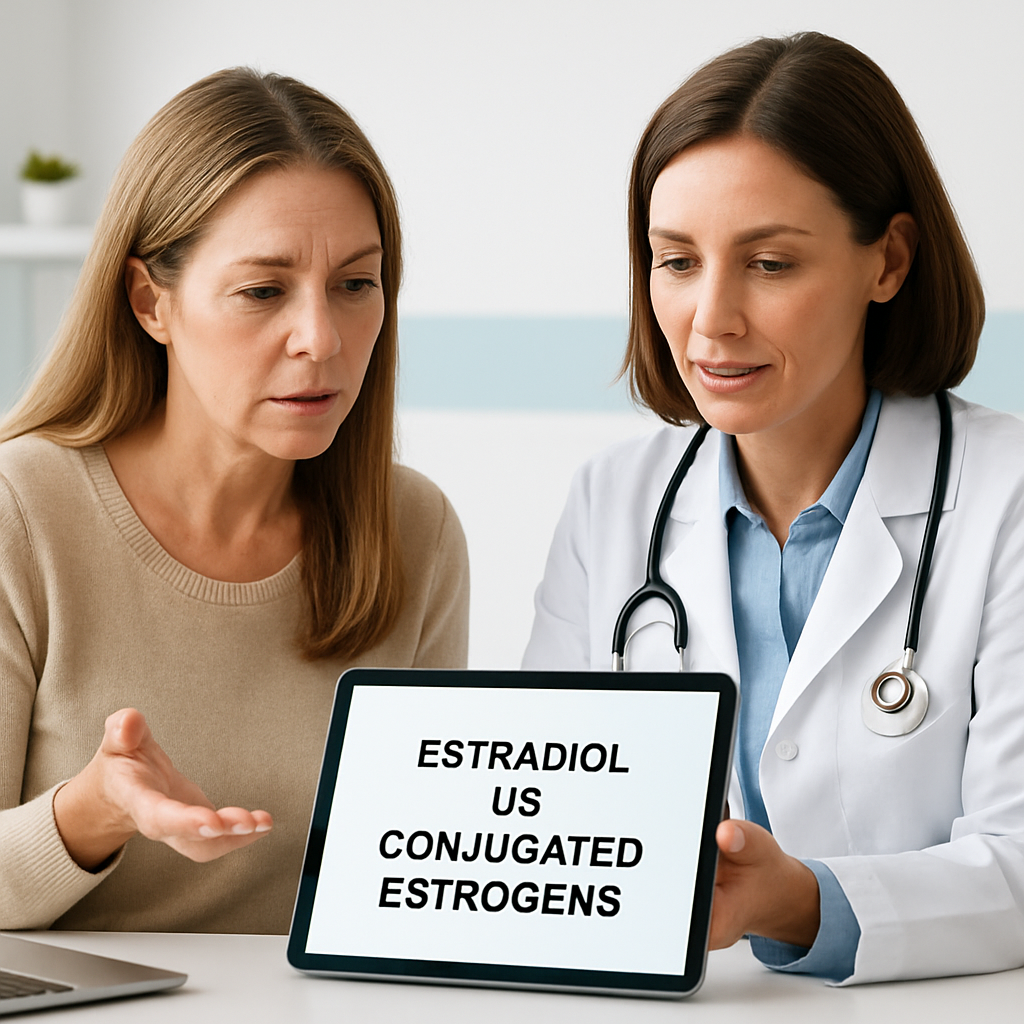

If you’ve been handed a prescription for hormone therapy and walked out of the office wondering whether estradiol vs conjugated estrogens actually makes a meaningful difference, you’re not alone. It’s one of the most common questions women ask at the pharmacy counter once the appointment fog wears off.
Both treat the same core problem: dropping estrogen levels during and after menopause, and the symptoms that follow. Hot flashes. Night sweats. Vaginal dryness. Bone loss that creeps up quietly.
But the two drugs come from different places, behave a little differently in the body, and carry slightly different risk profiles. Knowing which is which helps you have a sharper conversation with your prescriber.
What Estrogen Therapy Actually Does
Menopause is, biologically, an estrogen crash. Symptoms follow that crash. The North American Menopause Society and the FDA both recognize systemic estrogen as the most effective treatment for moderate-to-severe vasomotor symptoms (hot flashes and night sweats) and for preventing osteoporosis in women at significant risk.
What it does NOT do well: treat mood disorders on its own, reverse cardiovascular disease, or function as anti-aging therapy. The clinical evidence there is mixed at best.
If you still have a uterus, you’ll need a progestogen alongside the estrogen to protect the uterine lining. That’s true whether you choose estradiol or conjugated estrogens.
Estradiol vs Conjugated Estrogens: What’s Actually in the Pill
This is where the two diverge.
Estradiol (sold as Estrace, Climara, Vivelle-Dot, Divigel, and many generics) is bioidentical 17-beta-estradiol. Same molecule your ovaries used to make. It’s typically synthesized from plant sterols, usually soy or yam, then chemically converted to match human estradiol exactly.
Conjugated estrogens (the brand most people know is Premarin) are a mixture of roughly ten different estrogen compounds extracted from the urine of pregnant mares. Yes, really. The mix includes estrone sulfate, equilin sulfate, and several other equine-specific estrogens that humans don’t produce naturally but that bind to human estrogen receptors and exert similar effects.
So when comparing estradiol vs conjugated estrogens, you’re really comparing a single human-identical hormone against a complex blend of related (some human, some equine) estrogens.
Effectiveness: Is One Better Than the Other?
For hot flash relief and bone protection, head-to-head trials show roughly comparable effectiveness at equivalent doses. A 1 mg oral estradiol tablet works about as well as 0.625 mg of conjugated estrogens for most symptom relief. The NIH-funded Women’s Health Initiative studies, which shaped much of modern HRT practice, primarily used conjugated estrogens, so that’s where most of our long-term safety data comes from.
That said, some clinicians prefer estradiol for a few practical reasons:
- It’s available in more delivery formats (patches, gels, sprays, vaginal rings, tablets)
- Transdermal estradiol bypasses the liver, which lowers clot risk compared to any oral estrogen
- Blood levels are easier to monitor because labs measure estradiol directly
Conjugated estrogens are essentially oral-only in mainstream US prescribing, though a vaginal cream version exists for genitourinary symptoms.
Side Effects and Risk Profile
Both carry the FDA boxed warning class effects: increased risk of blood clots, stroke, breast cancer (with longer use), and endometrial cancer if used without a progestogen in women with an intact uterus.
Common side effects with either drug:
- Breast tenderness, especially in the first few months
- Headaches or migraines that worsen
- Nausea (more often with oral forms)
- Spotting or breakthrough bleeding
- Fluid retention and mild weight changes
Where they may differ slightly: some observational data, including a 2014 JAMA Internal Medicine study, suggested conjugated estrogens may carry a modestly higher venous thromboembolism risk than oral estradiol, though the difference is small and not consistent across all studies. Transdermal estradiol appears to have the lowest clot risk of any systemic option.
Worth knowing too, hormones rarely act alone in your medication list. If you take thyroid medication, the interactions between levothyroxine and hormonal therapy can shift your dosing needs, and your prescriber may want to recheck TSH a few months after starting HRT.
Cost and Access
Generic estradiol is cheap. Really cheap. Most patients pay under $15 a month for oral generics, and patches run $30 to $80 without insurance depending on brand.
Premarin, the dominant conjugated estrogens brand, has no true generic equivalent because the mixture is hard to replicate exactly. Expect $200 to $300 a month cash price, though manufacturer coupons and insurance often soften that.
For most patients without a specific reason to stay on conjugated estrogens, switching to generic estradiol saves significant money without sacrificing effectiveness. Compare prices on generic estradiol at edrugstore.com if cost is a factor in your decision.
This pattern, where bioidentical generics undercut older branded products, shows up across hormone therapy. It’s similar to what we see with testosterone gel versus injections on the men’s side, where the route and formulation drive both cost and convenience more than raw effectiveness.
Who Should Pick Which
A reasonable framework, though your prescriber will tailor it:
Estradiol tends to fit better for:
- Women who want a transdermal option (patch, gel) to reduce clot risk
- Anyone watching out-of-pocket cost
- Patients with a history of migraine, mild liver concerns, or higher baseline VTE risk
- Women who prefer a bioidentical hormone for personal reasons
Conjugated estrogens may still make sense for:
- Women who’ve done well on Premarin for years and don’t want to switch
- Specific clinical situations where your prescriber has a reason to favor the mixture
- Patients enrolled in studies or programs that specify it
Neither one is universally "better." The right answer in the estradiol vs conjugated estrogens question depends on your symptom profile, risk factors, delivery preference, and budget.
Bottom Line
When weighing estradiol vs conjugated estrogens, both treat menopausal symptoms effectively, both carry the same class of risks, and both require a progestogen if your uterus is intact. Estradiol gives you more delivery options, costs less, and may carry slightly lower clot risk in transdermal form. Conjugated estrogens have the longest track record and the largest safety database from the WHI trials.
Talk to your prescriber about your specific symptoms, your clot and cancer risk factors, and how you’d prefer to take the medication. And ask whether starting with the lowest effective dose, then reassessing at three and six months, makes sense for you.
This article is for informational purposes only and is not medical advice. Always consult a licensed pharmacist or physician before starting, stopping, or changing any medication.
References
- FDA Menopause and Hormones, FDA-approved indications and boxed warnings for estrogen products.
- North American Menopause Society, Clinical position statements on HRT prescribing.
- NHLBI Women’s Health Initiative, Long-term safety data on conjugated estrogens.
- JAMA Internal Medicine 2014: Oral estrogens and VTE risk, Comparative clot risk between oral estradiol and conjugated estrogens.

Dr Steven Schlosser
Dr. Schlosser graduated from Lafayette College Phi Beta Kappa and attended Georgetown Medical School. He had 4 years of medical residency training at Tufts University in Boston in both Gynecology and Internal Medicine. He has had a spotless medical career for the past 40+ years and is Board Certified. Learn More