


Of the three main forms of dietary fat, saturated fat is probably the most problematic healthwise. However, not all saturated fats are the same, and some types are better than others.
Introduction
Once upon a time in the not too distant past, self-proclaimed nutrition gurus led us to believe that the healthiest diet was one that avoided fats of all kinds. Thankfully, today we know that not all fats are bad. In fact, certain fats should be an integral part of our diets because they provide health benefits that aren’t available from other macronutrients.
As the body of knowledge about dietary fats has grown, people have learned more about the relative merits and disadvantages of various types of fat. For example, monounsaturated and polyunsaturated fats are far more preferable than those of the saturated variety. And of those two, the monounsaturated fats are best of all.
Saturated and so-called trans fats are generally regarded as the least healthy fats of all. But even here, a total exclusion of these fats from your diet is probably not advisable, as certain subtypes of these fats have some redeeming health benefits.
However, one fact remains. An unhealthy reliance upon saturated fats, particularly ones that are derived from animals, poses a hazard to those who are striving to maintain optimal heart and erection health.
What Are Saturated Fats?
Saturated fats come primarily, but not exclusively, from animal food products. They are comprised solely of saturated fatty acids, which themselves are chains of carbon atoms, and are typically solid at room temperature.
According to Healthline.com, the most common saturated fatty acids are stearic acid, a chain 18 carbon atoms in length; palmitic acid, 16 carbon atoms long; myristic acid, 14 carbon atoms long; lauric acid, 12 carbon atoms; capric, 10 carbon atoms; caprylic, 8 carbon atoms; and caproic, 6 carbon atoms.
Current nutritional guidelines, as laid out in Dietary Guidelines for Americans 2015-2020, suggest that no more than 10 percent of a healthy diet should be made up of saturated fats. This basic rule-of-thumb is endorsed by the World Health Organization, which also recommends a healthy diet that contains 10 percent or less of saturated fats.
The American Heart Association recommends an even lower intake of saturated fats, suggesting that a truly heart-healthy diet is one that derives no more than 5 to 6 percent of its calories from saturated fats. For people who are trying to keep their daily intake to 2,000 calories, that would allow for no more than 120 calories in saturated fats.
But not all saturated fats are equal. The two major sources of saturated fats are animal-based and plant-derived. The former category would include fatty cuts of red meats, such as beef, lamb, and pork; the skin of poultry, including chicken, duck, and turkey; processed meats, such as salami and sausage; and dairy foods, such as butter, cheese, cream, and milk.
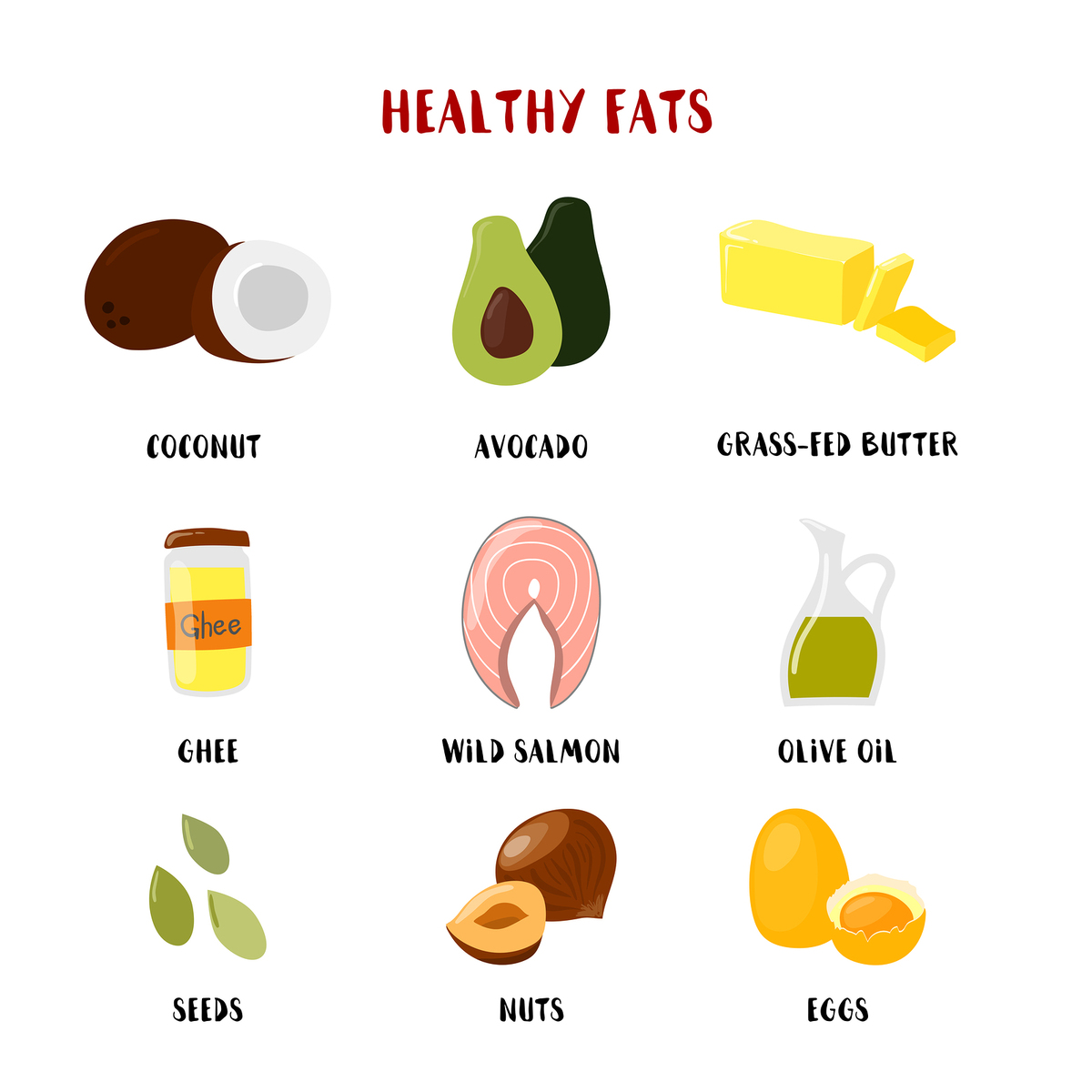
Plant-derived saturated fats include coconut oil and its byproducts, as well as palm oil and palm kernel oil. These plant-based saturated fats are seen in some brands of margarine, although other brands of margarine also contain some trans fats, which most dietitians say should not be consumed at all.
Saturated Fats and Cholesterol
Much of the case against saturated fats is based on their contribution to increased cholesterol levels in the body. But that argument can cut both ways.
While saturated fats are believed to increase blood levels of low-density lipoprotein (LDL), the so-called bad cholesterol, they also increase levels of high-density lipoprotein (HDL), or good cholesterol. Having a healthy ratio of the two is important in maintaining optimal cardiovascular health.
However, there was a time when medical professionals concerned themselves only with total cholesterol — a combination of LDL and HDL. And if you had total cholesterol over a certain number (one that’s been adjusted by dietary authorities over the years), you were in trouble and at an increased risk of cardiovascular disease.
While it’s still considered healthiest to keep total cholesterol below 200, we now know that the ratio of HDL to LDL within that range is more determinative of heart health than the total number itself.
Which Saturated Fats Are Healthiest?
In recent years, medical scientists have moderated their blanket warnings about the dangers of saturated fats and have, in fact, suggested that certain saturated fats are healthier than others, particularly in terms of cardiac health.
In a study published in the March 15, 2019, issue of the International Journal of Cardiology, a team of British, Danish, and Dutch researchers found that heart attack risk varied sharply based on the type of saturated fat consumed.
The researchers evaluated dietary data and tracked health outcomes of roughly 75,000 people in the United Kingdom and Denmark. Out of both groups, 3,500 experienced heart attacks during follow-up periods, which extended to 13 years in Denmark and 18 years in the United Kingdom.
In correlating dietary data with health outcome, researchers found that those whose diets were low in the consumption of longer-chain saturated fats — 16 or more carbon atoms — were less likely to suffer heart attack than those whose consumption of those fats was higher. They also found that those who ate shorter-chain saturated fats — 14 or less carbon atoms — were even less likely to experience heart attack.
These longer-chain saturated fats typically come from meat, while the shorter-chain saturated fats come from dairy products and plant sources.
Lead investigator Ivonne Sluijs of the Julius Center for Health Sciences and Primary Care at University Medical Center Utrecht in the Netherlands, acknowledged some of the study’s shortcomings. In an interview with ScienceDaily.com, she said, “Our study only allowed us to draw conclusions on the level of associations between saturated fatty acids and the development of myocardial infarction [heart attack]. We do not know whether those fatty acids are actually the cause of differences between the occurrences of myocardial infarction we observed.”
Sluijs went on to suggest that future studies might more tightly control the consumption of saturated fatty acids and might, perhaps, compare the effects of that diet with one higher in unsaturated fatty acids.

The Heart-Penis Link
Heart health and erection health are closely linked, because both the heart and the penis depend upon a robust flow of blood to maintain optimal function. The heart, penis, brain, and other organs throughout the body are linked by a network of blood vessels that delivers oxygen-rich blood via arteries and carries away oxygen-depleted blood through the veins.
Because the arteries that supply the penis are smaller than those that carry blood to and from the heart and brain, the former are more likely to show signs of decreased blood flow due to atherosclerosis or other forms of vascular compromise.
It can truly be said that erectile dysfunction is often an early-warning sign of more serious cardiovascular health issues that, if heeded, might well head off a heart attack or stroke in the future. That’s why it’s important to consult your doctor or another health professional if you begin to see a decline in erectile function. The sooner you act, the easier it may be to treat the underlying issues that are causing symptoms of impotence and might in the future threaten more serious health consequences.
Ordering ED Drugs Online
Viagra and the other ED drugs known collectively as PDE5 inhibitors are designed to treat ED symptoms caused by an insufficient flow of blood to the penis, the most common cause of male impotence. To buy these medications, you’ll need a prescription, which you can have filled at a local pharmacy or use to order the drugs online.
If the convenience of ordering your ED drugs online appeals to you, consider taking your business to eDrugstore.com, an Arizona-based online facilitator that’s been in the business since the late 1990s. If you have a doctor’s prescription, you can fax it or scan and email it along with your order. If not, eDrugstore can set up a complimentary online consultation with a licensed U.S. physician who can authorize a prescription if appropriate. To learn more, visit eDrugstore’s Erectile Dysfunction page.

We specialize in providing our over 1,000,000 customers with relevant product and condition information created by our professional editorial staff which includes our team of medical writers, medical practitioners, and health educators. eDrugStore.com Staff on Facebook