

 When an aging grandmother gives birth to her own granddaughter, it tends to turn heads. But with advances in medicine, the event is hardly considered a miracle these days.
Kristine Casey is a 61-year-old mother of three daughters. But last week she delivered another baby girl as a surrogate for one of her real daughters, and her daughter’s husband. The baby was named Finnean, and she was introduced to the world via Caesarean section at a Chicago hospital.
ABC reports that the first known arrangement for a surrogate grandmother to deliver her daughter’s child, or children, occurred in 1987 when a woman in South Africa gave birth to triplet grandchildren. In 2008, ABC News’ “Good Morning America” featured an interview with 56-year-old Jaci Dalenberg of Ohio. Dalenberg delivered triplet girls who she carried for her daughter, Kim Coseno.
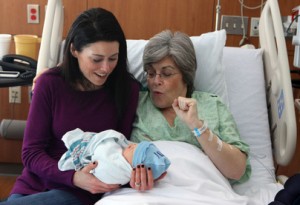 In this latest case, Casey said she felt a spiritual calling to help her daughter, who failed several times in her attempt to conceive her own children. Casey wrote her daughter and son-in-law (Sara and Bill Connell) a letter that included an offer to become a surrogate. Sara first tried to get pregnant in 2004 and since then sought infertility treatment, delivered stillborn twins and suffered a miscarriage. Casey’s offer was obviously something to consider, and the pregnancy was come to pass.
Some hospitals, such as the University of Chicago Medical Center (UCMC), limit the age of surrogate mothers due to the increased risk of complications surrounding pregnancy and birthing among aging women. The cutoff age for surrogates is 55 at UCMC.
One obstetrician said the risks of high blood pressure, gestational diabetes and miscarrying are usually higher among older women. Casey did, in fact, experience some complications with her kidneys when she delivered the baby girl, named Finnean. Those problems were apparently quickly dealt with, however.
 Although medical concerns can be an issue, synthetic hormone supplementation can make an aging uterus act like a youthful one at any age. Casey had gone through menopause 10 years before giving birth last week. Casey became pregnant upon her second round of in vitro fertilization, and synthetic hormones were probably administered through the first trimester before placental hormones took over.
In terms of the ethical issues surrounding in vitro fertilization among mother and daughter, Josephine Johnston of the Hastings Center, a bioethics research institute, said there’s nothing to be concerned about. Medically speaking, the risks for developmental or other disabilities are relatively low, as well.
“It seems like an unquestionably loving and generous thing for a family member to do,” Johnston told the Chicago Tribune.
Now, Casey and the Connells seem incredibly happy to have a more complete family, and a big-time story to tell their daughter when she grows older. Until then, however, the Connells will keep their baby, and themselves, under wraps. They granted only one interview, to the Tribune, saying afterward that no further media requests would be granted.

We specialize in providing our over 1,000,000 customers with relevant product and condition information created by our professional editorial staff which includes our team of medical writers, medical practitioners, and health educators. eDrugStore.com Staff on Facebook