

Peak Male Performance. Stronger. Fuller. Confident.
Premium male enhancement solutions delivered discreetly to your door.
Physicians
Private
Delivery

Male Enhancement Pump
Electric pump engineered for stronger, fuller results.
- Hands-Free Electric Operation
- Promotes Blood Flow
- Discreet & Reusable

Nitric Oxide
Boosts blood flow for harder, fuller erections.
- Improves Circulation
- Supports Stronger Erections
- Daily Performance Support

Semen Volume Maximizer
Daily formula to support increased volume and intensity.
- Boosts Volume
- Enhances Intensity
- Once-Daily Formula
If you’ve taken sildenafil (Viagra) for a while and it’s stopped working the way it used to, you’re not alone, and the alprostadil vs sildenafil question is one of the most common ones that comes up at the pharmacy counter once oral therapy hits a wall. About 30 to 35% of men don’t get a reliable response from PDE5 inhibitors like sildenafil, tadalafil, or vardenafil, especially after prostate surgery, in longstanding diabetes, or with significant vascular disease.
That’s when alprostadil enters the conversation. It works completely differently, and for a lot of men who thought they were out of options, it’s the treatment that finally works.
Here’s what to know before you have that conversation with your prescriber.
How Sildenafil Works, and Why It Sometimes Doesn’t
Sildenafil is a PDE5 inhibitor. It blocks the enzyme that breaks down cGMP, the signaling molecule that lets blood flow into the penis during arousal. Critically, sildenafil needs an intact nitric oxide signal to work. No arousal signal, no cGMP, nothing for sildenafil to protect. The pill doesn’t create an erection. It amplifies one that’s already starting.
That’s why sildenafil fails in specific situations:
- Severe nerve damage after radical prostatectomy
- Advanced diabetic neuropathy affecting pelvic nerves
- Significant arterial disease limiting blood inflow
- Low testosterone reducing the arousal signal itself
- Certain antidepressants blunting the response
If any of these describe you, no amount of sildenafil, even at the maximum 100 mg dose, will reliably produce an erection. That’s not failure on your part. It’s mechanism.
How Alprostadil Works Differently
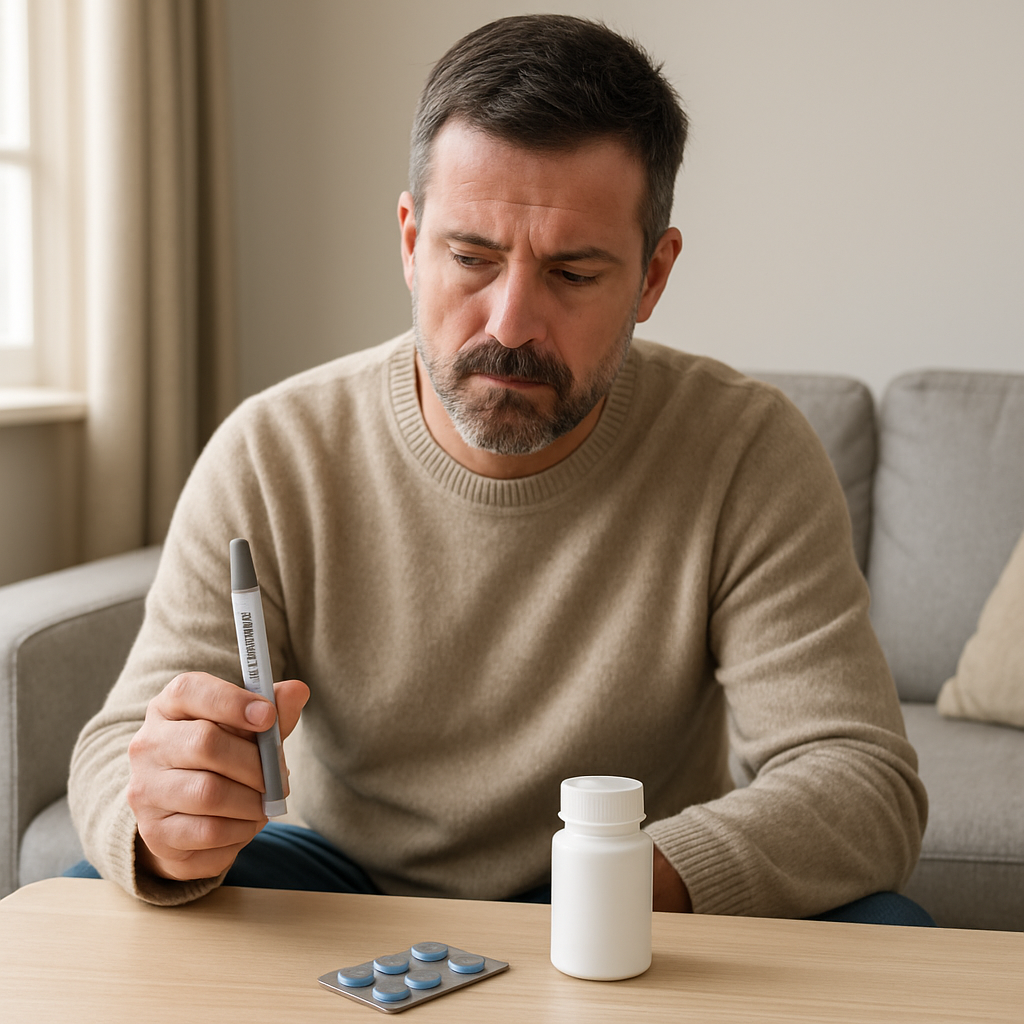
Alprostadil is synthetic prostaglandin E1. Instead of amplifying a signal, it directly relaxes the smooth muscle in penile arteries and causes blood to flow in, regardless of whether nerve signaling is intact. That’s the key difference in the alprostadil vs sildenafil comparison. Alprostadil bypasses the plumbing problem entirely.
It comes in two FDA-approved forms:
- Intracavernosal injection (Caverject, Edex): a very fine needle into the side of the penis
- Intraurethral suppository (MUSE): a small pellet inserted into the urethra
Yes, the injection sounds worse than it is. Most men describe it as a pinch, and the needle is smaller than an insulin needle. The FDA prescribing information reports success rates of 70 to 90% for the injection form, which is substantially higher than sildenafil in men who’ve already failed oral therapy.
Alprostadil vs Sildenafil: Head to Head
Onset of action
- Sildenafil: 30 to 60 minutes
- Alprostadil injection: 5 to 20 minutes
- Alprostadil suppository: 5 to 10 minutes
Success rate in men who failed pills
- Sildenafil dose escalation: modest gains, often disappointing
- Alprostadil injection: 70 to 90% in most published series
- Alprostadil suppository: about 40 to 60%
Duration
- Sildenafil: erection responds to arousal for about 4 hours
- Alprostadil: produces an erection lasting 30 to 60 minutes regardless of arousal
Common side effects
- Sildenafil: headache, flushing, nasal congestion, blue-tinged vision
- Alprostadil: penile pain or aching (about 30% of users), injection site bruising, rare risk of priapism
Cost
- Generic sildenafil: often under $1 per tablet
- Alprostadil: $30 to $60 per dose, depending on form and insurance
For most men, sildenafil is still the right first step because it’s cheap, easy, and works about 70% of the time. But if you’ve tried the maximum dose without success, the standard first, second, and third line ED treatment sequence usually moves next to alprostadil rather than adding more pills. If you haven’t yet tried a longer-acting pill, you might also want to review how tadalafil daily dosing compares to on-demand use before switching classes entirely.
Who Should Consider Alprostadil
Alprostadil tends to be the right choice when:
- You’ve failed adequate trials of at least two PDE5 inhibitors at maximum dose
- You have significant nerve damage (post-prostatectomy is the classic example)
- You can’t take PDE5 inhibitors because of nitrate therapy for chest pain
- You want a faster onset for spontaneity reasons
- Oral medications produced intolerable side effects
Men recovering from prostate surgery are a special case. Nerves can regrow, sometimes for 18 to 24 months after the operation, and alprostadil is often used during that window to maintain penile tissue health. Whether nerves regenerate meaningfully after prostatectomy depends on the surgical technique and how much of the neurovascular bundle was preserved.
Who Should Avoid Alprostadil
Skip alprostadil, or use with real caution, if you have:
- Sickle cell disease or trait (priapism risk)
- Multiple myeloma or leukemia
- Anatomical deformities of the penis (Peyronie’s disease, severe curvature)
- A history of priapism from any cause
- Bleeding disorders or you’re on high-dose anticoagulants
Priapism, an erection lasting more than four hours, is the most serious risk. It’s uncommon (roughly 1% of users in Cleveland Clinic’s summary of the data) but requires an ER visit right away. Waiting causes permanent tissue damage.
What to Try Before Injections
Before you accept that pills have failed, make sure you’ve actually optimized them. In practice, what I see most often is patients who tried 50 mg of sildenafil twice, didn’t get results, and gave up. That’s not a fair trial. The honest answer is that many "failures" respond once you address timing, food effects, arousal, and dose. If you’re stuck at 100 mg with no response, our guide on what to do when 100 mg of Viagra isn’t working walks through the specific fixes worth trying first.
If you’ve truly exhausted oral options, talk to a edrugstore.com pharmacist about whether alprostadil or a combination approach fits your situation. Insurance coverage varies a lot and the counseling on injection technique matters.
Bottom Line on Alprostadil vs Sildenafil
The alprostadil vs sildenafil decision isn’t really either/or. Sildenafil is still first-line for most men because it’s simple, effective, and cheap. Alprostadil is the workhorse when pills fail, particularly for men with nerve damage or advanced vascular disease where amplifying a signal isn’t enough. Success rates with alprostadil injection routinely exceed 70%, which is meaningful when you’ve felt like you’re out of options.
Ask your prescriber whether an in-office test dose of alprostadil makes sense. That first supervised dose is the best way to see if it works for you without guesswork.
This article is for informational purposes only and is not medical advice. Always consult a licensed pharmacist or physician before starting, stopping, or changing any medication.
References
- NIH StatPearls: Sildenafil pharmacology, mechanism of PDE5 inhibitors and why they require intact nitric oxide signaling.
- FDA prescribing information for alprostadil (Caverject), approved indications, efficacy data, and safety warnings.
- Cleveland Clinic: Alprostadil injection overview, patient-facing summary of use, side effects, and priapism risk.

Dr Steven Schlosser
Dr. Schlosser graduated from Lafayette College Phi Beta Kappa and attended Georgetown Medical School. He had 4 years of medical residency training at Tufts University in Boston in both Gynecology and Internal Medicine. He has had a spotless medical career for the past 40+ years and is Board Certified. Learn More