
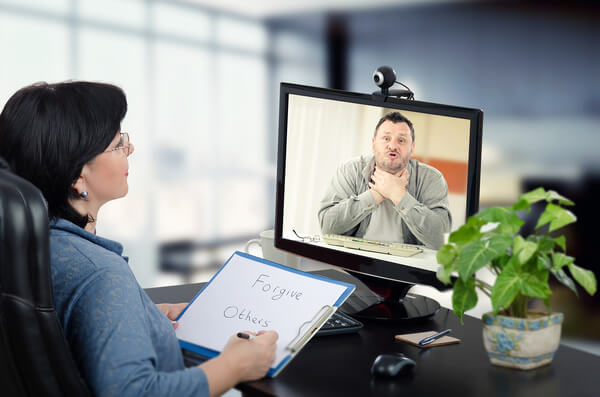


Correctional facilities across the United States are increasingly turning to telemedicine as a way to improve the health care of their inmates while also saving money in the process.
The virtual approach to health care also offers benefits on the security front, sharply reducing the time that inmates spend outside the prison walls.
Actually, prisons were among the first institutions to experiment with telemedicine as an alternative to traditional avenues of treatment for the inmates in their custody.
Some reportedly tried primitive versions of telehealth as early as the 1980s. However, the quantum leaps in the technology of telemedicine have made it a far stronger contender than it was in those early years.
A Perfect Match
Marc Stern, M.D., a former assistant secretary for health services in the Washington State Department of Corrections, says, “Telemedicine is perfectly designed for prisons.” However, Dr. Stern is quick to point out that telemedicine isn’t always the ideal solution and that there are times when it’s important for physicians to visit imprisoned patients in person.
“You have to get a flavor for how a prison operates, what is the food like, what is the noise level, how attentive is the staff, how high or low are the bunks,” Dr. Stern says. “Occasionally, you have to walk through in order to understand that peculiar environment.”
South Carolina Initiative
One of the more recent developments on the use of telemedicine in correctional facilities came in early July 2016 when the South Carolina Department of Corrections announced a partnership with the Medical University of South Carolina. Using the latest cutting-edge technologies of telemedicine, this joint venture will allow doctors at the Charleston medical center to examine inmates remotely and diagnose illnesses.
Bryan P. Stirling, director of the South Carolina Department of Corrections, told Associated Press reporter Meg Kinnard that the partnership with MUSC will sharply reduce transportation costs associated with inmate care. Such doctor’s visits outside the prison walls typically require the use of two correctional officers plus a driver, he said. More importantly, however, the move to telemedicine will reduce the security risks to physicians that occur every time inmates are taken outside the prison walls.

‘Bad Things’ Can Happen
“Every time the fence opens and an offender goes out, there’re chances for bad things to happen,” Stirling told Kinnard. “This will allow us not only to better serve this population, but also it’s a public safety thing. Keeping them behind the fence just makes sense.”
Stirling pointed out that many of the state’s correctional institutions are located in rural areas, hours away from the nearest hospital or urgent care clinic. While many of the state’s correctional facilities do have health care facilities, many of them are unstaffed during the evening hours, a time when fewer correctional officers are on duty as well. This SCDC director said this is a combination that sharply increases the risk of transporting a prisoner at night.
SC Telehealth Alliance
For its part, Charleston-based MUSC has already been fairly active on the telemedicine front. It is a member of the South Carolina Telehealth Alliance, a network of academic medical centers, community hospitals, and health care providers that seek collectively to improve access to quality health care throughout the Palmetto State.
In an interview with AP, James T. McElligott, M.D., director of telehealth at MUSC, said the tools of telemedicine allow medical professionals to diagnose and treat thousands of South Carolinians who might not be unable to see a doctor in person. Such telemedicine tools include video conferencing, messaging systems, and digital medical record keeping and sharing, he said.
Eases Pressure on Providers
Dr. McElligott told Kinnard that treating more people remotely benefits not just the patients but health care providers as well. Access to telehealth for routine medical issues reduces the number of people clogging up hospital ER waiting rooms, easing the pressure on overworked medical personnel.
In his interview with AP, Dr. McElligott posed the following rhetorical question: “When are you more likely to miss something? When you are rushed to get to everything in 15 minutes. Would you be better off making five-minute visits every week? We’re probably looking at briefer intervals of access to patients but overall more time and attention.”
Inmate Medical Data Digitized
As a prelude to the launch of South Carolina’s telemedicine project, inmate medical records are being digitized, according to SCDC’s Stirling. This phase of the operation is being funded with existing budget monies. Once that project has been completed, the telehealth initiative will be financed by funds appropriated by the state legislature to the Telehealth Alliance, which was founded by MUSC and now includes SCDC as a member.
Health care within the walls of American correctional institutions is far more expensive than most people realize, writes Kinnard. A significant factor in these increasing health costs is the gradual graying of the nation’s prison populations. According to data from the Bureau of Justice Statistics, inmate health care accounted for $7.7 billion — or nearly 20 percent — of the overall corrections budget of $38.6 billion in 2011, the most recent year for which such statistics are available. In 2011, South Carolina spent $2,933 per inmate on health care, less than half of the national average.

Texas Embracing Telemedicine
Texas is another state that’s been active in the integration of telemedicine into the health care programs of the state’s prison system. In a 2015 article in The Dallas Morning News, staff writer Seema Yasmin profiled a telemedicine project in place at the state’s W.J. Estelle Prison in Huntsville. As part of that profile, she recounted the following patient-doctor encounter:
“Christopher Aldridge walks into the clinic, hops onto the edge of the examination table, and greets his doctor. Aldridge, 33, had brain surgery in Austin three years ago because of a buildup of pressure inside his skull. He now needs regular appointments with a specialist.
“‘Have you had any vision changes?’ asks the doctor. Aldridge replies ‘yes’ before responding to questions about headaches, dizziness and pain.
A Telemedicine Encounter
“It sounds like a routine medical visit — but patient and doctor are not in the same room or even in the same city. The doctor is in a clinic in Galveston, and Aldridge, an inmate at the Estelle prison in Huntsville, is 135 miles away in the prison clinic, talking to the doctor on a TV screen.”
The Lone Star State’s increasing adoption of telehealth technologies has helped it to reduce the cost of inmate health care, according to Yasmin. She cites a 2013 report from the Pew Charitable Trusts that showed the cost of providing health care per inmate had risen nationally by an average of 28 percent from 2001 to 2008. According to that report, Texas and Illinois were the only states that trimmed inmate health care spending during that period. Texas cut such costs by 12 percent, while Illinois cut those costs by 3 percent.
If you’d like to read additional articles about telemedicine and other topics of interest to health consumers, check out our blog.

We specialize in providing our over 1,000,000 customers with relevant product and condition information created by our professional editorial staff which includes our team of medical writers, medical practitioners, and health educators. eDrugStore.com Staff on Facebook