

A new species of dinosaur with dracula-like teeth was discovered in the archives of the Harvard research center by Paul Sereno. — Click to Tweet.
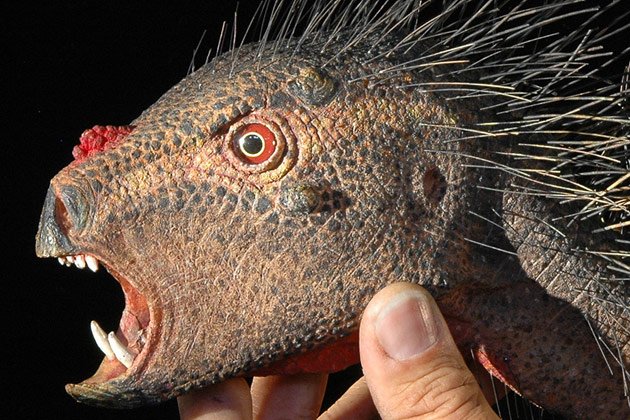
The remains of the dinosaur were discovered 50 years ago by a 1960’s research team from Harvard, somewhere near the border of South Africa. After being taken back to Harvard. the fossil got buried in the collection — never being described fully.
But recently, in preparation to be shipped to Cape Town’s South African Museum, the fossil was uncovered by Paul Sereno. He recently published a paper on this fossil and other fossils from dinosaurs in the same family.
Fossil Characteristics
The fossil was only a few feet tall — about 2. It’s skull was about 3 inches long. And it was mostly head and tail, weighing less than a housecat.
It also had a parrot-like beak that was strangely combined with two sets of teeth, one of sharp canines and one of tall teeth meant to cut up plants. Although the canines are more puzzling, it’s likely they were meant to scare off predators and for competitive sparring — which would have also served a purpose in attracting mates.
Sereno believes that this dinosaur may also have been covered in quills, much like a porcupine. It’s less certain whether the quills served the same function, though, as they weren’t as tough and spiky as a porcupine’s, and they wouldn’t have conserved heat very well. It’s likely that they were differently colored to differentiate species, or that they made the animal appear larger, scaring off predators.

Significance for Evolutionary Science
This fossil has been dubbed Pegomastax, and it’s part of a group of dinosaurs called heterodontosaurus, which simply means “different teeth.”
It’s hoped that Pegmastax might give some evolutionary clues for the entire line because it is relatively near the base of its family tree, and it’s also from 200 million years ago, which is about the time that Pangea was breaking up.
This splitting of the massive supercontinent separated different species of heterodontosaur, which helps explain why we see such large variation with this family. For example, Pegomastax has a distinctly higher crown than others in its family, and one other species has triangular teeth.
Conclusion
It will be interesting to see what other scientists make of this relatively rare find, and where it leads evolutionary theory concerning the heterodontosaur.

We specialize in providing our over 1,000,000 customers with relevant product and condition information created by our professional editorial staff which includes our team of medical writers, medical practitioners, and health educators. eDrugStore.com Staff on Facebook