


Faced with the continuing challenge of keeping their health care benefit costs under control, large U.S. employers are turning increasingly to telemedicine as the most attractive and cost-effective way to safeguard employee health.
Speaking at the National Press Club in early August 2016, Brian Marcotte, president and chief executive officer of the National Business Group on Health, reported on the results of his group’s survey of the major employers it represents. NBGH is a nonprofit association with a membership made up of roughly 425 large employers, including both Fortune 500 companies and major public-sector employers.
Health Care Delivery Now in Spotlight
Marcotte said the results from NBGH’s most recent survey show that employers believe that they have already exhausted most, if not all, of the cost-saving potential available through health plan design. Respondents also indicated that they have shifted their focus to the ways in which healthcare is accessed and delivered.
Based on the survey’s findings, Marcotte estimated that 90 percent of NBGH’s members next year will make telemedicine services available to employees who are located in states where such services are legal. This will represent a substantial increase from the 70 percent of members who have already made telemedicine available to their employees. Marcotte further predicted that 100 percent of NBGH members will offer telemedicine services to their employees by 2020.
Plan Design Strategy Exhausted
Employers’ increased focus on telemedicine’s potential to help control health care costs is fueled in large part by the realization that there’s little to be gained by further tweaking of health plan design. Marcotte pointed out that employers, many of which have gone to high-deductible plans, realize that their focus necessarily must focus from the front end of the coverage equation to the specifics of health care services delivery. “You really have to train your sights on the delivery system if you want to drive efficiencies and control health care costs,” he said.
Telemedicine has proved itself a convenient and cost-effective way to deliver health care services, particularly in the areas of mental health care, rapid-response stroke care, and senior health care. But its most attractive feature for employers is its lower costs, compared with those of traditional health care delivery models. Marcotte pointed out the average tab for a telemedicine session is $40. This is far less expensive than a trip to the hospital emergency room, which averages $700; a visit to the local urgent care center, which runs about $150; and a typical visit to the doctor’s office, the average charge for which is $100.

Access to Telemedicine Increasing
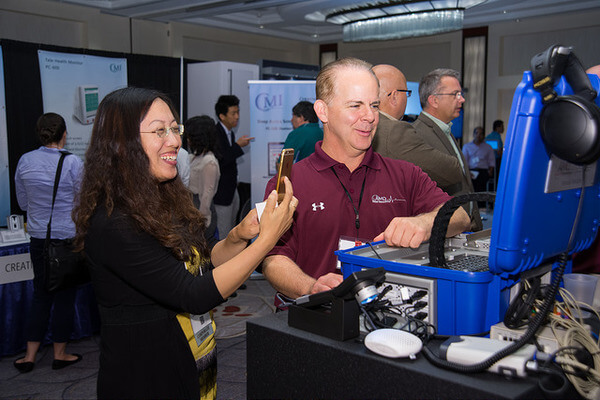
In today’s workplaces, most employees have a smartphone, which can serve as the medium for a televideo session with a telemedicine provider. However, many employers have taken the initiative to set up telemedicine kiosks in the workplace that are easily accessible by their employees with a pressing medical problem.
The growing availability of telehealth options points up yet another benefit of telemedicine over traditional in-person health care. An employee with employer-provided access to telemedicine can get in touch with a provider in minutes, discuss the problem, and decide on a course of action in a fraction of the time it would take to do so via the traditional route. This saves the employer hours of working time that might otherwise be lost if the employee had to take off part or all of a day to visit a doctor or hospital.
Anthem Spearheads Trend
Anthem, one of America’s largest health care insurers, has been a leader in the movement to install telemedicine kiosks in the workplace. In the 18 months ending in late June 2016, the insurer installed 34 kiosks in the offices and other workplace facilities of 20 employers, according to a report posted on the website of Kaiser Health News.
John Jesser, an Anthem vice president, told KHN staff writer Phil Galewitz that kiosks such as those it has recently installed are an ideal option for companies that are either too small or financially unable to finance an in-house clinic with doctors and nurses on standby. “This technology [telemedicine kiosks] should make it more affordable for employers of many sizes,” Jesser said.
Large public employers that have taken the initiative to install their own telehealth kiosks in the workplace include the city of Kansas City, Missouri, and the Palm Beach County School District in Florida. Private employer Jet Blue told Galewitz that it plans to add a telehealth kiosk for its employees at John F. Kennedy International Airport in New York.
How Kiosks Are Equipped
These in-house kiosks are typically equipped with video screens on which employees with health issues can discuss those problems with health care providers located elsewhere. The typical kiosk also is equipped with a number of familiar diagnostic tools, such as thermometers, pulse oximeters, blood pressure cuffs, and other devices that enable remotely located medical professionals to get close-up views of patients’ ears, eyes, mouths, and throats.
Among other findings from NBGH’s 2017 survey, according to Marcotte, large companies predict that their health care benefit cost increases will hold steady at 6 percent in 2017, the same rate of increase they would have experienced in both 2015 and 2016 had they not made changes to their plan designs.
Given the upsurge in specialty pharmacy costs, large employers’ ability to keep the rise in health care benefit costs to 6 percent — or slightly less in some cases — is impressive, said Marcotte. However, “costs are still running at more than twice the rate of inflation and general wage increases, thereby threatening affordability. These cost increases, while stable, are both unsustainable and unacceptable,” he said.

The pressure of these ever-increasing costs has driven large employers to more fully embrace the cost-cutting potential of telemedicine. But employer responses to NBGH’s 2017 survey also identify other trends likely to be seen in the year ahead and beyond. These include:
- Consumer-Directed Health Plans, or CDHPs, will increase slightly in 2017. Already available from 83 percent of large employers in 2016, Marcotte said that percentage will rise to 84 in 2017.
- Imposition of spousal surcharges for insurance coverage seems to be leveling off. Marcotte expects about a third of its members will impose such surcharges in 2017 for spouses who could obtain health coverage through their own employers. This is the same rate as that seen in 2017. A few employers will prohibit the coverage of spouses in cases where other coverage is available through an employer.
- Options available at Centers of Excellence, which improve public access to health care, will grow, fueling an increase in their use from 79 percent in 2016 to 85 percent in 2017.
- Among other tools to manage care, 80 percent of the corporate respondents to the survey said they plan to offer nurse coaching for care and condition management, while 72 percent said they’ll offer nurse coaching for lifestyle management. Sixty-five percent of responding employers said they will provide their employees with self-service decision-making tools to help them become better health care consumers.
If you would like to stay abreast of the latest developments in telemedicine and other news on the consumer health front, check out our blog.

We specialize in providing our over 1,000,000 customers with relevant product and condition information created by our professional editorial staff which includes our team of medical writers, medical practitioners, and health educators. eDrugStore.com Staff on Facebook