
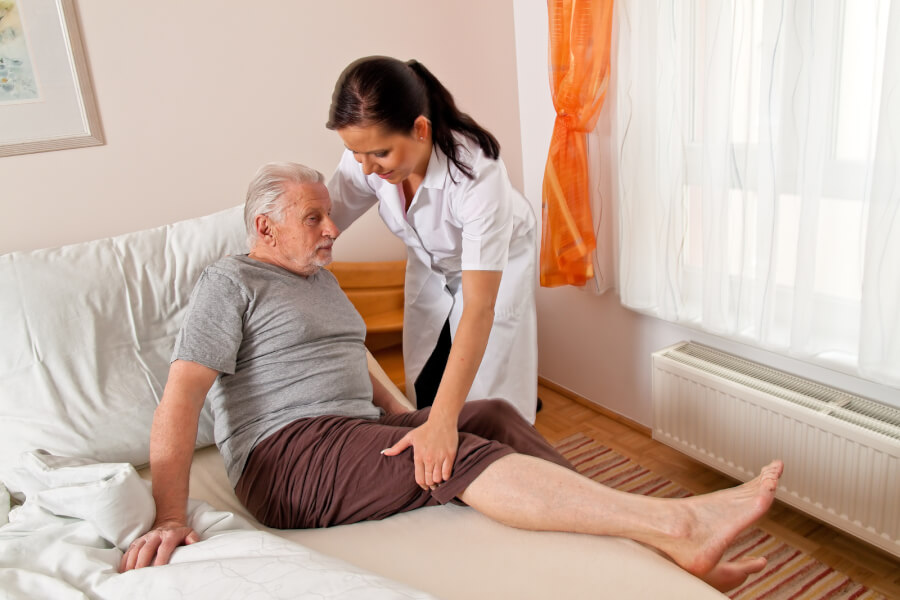


If you’re like most children of aging parents, particularly those with disabilities or other worrisome medical conditions, you worry a lot about what could happen to them when no one’s there to help. While you’d feel much more comfortable if they were in a nursing home, they refuse to go, and the cost of a live-in caregiver is beyond your means — and theirs. What to do?
Telemedicine — the use of telecommunications technologies to provide medical care remotely — may be the answer you’ve been looking for. While it provides increased access to both routine and specialized medical care for people of all ages, telemedicine is ideally suited to serve elderly patients who insist on staying in their homes despite signs of declining health.
Challenge to Grow in Years to Come
And the challenge of finding new and more effective ways to treat the world’s aging population is only going to grow in magnitude in the years ahead. The U.S. Census Bureau projects that the number of Americans over the age of 65 will grow to 83.7 million by 2050, almost double the estimated 2012 population of 43.1 million U.S. seniors. Even more worrisome is the rapid growth expected in the number of Americans who are 80 or older. That figure is expected to quadruple in the period from 2000 to 2050.
The Winter 2014 newsletter of the Parkinson’s Disease Foundation (PDF) offers a close look at the potential role telemedicine could play in caring for those with the disease, estimated at roughly 500,000 in the United States. The vast majority of those patients are elderly.
Incidence of Parkinson’s Disease
According to a demographic study of U.S. Parkinson’s patients, published in the April 2010 issue of Neuroepidemiology, the mean incidence of Parkinson’s disease among Medicare beneficiaries increases sharply from age 65 to 85 and above. The mean PD incidence per 100,000 Medicare beneficiaries is put at 124.22 for those between 65 and 69, rising to a mean incidence of 970.19 for those 85 and over.
The article in the PDF newsletter looks specifically at a handful of institutions that already provide telemedicine care for people with Parkinson’s. These institutions include the Veterans Health Administration, Medical University of South Carolina, Johns Hopkins University, and the University of Rochester. The article’s author notes, “From these programs, we have learned how to create new models of care and how to negotiate barriers to access, including insurance restrictions and the risk of privacy violations.”
Care, Quality of Life Improve
PDF research shows that the care and quality of life of Parkinson’s patients improve when they see a physician who specializes in mobility disorders. Alarmingly, however, about 40 percent of those with PD not only do not see a specialist, they don’t even see a general-practice neurologist.
In its comparison of conventional in-person care versus telemedicine care, the PDF article finds that telemedicine greatly increases the likelihood that PD patients will get access to a Parkinson’s specialist. This improved access to specialized care is particularly good news for patients who live in remote rural areas and those whose disability is so great that traveling outside the home to a medical appointment is all but impossible.
Johns Hopkins Program Cited
As an example of increased access to specialized care, the article cites the work that Johns Hopkins is doing with Parkinson’s patients. The Baltimore-based institution provides telehealth consultations for PD patients in 11 countries and five states, few of whom would be able to access specialized care without the university’s intervention. “In theory, telehealth may similarly increase the number of people who have access to physical and speech therapy.”
Yet another benefit of telemedicine care versus conventional in-person treatment is the savings that can be realized in time, trouble, and money. A 2013 research study funded in part by PDF found that a telemedicine appointment, when compared with a traditional visit to the doctor, saved PD patients an average of 100 miles of travel and three hours in time.
Advantages of Telehealth Consultations
For those skeptical about how a virtual visit from the doctor compares with a conventional trip to the doctor’s office, the PDF article offers some persuasive findings from preliminary studies of this issue. Those findings indicate that a virtual visit may be more effective than an in-person visit to the doctor. In a telemedicine setting, the doctor is able to see the patient in his or her everyday environment and may be better able to spot household risk factors and suggest ways to reduce such risks.
Additionally, early findings from research into telehealth consultations indicate that patients are more relaxed, better able to communicate with their doctors, and more likely to remember any advice or instructions the doctors may offer. The PDF article cites a study conducted at the University of Rochester that found that PD patients at nursing homes who were given telemedicine consultations as an option got high-quality care and actually preferred the telehealth option over in-person consultations.

Italian Study
Further evidence of telemedicine’s benefits in caring for the elderly comes from a small-scale Italian study that was previewed online in advance of its publication in the “Journal of Telemedicine and Telecare.” The Italian research team looked specifically at the effects of a telehealth system in use at a daycare center in southern Italy. Researchers made a clinical and neurobehavioral assessment of 18 elderly patients, as well as the effects of the program on the care burden of the elderly patients’ 20 caregivers.
The Italian study found that participation in the telehealth program brought a significant improvement in the patients’ psychiatric condition while at the same time noticeably reducing the burden on caregivers. In the conclusion to their study, the researchers write, “It appears that a telehealth system integrated into a local health care service may significantly improve elderly persons’ behavior and also reduce the caregivers’ burden.”
Wearable Devices Can Help
In an article posted at mHealthNews.com, Kirby Cunningham looks at an emerging trend in technology that may help more seniors, particularly those with memory problems, to remain in their homes well into their golden years. Cunningham points in particular to “the use of wearable devices that can track seniors’ vital signs and location and alert caregivers or family members when they have fallen or exited an exterior door.”
Telemedicine encompasses not just telecommunications technology that enables face-to-face interaction between patients and medical professionals but also any exchange of medical data that helps facilitate health care goals. In the case of seniors with mild memory problems, writes Cunningham, “programs in which caregivers phone seniors to check on health status and offer medication reminders have been shown to be effective.”
Use of Sensor Technology
As memory decline progresses, caregivers could better track the well-being of elderly patients with the use of sensor technology that can pinpoint a patient’s location and/or sleeping position and also indicate when a patient’s safety might be at risk.
If you’re interested in reading additional articles about advances in telemedicine and other related health care topics, check out our blog.
Don Amerman is a freelance author who writes extensively about a wide array of nutrition and health-related topics.

We specialize in providing our over 1,000,000 customers with relevant product and condition information created by our professional editorial staff which includes our team of medical writers, medical practitioners, and health educators. eDrugStore.com Staff on Facebook