

Recently discovered by Nasa, the spectacular Helix nebula looks just like a beautiful eye floating in space! — Click to Tweet.
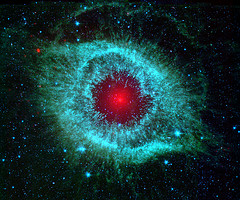
Also known as NGC 7293, the Helix nebula is the remnants of a dying star. The Helix nebula is located about 650 light-years from Earth, and can be seen in the constellation of Aquarius.
Just like our star will in about 5 billion years, the star that formed the Helix nebula eventually reached the last remnants of its fuel and began to expel its outer layers. When a star about the size of our sun runs out of hydrogen and helium in its core, then fusion begins to slow down.
Eventually the outer layers of gas begin to shed, and the star expands into a nebula. The core remains, condensing under its own gravity into a white dwarf. White dwarves are interesting phenomena. Often they’re about size of our planet, but they have a mass — and a gravity well — very close to the size of our own star.

Photographic Technology
These new pictures were just released Wednesday, so few people have seen exactly how stunning this nebula is. The photos actually required two different telescopic systems to be generated. They combine data from NASA’s Spitzer Space Telescope, which observes in long-wavelength infrared light, with data from the Galaxy Evolution Explorer (GALEX), which was able to gather the short-wavelength ultraviolet light coming from the object.
Scientific Classifications
The Helix nebula is classified as a planetary nebula, although the term is a misnomer. Originally coined by William Herschel who was compiling an astronomical catalog. He’d recently discovered the planet Uranus, and decided these new objects looked similar to the gas planets of our solar system
With our new telescopes, though, they’re clearly different. Their appearance is even grander than the most beautiful gas giants, and their gases spread out in multi-colored layers of, well, nebulous imagery.

We specialize in providing our over 1,000,000 customers with relevant product and condition information created by our professional editorial staff which includes our team of medical writers, medical practitioners, and health educators. eDrugStore.com Staff on Facebook