


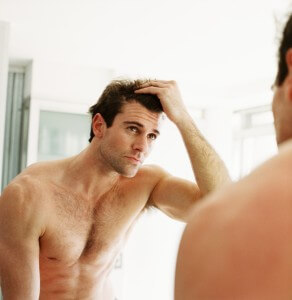
A good hair day might have less to do with the shampoo and styling products you use, and more to do with whether you’re happy with your mane at all. And if a bad hair day spreads out into weeks, months or years, maybe it’s time to do something about it.
Being happy with your hair can do more than help you walk out the door in a better mood. Research shows that overall self-confidence in men is strongly tied to hair, and whether or not you’re happy with it.
For some men, hair loss can feel devastating. Hair transplant surgeon, Dr. Asim Shahmalak, for Huffington Post, explains that for many years, medical professionals largely dismissed the psychological effects that hair loss can create in men.
What’s worse than feeling uncomfortable about your appearance? Having those feelings disregarded as unimportant. But that’s changing.
What Causes Hair Loss in Men
Androgenetic alopecia is the official name for hair loss that affects nearly 35 million men in the U.S. Where genetics isn’t fully to blame, other medical factors might be, such as coronary disease, insulin resistance, and enlargement of the prostate.

Until recent years, if an illness were the cause, the illness was treated, but hair loss was simply a side-effect that was par for the course. And so the medical community offered little support for a chronic bad hair day.
Androgenetic alopecia is, indeed, caused by both genetic and environmental factors, or a combination of the two, so says the U.S. National Library of Medicine, Genetics Home Reference section.
Many men have no underlying condition that might be labeled as life threatening or even serious. For some perfectly healthy men, hair loss is simply inherited. Look at family photos, and scan the room at the next gathering. If a close relative began experiencing hair loss at or near your age, you might carry the same genes.
More scientifically, the androgen hormone, dihydrotestosterone, is what causes hair to grow. Ironically, high levels of androgens can have the opposite effect, resulting in hair loss instead of growth. New hair restoration treatments suppress dihydrotestosterone, which helps many men regrow hair.
What Men Have Done about Hair Loss in the Past
History proves that alopecia is not a new concern. The remedies of choice might not have worked, but they were definitely creative.
In Ancient Egypt, a mixture including hippopotamus fats and porcupine hair, and some other ingredients that don’t bear repeating, were boiled and applied to the scalp, according to The History Channel.
Hippocrates preferred a blend of horseradish, opium, spices, and, of all things, bird droppings. If the other ingredients didn’t work, at least the opium probably meant that he didn’t care.
Julius Caesar experimented with clever combing techniques and bizarre concoctions dreamed up by the lovely Cleopatra before settling on the famous laurel wreath as his now-famous head covering.
In relatively recent times, men have tried teas, cleverly marketed snake oil, and even heated metal dome-shaped caps. You can probably imagine how successful each of these was, since none remain in use today.
Hair transplants gained a lot of attention in the late 1930s, and for two good reasons: They successfully relocated hair from thicker to thinner areas of the head, and they made the transplant recipient’s hairline look a bit like a baby doll’s. Transplants have improved a lot since then.
Since none of these remedies addressed the cause of androgenetic alopecia, none caused hair to regrow.
The Changing Attitude of the Medical Community
Men who experience hair loss know just how disheartening it is to find more hair on the hairbrush each day, and less where they’d rather it be. But science lagged behind for many years. Remedies didn’t work, or didn’t work well enough, and some were outright dangerous. Few serious studies examined the causes of hair loss, and fewer dared to delve into the potential psychological effects of alopecia.

Although hair loss can be caused by a medical condition, the general rule of thumb was, until recent years, that it’s more likely genetic (or a combination of both), but it was not like suffering a heart attack or other serious ailment where physical health was in jeopardy. This attitude about hair loss remained true, even if the underlying cause was serious.
But in 2006, something changed. The Stough Hair Center study, Psychological Effect, Pathophysiology, and Management of Androgenetic Alopecia in Men revealed its findings, which were, in part, that alopecia was a physically and psychologically harmful medical condition.
Not part of a condition, not a side-effect, but its own harmful condition.
So, Where’s the Harm?
Part of the harm suggested by the Stough study deals with the psychological effects of hair loss in men. And since androgenetic alopecia is a progressive condition, the psychological effects can also worsen over time.
Another study, conducted in Spain and reported in the Current Medical Research and Opinion Journal, explains that over 75% of the men surveyed considered their hair to be an important feature, and 62% agreed that hair loss had a detrimental effect on self esteem.
Further, these men expressed concerns about becoming less attractive, losing all of their hair, and some even reported depression.
This study, titled The Psychosocial Impact of Hair Loss among Men: A Multinational European Study, also brought to light a surprising revelation. Of the 1,536 men in five countries who participated, fewer than 10% of them were using any hair restoration medication. Many had never tried a preparation at all.
But of the 10% who did use hair restoration medication, more than half reported psychological benefits in addition to regrowing hair. Those benefits included renewed self esteem, and general perception of personal attractiveness.
Psychological harm isn’t the only negative to alopecia. Physical harm can also result from hair loss. Hair is not just attractive, it’s also protective, and guards against sunburn, minor injury, and even cold temperatures.
While this study certainly produced some interesting findings, the conclusions make it more interesting. The large number of men who reported hair loss and psychological harm, and the comparatively minuscule number of men who sought treatment for it, meant there was an unexplained gap between need and treatment.
Effective hair loss remedies such as the dihydrotestosterone synthesis inhibitor Finasteride work, but few men, at least in this study, approached their doctor about it. Such a simple step, and it could help in so many ways.
Your doctor knows about Finasteride, too. Talk with him, explain your concerns, and let him guide you to what’s right for you. He will probably want to rule out health conditions before moving forward with treatment. Once you know the cause of your hair loss, you can start working toward improving it. And even with another medical condition, treatment is still likely possible.
Avoiding mirrors doesn’t have to be part of your future, and neither does low self-esteem or depression. By taking that first step, you can leave all of those bad hair days in the past.
eDrugstore.com sells Propecia and its generic equivalent, Finasteride, which are scientifically proven to regrow hair for many men. We offer competitive prices and the privacy and convenience of online ordering, and your discreetly-packed shipment arrives right at your door. If you’re ready to try something that works, see what eDrugstore.com has to offer.

We specialize in providing our over 1,000,000 customers with relevant product and condition information created by our professional editorial staff which includes our team of medical writers, medical practitioners, and health educators. eDrugStore.com Staff on Facebook