


Sex hasn’t felt very interesting lately. At the same time, your periods may be getting unpredictable, your sleep has gone downhill, or you’re waking up drenched in sweat. It’s natural to wonder whether the change in your sex drive is simply part of perimenopause or whether something else is going on.
Either explanation is possible, and sometimes both are involved. Perimenopause can reduce desire directly or through symptoms such as poor sleep and painful sex. A persistent loss of sexual interest that causes distress can also be a sign of hypoactive sexual desire disorder, or HSDD.
The distinction matters because treatment depends on what’s behind the change. Perimenopause symptoms, pain, medication side effects, relationship difficulties, and HSDD don’t necessarily call for the same approach.
What Perimenopause Does to Desire
Perimenopause is the transition leading up to menopause, and it usually begins during a woman’s 40s. During this time, estrogen and progesterone can rise and fall dramatically from one cycle to the next. Testosterone follows a different pattern, generally declining with age rather than fluctuating alongside estrogen and progesterone.
Those hormonal changes can affect sexual desire, but the connection isn’t always direct. Perimenopause can also bring hot flashes, disrupted sleep, mood changes, vaginal dryness, and pain during sex. Any one of these symptoms can make sex less appealing. When you’ve slept poorly for a week or intercourse has become uncomfortable, a drop in desire isn’t surprising.
Sexual concerns are common during this stage of life. A 2021 article in Frontiers in Global Women’s Health reported that up to 87% of perimenopausal and postmenopausal women experience at least one sexual concern. That broad category includes decreased desire, pain, orgasm difficulties, and other changes.
The statistic doesn’t mean that 87% of women have low libido or a sexual disorder. It shows that noticing some change in your sexual health during the menopause transition is very common.
What Is Hypoactive Sexual Desire Disorder (HSDD)?
HSDD is more specific than having a lower sex drive than you once did. It’s a recognized medical condition with defined clinical features.
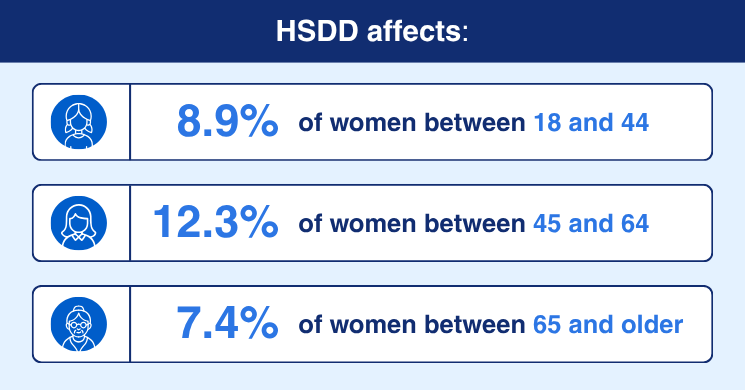
Personal distress is central to the diagnosis. According to the American College of Obstetricians and Gynecologists, a change in sexual function is considered a dysfunction only when it bothers the person experiencing it. If you have less interest in sex but feel perfectly comfortable with that change, it wouldn’t ordinarily be considered HSDD.
The ISSWSH expert consensus describes HSDD as a lack or loss of sexual motivation that lasts at least six months and causes distress. Clinicians also look at whether the condition is acquired and generalized.
“Acquired” means your desire was previously satisfying and then declined. “Generalized” means the loss of desire occurs across different situations, forms of stimulation, and partners rather than only under certain circumstances.
FDA labeling for Addyi and Vyleesi uses these terms to define the patients for whom the medications are indicated. In both cases, the low desire must cause marked distress or interpersonal difficulty and cannot be better explained by a medical or psychiatric condition, relationship problem, medication, or other substance.
That doesn’t mean HSDD is diagnosed only after every other possibility has been ruled out. A clinician looks for its defining features while also assessing other factors that could be causing or contributing to the change. These may include medical conditions, medications, depression or anxiety, pain, relationship difficulties, and major life stress.
Source: ISSWSH Expert Consensus Review
Where the Two Overlap, and Why That Makes This Confusing
Perimenopause and HSDD don’t fit into tidy, separate boxes. Perimenopause can reduce desire, and HSDD can occur before or after menopause. A woman can also experience both at the same time.
Suppose your desire began to decline around the same time as your sleep deteriorated and sex became painful. Those symptoms could point toward perimenopause as an important contributor. If the loss of desire also persists across situations, lasts at least six months, and causes significant distress, HSDD may deserve consideration too.
Duration and distress are important clues, but they don’t settle the question by themselves. A persistent change can still be related to menopause, particularly when vaginal dryness, pain, poor sleep, or mood symptoms remain untreated.
A clinician will usually look at the full pattern. Has your desire changed from its previous level? Does the change occur across situations? Does it bother you? Did it appear alongside menopause symptoms, a new medication, an illness, relationship strain, or another major change in your life?
The answers help identify what may be driving the problem and what kind of treatment is most likely to help.
Signs Perimenopause May Be Contributing
Certain patterns make perimenopause a likely part of the picture.
- Your desire fluctuates. Interest in sex may rise and fall with your cycle or with the severity of your symptoms during a particular week.
- Other symptoms appeared around the same time. Your periods became irregular, or you began experiencing hot flashes, night sweats, sleep disruption, vaginal dryness, pain, or mood changes.
- Another symptom seems to be getting in the way. You may still be capable of desire, but exhaustion, discomfort, or anxiety about painful sex makes it difficult to access.
These signs don’t rule out HSDD. They suggest that addressing the accompanying perimenopause symptoms may be an important part of restoring your sexual well-being.
Signs HSDD Deserves Consideration
HSDD may be worth discussing with a clinician when the change follows a more persistent and distressing pattern.
- The change has lasted at least six months. Your loss of desire isn’t limited to an unusually stressful week or a brief disruption in your life.
- The change genuinely bothers you. You may feel frustrated, sad, worried, or disconnected from your partner because your desire has changed.
- Your interest has declined from a previously satisfying level. This is a noticeable departure from what was normal for you.
- The loss of desire occurs across situations. It isn’t limited to one partner, one type of sexual activity, or a particular set of circumstances.
These signs aren’t a self-diagnostic checklist. They’re reasons to ask for a fuller assessment.
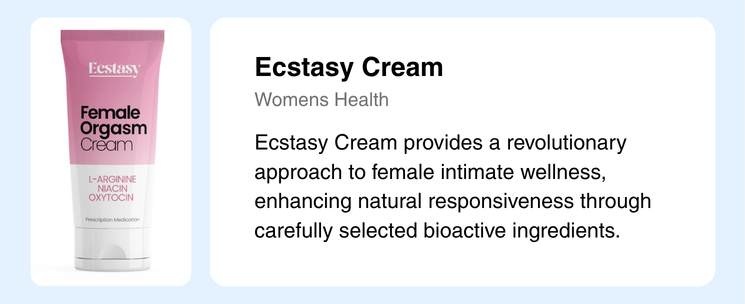 Is it low libido? Ecstasy Cream may help.
What to Do Next
Start by paying attention to the pattern rather than trying to assign yourself a diagnosis. Track your desire alongside your periods, hot flashes, sleep, mood, vaginal comfort, pain, medications, and stress.
A few cycles of notes may reveal connections that are easy to miss from day to day.
If your desire seems to fall when other perimenopause symptoms get worse, talk with your doctor about managing those symptoms. Improving sleep, treating vaginal dryness or pain, reviewing medications, and addressing mood changes may also improve your interest in sex.
If your loss of desire has lasted six months or longer and is causing distress, mention HSDD by name at your appointment. Many women don’t realize that persistent, distressing low desire can be assessed and treated as its own concern.
Treatment depends on the diagnosis, your medical history, and the medication’s approved indication. Addyi is FDA-approved for women younger than 65 with acquired, generalized HSDD, including postmenopausal women. Vyleesi is approved for premenopausal women with acquired, generalized HSDD and isn’t indicated after menopause.
Perimenopause can make the terminology confusing because you haven’t yet reached menopause, but your cycles and symptoms are changing. Your doctor can help determine whether you meet the criteria for HSDD and whether either medication is appropriate for your health history and menopause status.
Learn more: Our Vyleesi vs. Addyi comparison explains how the two FDA-approved HSDD medications differ, including who can use each one.
Another Option for Premenopausal Women
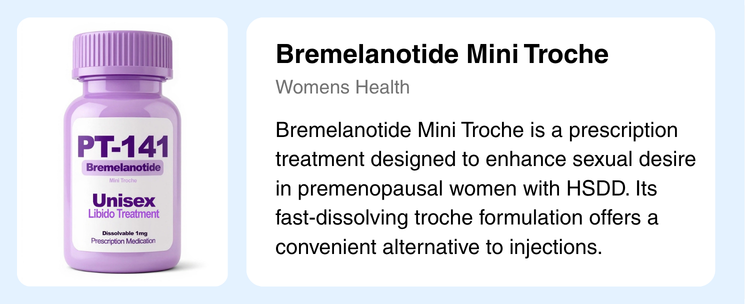
Bremelanotide, the active compound in Vyleesi, is also known by its research name, PT-141. This is the same molecule, but it’s also available in a different form as a compounded troche, a small lozenge dissolved under the tongue rather than injected.
Compounded formulations like sublingual troches use a different route of administration than the FDA-approved Vyleesi injection, which is why the FDA doesn’t treat them as an exact copy of the branded product.
PT-141 is a needle-free stand-in for Vyleesi, but discuss it directly with a provider rather than assuming the two are interchangeable. If you want to understand how a bremelanotide troche is formulated and who it may be appropriate for, our PT-141 troche page walks through the details.

Buying Women’s Sexual Health Products Online
You don’t have to dismiss a persistent or distressing change as an inevitable part of getting older. It deserves a conversation with a doctor, especially if it’s affecting your well-being or your relationship.
eDrugstore’s licensed physicians can help you sort through these options and determine the right medication for you. Start by learning more about our PT-141 or the other women’s sexual health options we offer.
FAQ
Can perimenopause cause low libido on its own?
Yes. Changes in estrogen can affect sexual function, while symptoms such as hot flashes, sleep disruption, mood changes, vaginal dryness, and pain can make desire harder to access. Testosterone generally declines with age rather than following the same cycle-to-cycle fluctuations as estrogen and progesterone.
How long does perimenopause-related low libido usually last?
There’s no standard timeline. Perimenopause can last for years, and longitudinal research has found that sexual desire may continue to decline through the late menopause transition and into early postmenopause.
Duration alone won’t tell you what’s causing the change. Persistent low desire may still be related to vaginal dryness, pain, poor sleep, mood, medications, health conditions, relationship factors, or menopause itself.
Is HSDD the same as low libido from menopause?
No. HSDD involves persistent or recurring low desire that causes distress. Diagnosis also requires a clinical assessment of the pattern and other possible explanations. A menopause-related change may or may not meet those criteria.
Can I have HSDD before my periods stop completely?
Yes. HSDD can occur before menopause, including during perimenopause. Menopause symptoms and HSDD can also coexist, so clinicians consider more than menstrual status when making a diagnosis.
When should I talk to a doctor about low sex drive?
Talk to a doctor whenever the change concerns you. An appointment is especially worthwhile if the problem persists, causes distress, affects your relationship, or involves vaginal dryness or pain. A clinician can assess menopause symptoms and other possible contributors while determining whether HSDD may be involved.
Disclaimer: This article provides general information about health and related topics but is not intended as a substitute for professional medical advice, diagnosis, or treatment. Always seek the advice of your physician or another qualified health provider with any questions you may have about a medical condition.

Paula Clark worked in the healthcare industry for 17 years before becoming a full-time freelance health and medical writer. Her clients appreciate her ability to convey complex information in terms laypeople can understand. Paula prides herself on the depth and accuracy of her research. Her goal is to add authority to your site in words that will delight both Google and your readers.