
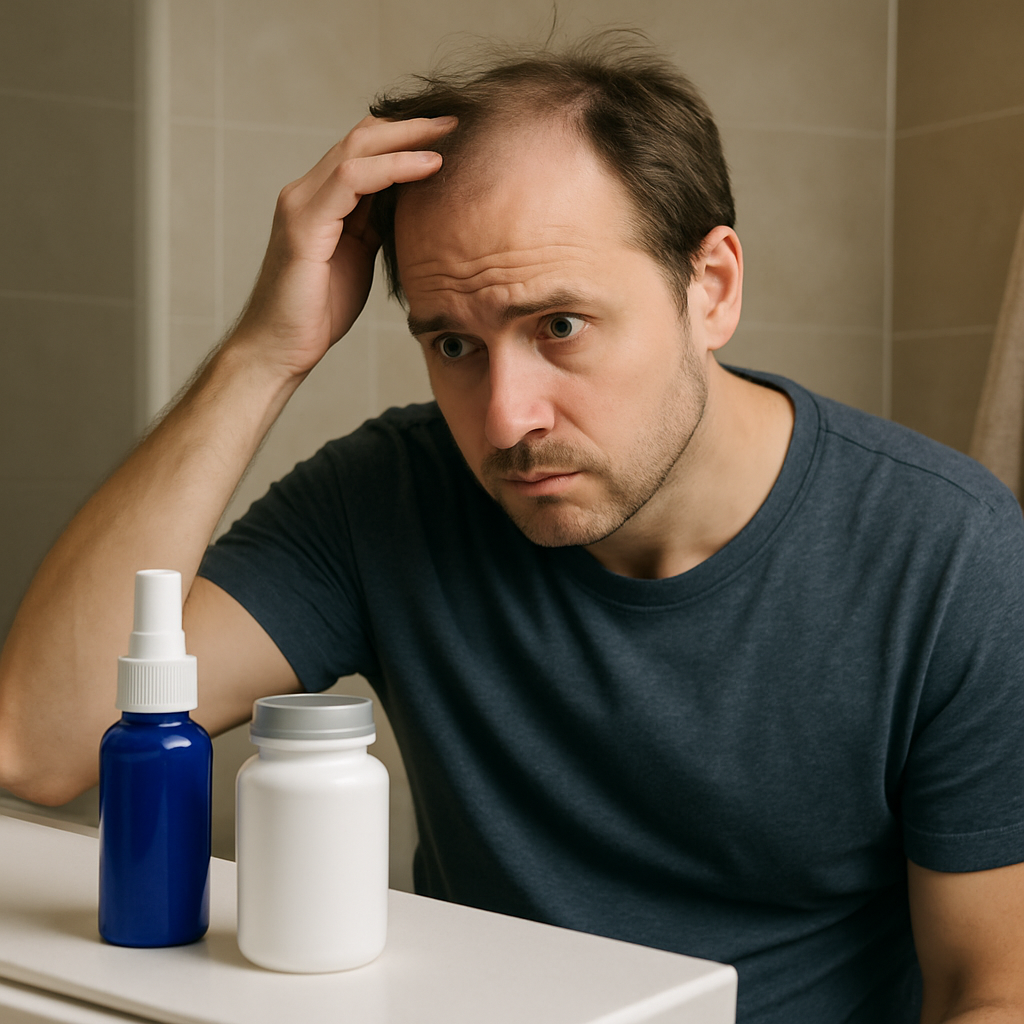

If you’re shedding hair and trying to decide between minoxidil vs finasteride, the question you’re really asking is: which one is going to give me visible results before my next family wedding, work photo, or just before I lose my mind staring at the drain?
Honest answer: one of them shows up faster in the mirror. The other is doing more important work behind the scenes. And most patients who get serious about regrowth eventually end up using both.
Here’s what the timelines actually look like, what the science says, and how to decide which is worth starting first.
How Minoxidil and Finasteride Actually Work
These two drugs treat the same problem (androgenetic alopecia, also called male or female pattern hair loss) through completely different mechanisms.
Minoxidil is a topical vasodilator. Originally developed as a blood pressure pill in the 1970s, researchers noticed patients growing hair in unexpected places. It now comes as a 2% or 5% solution or foam you apply to the scalp, and it works by shortening the resting phase of the hair cycle and pushing follicles back into the growth phase. The FDA approved minoxidil for over-the-counter use for pattern hair loss in 1988.
Finasteride is an oral 5-alpha-reductase inhibitor. It blocks the conversion of testosterone into dihydrotestosterone (DHT), the hormone responsible for shrinking hair follicles in genetically susceptible people. Less DHT, less follicle miniaturization, less shedding. The National Library of Medicine summary on finasteride covers the basics well if you want the prescribing details.
So minoxidil pokes follicles awake. Finasteride takes away the hormonal signal that’s killing them. Different jobs.
Minoxidil vs Finasteride: The Speed Question
This is where minoxidil vs finasteride gets interesting, because the answer flips depending on what you mean by "works."
Visible regrowth: minoxidil is faster
In most clinical trials, topical minoxidil users start noticing reduced shedding around weeks 8 to 12. Some baby-fine vellus hairs appear by month 3 or 4. Real cosmetic improvement (the kind other people notice) typically lands between months 4 and 6.
There’s also an early phase that catches people off guard. In the first 2 to 8 weeks, minoxidil often causes a temporary increase in shedding as old hairs fall out to make room for new growth. It’s expected. It’s not the drug failing. But it’s the reason a lot of people quit before the drug has a chance to work.
Stopping the loss: finasteride works earlier than you think
Finasteride suppresses scalp DHT by around 60 to 70% within roughly 2 weeks of starting daily 1 mg dosing. Hormonally, it’s already working. The catch is that hair grows on a slow biological clock. You won’t see anything on your head for 3 to 6 months, and meaningful regrowth usually takes 6 to 12 months. A landmark 5-year study published in the Journal of the American Academy of Dermatology showed sustained improvement in about 90% of men taking finasteride long-term.
So if you measure "works faster" by visible cosmetic change, minoxidil typically wins by a month or two. If you measure it by "the moment the drug starts protecting your follicles," finasteride is doing its job within weeks, you just can’t see it yet.
For a deeper dive on the head-to-head outcomes, this breakdown of finasteride results vs minoxidil results walks through what each looks like at 6, 12, and 24 months.
Side Effects: What You’re Actually Signing Up For
The risk profiles are very different, and this is where the conversation with your prescriber matters most.
Minoxidil side effects (mostly local):
- Scalp itching, dryness, or flaking (often from the propylene glycol in the liquid formulation, not the drug itself)
- Unwanted facial hair growth, more common in women
- Temporary increased shedding in the first 2 months
- Rarely, dizziness or fluid retention with oral minoxidil
Finasteride side effects (systemic, hormonal):
- Decreased libido in roughly 1 to 2% of users in trials
- Erectile dysfunction in about 1 to 2%
- Reduced ejaculate volume
- Rare reports of persistent sexual or mood symptoms after stopping
- Not safe for women who are pregnant or may become pregnant
The Mayo Clinic overview of finasteride gives a balanced view of the risk discussion you should have with your doctor. Most men tolerate it fine. A small subset doesn’t. If you fall in that subset, you’ll usually know within the first few months.
Which One Should You Start First?
What I tell patients depends on three things: how aggressive the hair loss is, how much risk tolerance you have for systemic side effects, and whether you’re male or female.
If you’re a man with early thinning at the crown or hairline and you want to be aggressive about it, the combination of both drugs outperforms either one alone. Multiple studies show roughly 60 to 70% better outcomes when used together vs minoxidil monotherapy. You can read a fuller treatment of the finasteride vs minoxidil tradeoff here.
If you’re a woman, minoxidil is usually the starting point. Finasteride is not FDA-approved for female pattern hair loss and is contraindicated in women of childbearing age because of birth defect risk. There’s a useful overview of options for thinning hair in women over 45 that covers what’s actually safe and evidence-based.
If you can only pick one and your main concern is hairline preservation, finasteride tends to outperform minoxidil at the temples and hairline. Minoxidil shines at the crown.
Many readers find that starting minoxidil while they think through whether they want oral finasteride is a reasonable first move. You can compare formulations and prices on minoxidil and finasteride at edrugstore.com if you want to see what’s available without prescription gatekeeping for the minoxidil side.
The Bottom Line on Minoxidil vs Finasteride Speed
In the minoxidil vs finasteride speed contest, minoxidil typically delivers visible regrowth a month or two earlier, but finasteride starts protecting follicles within weeks even though you can’t see it. The strongest results come from using both. Whichever you choose, give it a full 6 months before judging whether it’s working. Talk to your prescriber about whether oral finasteride is appropriate given your medical history, and ask your pharmacist about minoxidil formulation differences (foam vs liquid) if scalp irritation is a concern.
This article is for informational purposes only and is not medical advice. Always consult a licensed pharmacist or physician before starting, stopping, or changing any medication.
References
- FDA Drug Information, regulatory status and approval history for minoxidil and finasteride.
- MedlinePlus: Finasteride, NIH-curated patient information on finasteride dosing and warnings.
- JAAD 5-year finasteride study (PubMed), long-term efficacy data on oral finasteride 1 mg.
- Mayo Clinic: Finasteride Oral Route, clinical overview of finasteride uses and side effects.

Dr Steven Schlosser
Dr. Schlosser graduated from Lafayette College Phi Beta Kappa and attended Georgetown Medical School. He had 4 years of medical residency training at Tufts University in Boston in both Gynecology and Internal Medicine. He has had a spotless medical career for the past 40+ years and is Board Certified. Learn More