
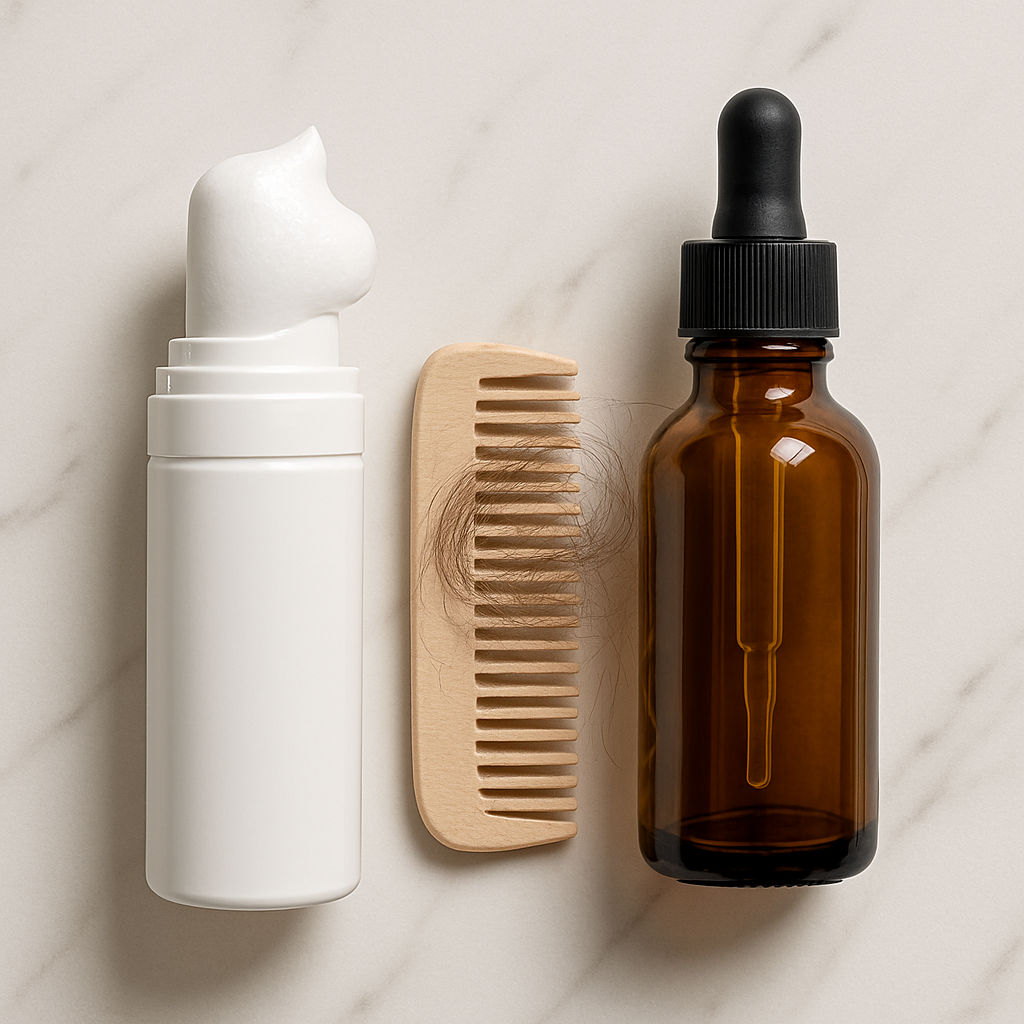

If you’ve stood in the hair loss aisle staring at two boxes that seem to do the same thing for very different prices, the minoxidil foam vs liquid question is probably the one slowing you down. Both contain the same active drug. Both are FDA-approved for androgenetic alopecia. So why does one cost more, feel different on the scalp, and get recommended over the other by some dermatologists?
The short version: they regrow hair at roughly the same rate when used correctly. The longer version, which actually matters for whether you’ll stick with treatment for the year it takes to see real results, is more interesting.
Here’s what tends to get glossed over at the pharmacy counter.
What Minoxidil Actually Does
Minoxidil started life as an oral blood pressure medication in the 1970s. Patients grew hair in unexpected places, researchers paid attention, and by 1988 the FDA had approved topical minoxidil for male pattern baldness. Female approval followed in 1991.
Mechanistically, it’s still not fully nailed down. The working theory is that minoxidil opens potassium channels in the hair follicle, prolongs the anagen (growth) phase, and increases blood flow to the dermal papilla. The National Institutes of Health summary on minoxidil notes that visible regrowth typically takes four months, with peak effect closer to a year of consistent daily use.
That "consistent daily use" part is where the foam vs liquid debate actually lives. Adherence is the whole game.
Minoxidil Foam vs Liquid: The Core Differences
Both formulations deliver 5% minoxidil to the scalp (women’s products are sometimes 2%, though 5% foam is approved for women too, used once daily). What changes is everything around the drug.
The liquid (solution) uses propylene glycol as the vehicle. That’s what keeps minoxidil dissolved and helps it penetrate the stratum corneum. Propylene glycol is also the ingredient most likely to cause scalp irritation, itching, flaking, and contact dermatitis. A 2016 study in the Journal of the American Academy of Dermatology found that propylene glycol was the main driver of irritation complaints in topical minoxidil users.
The foam skips propylene glycol entirely. It uses cetyl alcohol, stearyl alcohol, and butane as a propellant. Less irritation. Dries faster. Doesn’t drip onto your forehead or pillow. Most patients describe it as cosmetically nicer to use.
So when patients ask me about minoxidil foam vs liquid head-to-head, the honest framing is this: same drug, same regrowth potential, very different user experience.
Efficacy: Are They Really Equal?
A 2007 clinical trial published in JAAD compared 5% foam to 5% solution in men with androgenetic alopecia. After 16 weeks, hair count increases were statistically similar between groups. The foam group had significantly lower rates of pruritus and dandruff.
What I tell patients is: if you can tolerate the liquid without itching, scaling, or that greasy feeling, it works. If those side effects make you skip applications, the foam will outperform it in the real world, simply because you’ll actually use it.
Application and Absorption
The liquid uses a dropper or spray. The foam comes out of a can, melts on contact with the scalp, and you work it in with your fingers. Both need about two to four hours of contact time before showering.
One practical note: the liquid covers a wider area more easily when applied with the spray nozzle. For diffuse thinning across the whole crown, some patients prefer it. For a focused area like the vertex or a receding hairline, the foam is easier to target without runoff.
Side Effects Worth Knowing
Most side effects are local and mild. The systemic absorption of topical minoxidil is low (around 1.4% in intact scalp), but it’s not zero.
- Scalp irritation, dryness, or flaking (more common with liquid)
- Initial shedding around weeks 2 to 8 (this is the old, weakened hairs falling out as new growth pushes them; it’s normal but distressing)
- Unwanted facial hair, especially in women, from runoff or transfer
- Rarely: dizziness, lightheadedness, fast heartbeat, or fluid retention
- Contact dermatitis (more likely with the propylene glycol vehicle)
The Mayo Clinic guidance on topical minoxidil recommends stopping and calling your doctor if you notice chest pain, rapid heartbeat, swelling in the hands or feet, or sudden unexplained weight gain. Those are rare but real.
If irritation is your problem, switching from liquid to foam often solves it without changing the drug at all. If you’re already dealing with other dermatologic treatments, like a stronger retinoid for acne, the layering matters. Our breakdown of tazarotene versus tretinoin covers that interaction territory.
Cost, Convenience, and the Adherence Problem
The liquid is cheaper. Generic 5% minoxidil solution runs around 15 to 25 dollars for a three-month supply. The foam tends to cost 30 to 50 dollars for the same duration. Over a year, that gap adds up.
But here’s the trap: the cheaper product you don’t use is more expensive than the pricier one you actually apply every day. I’ve watched plenty of patients buy the liquid, quit after three weeks because of itch, and conclude that "minoxidil doesn’t work for me." The drug didn’t fail. The vehicle did.
Many readers comparing minoxidil foam vs liquid options find that switching formulations or pairing topical minoxidil with oral finasteride gives better results than either alone. If you’re weighing the systemic route, our comparison of oral versus topical finasteride walks through the trade-offs. And for patients curious about the newer oral approach, the oral minoxidil dosing and results breakdown is worth a read. Compare prices on both formulations at edrugstore.com to see what fits your budget.
Which Should You Choose?
A reasonable starting point for most patients:
- Choose the foam if you have sensitive skin, you’ve had irritation from the liquid before, you hate the greasy feeling, or you tend to apply in the morning and want it to dry fast.
- Choose the liquid if cost is the priority, you tolerate propylene glycol fine, or you need wider coverage with a spray applicator.
- Switch formulations if you’ve started one and the side effects are making daily use unrealistic.
Whichever you pick, give it four months minimum before judging results. And keep using it. The day you stop, the regrowth gradually reverses over three to six months.
The Bottom Line
The minoxidil foam vs liquid decision isn’t about which drug works better, because the drug is identical. It’s about which version you’ll actually apply every single day for a year or more. For most patients with sensitive scalps, the foam wins on tolerability. For cost-conscious patients who tolerate it well, the liquid does the same job for less money. Talk to your pharmacist or dermatologist about which formulation fits your skin, your budget, and your routine, and revisit the choice if side effects get in the way.
This article is for informational purposes only and is not medical advice. Always consult a licensed pharmacist or physician before starting, stopping, or changing any medication.
References
- FDA drug information, regulatory approval history and labeling for topical minoxidil.
- MedlinePlus on minoxidil topical, patient-focused dosing, expected timeline, and safety summary.
- Mayo Clinic topical minoxidil guidance, side effect warnings and when to contact a clinician.
- PubMed-indexed JAAD research, comparative trials of foam versus solution formulations and irritation rates.

Dr Steven Schlosser
Dr. Schlosser graduated from Lafayette College Phi Beta Kappa and attended Georgetown Medical School. He had 4 years of medical residency training at Tufts University in Boston in both Gynecology and Internal Medicine. He has had a spotless medical career for the past 40+ years and is Board Certified. Learn More