


Men in their 40s and 50s tend to deal with a cluster of concerns at the same time: disrupted sleep from nighttime bathroom trips, questions about flagging energy and testosterone, vague worries about circulation. The supplement market has an answer for all of it, usually packaged with sweeping claims and thin evidence.
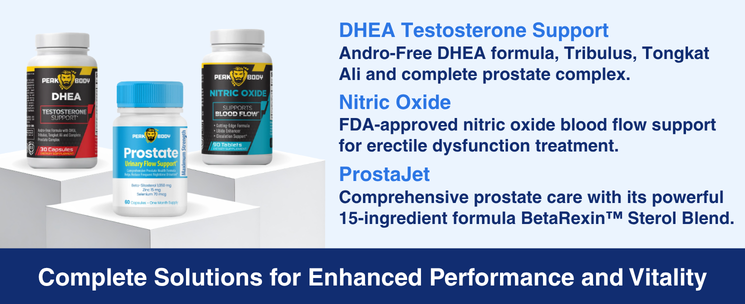
eDrugstore’s Men’s Health Bundle takes a different approach. It combines three separate supplements targeting distinct but related systems: prostate health (ProstaJet with beta-sitosterol), nitric oxide and blood flow support (L-arginine and L-citrulline), and DHEA testosterone support.
Each one addresses a real biological mechanism. Here’s what the research actually shows for each.
ProstaJet (Beta-Sitosterol): Strong Clinical Support
What Is Beta-Sitosterol?
Beta-sitosterol is a plant sterol found naturally in nuts, seeds, and vegetable oils. It’s the active ingredient in ProstaJet, dosed at 1,050 mg. Most of the research focuses on benign prostatic hyperplasia, or BPH, the medical term for an enlarged prostate.
BPH affects most men over 50 and produces familiar symptoms: frequent urges to urinate, weak flow, and difficulty fully emptying the bladder.
What Does the Research Show?
The evidence for beta-sitosterol is about as solid as you’ll find for any supplement in this category. A systematic review in the Cochrane Library evaluated four randomized, placebo-controlled trials involving 519 men with BPH.
Beta-sitosterol improved both urinary symptom scores and flow measures, with a low rate of adverse events. Gastrointestinal side effects occurred in just 1.6% of participants.
The numbers are worth looking at specifically. Across the reviewed trials, beta-sitosterol was associated with a 4.9-point improvement on the International Prostate Symptom Score (IPSS), a clinically validated measurement tool, and an increase in peak urine flow of 3.91 mL/s.
A 3-point IPSS change is generally considered clinically meaningful, so a 4.9-point improvement clears that bar.
Those results also held up over time. An 18-month follow-up study of men from an earlier double-blind, placebo-controlled trial found that participants who continued beta-sitosterol maintained stable symptom scores and flow measurements.
Who Benefits Most from ProstaJet (Beta-Sitosterol)?
Beta-sitosterol is most useful for men with mild to moderate BPH symptoms. It does not reduce prostate size, and the existing studies have limitations: relatively short treatment durations and inconsistent standardization of the beta-sitosterol preparations used.
The long-term safety profile hasn’t been fully established, either. For men in the target age range experiencing the urinary symptoms associated with BPH, though, the clinical case is real.
Sources: Cochrane Library | PMC Systematic Review | 18-month follow-up, PubMed
Nitric Oxide Support: Targeted Vascular Benefits
What Is Nitric Oxide?
Nitric oxide (NO) is a molecule your body produces naturally, and it plays a central role in how your cardiovascular system functions. It contributes to vasodilation, blood flow regulation, and the prevention of thrombosis. The NO support product in this bundle supplies L-arginine and L-citrulline, two amino acids the body uses as raw material for NO production. L-arginine is the primary substrate for NO synthesis, and higher NO output means greater blood flow to tissues.
What Does the Research Show?
The science behind L-arginine for men with circulatory issues is well established. In a double-blind, controlled study of patients with peripheral arterial occlusive disease, L-arginine supplementation improved clinical symptoms of intermittent claudication, the leg pain caused by reduced blood flow during physical activity.
Research from Brigham and Women’s Hospital found that L-arginine improved blood flow response in men with elevated LDL cholesterol, while producing no measurable effect in men with normal cholesterol.
That conditional response is worth understanding. In a placebo-controlled study of healthy males, L-arginine supplementation produced no significant change in NO production at any measured time point.
Researchers attribute this to what’s called the “L-arginine paradox”: In people with healthy vascular function, the enzyme responsible for NO synthesis is already operating near capacity, so additional substrate doesn’t increase output.
Who Benefits Most from Nitric Oxide?
Men with cardiovascular risk factors — elevated cholesterol, hypertension, diabetes, reduced kidney function, or simply advancing age — are the population most likely to see meaningful results.
These conditions are associated with reduced NO biosynthesis, which is exactly what L-arginine supplementation addresses. For men with healthy vascular function and no risk factors, the expected benefit is modest.
There’s also an interesting connection to the DHEA component in this bundle. Research published in the Journal of Biological Chemistry found that DHEA at physiological concentrations stimulates NO release from vascular endothelial cells by activating endothelial nitric oxide synthase.
A separate study confirmed that DHEA triggers NO synthesis in human endothelial cells through enhanced expression and stabilization of eNOS. The two products appear to support overlapping vascular pathways, which makes the combination more relevant for men with circulatory concerns.
DHEA Testosterone Support: Real Effects in the Right Population
What Is DHEA?
DHEA (dehydroepiandrosterone) is a hormone produced primarily by the adrenal glands. The body converts it into other hormones, including testosterone and estrogen. DHEA levels peak in the mid-20s and decline steadily with age, dropping as much as 80% between ages 25 and 75.
That decline is well documented, and it’s the basis for DHEA supplementation.
What Does the Research Show?
There is solid evidence that DHEA affects testosterone levels. A meta-analysis of 42 randomized controlled trials found that DHEA administration was associated with a statistically significant increase in testosterone, with a weighted mean difference of 28.02 ng/dL across all subgroups. That’s a meaningful signal across a large body of data.
Who Benefits Most?
The testosterone effect from DHEA is more pronounced in certain populations. The same meta-analysis found that older adults with documented hormonal decline showed the strongest response.
A study of healthy young men averaging 23 years old found that DHEA supplementation did not affect serum testosterone or estrogen, and produced no advantage in strength or lean body mass during an 8-week resistance training program compared to placebo.
For men in their 50s and 60s with declining DHEA levels, the evidence is more compelling. Mayo Clinic advises caution for men with any history of or elevated risk for hormone-sensitive cancers, including prostate cancer, and recommends discussing DHEA use with a physician before starting.
Quality control across DHEA supplements also varies, which makes sourcing matter.
A separate meta-analysis of 25 placebo-controlled trials in older men found DHEA was associated with a modest reduction in fat mass, though it showed no significant effect on lipid levels, bone health, sexual function, or quality of life in that population. The picture is real but nuanced: DHEA works best as part of a conversation with your doctor, particularly if you have known hormonal decline.
Sources: Journal of Andrology,| Medscape
Putting the Bundle Together
Each of these three products targets a distinct system, but they aren’t unrelated. Beta-sitosterol addresses urinary function directly. The NO support product targets blood flow and vascular health. DHEA supports hormonal balance and, through its effect on eNOS, also contributes to vascular function — creating meaningful overlap with the NO product for men with circulatory concerns.
The bundle makes the most sense for men in their late 40s to 60s dealing with more than one of these issues simultaneously. ProstaJet has the strongest clinical support across the board. The NO product performs best for men with identifiable cardiovascular risk factors. DHEA has real evidence behind it, particularly for older men with measurable hormonal decline, and warrants a conversation with your doctor before starting.
Conclusion
Supplement claims routinely outrun the science. This bundle is different in that each ingredient has genuine clinical research behind it. The question is whether that research fits your situation.
If you’re dealing with BPH symptoms, circulatory concerns, or age-related hormonal decline, there’s real evidence here worth taking seriously.
eDrugstore makes it easy to access quality-sourced supplements with the convenience and privacy of online ordering.
See all of our sexual health supplements here.
Disclaimer: This article provides general information about health and related topics and is not intended as a substitute for professional medical advice, diagnosis, or treatment. Always consult your physician or qualified health provider with any questions about a medical condition.
References
- Cochrane Review — Beta-sitosterols for BPH: https://www.cochranelibrary.com/cdsr/doi/10.1002/14651858.CD001043/abstract
- Beta-sitosterol systematic review (PMC): https://pmc.ncbi.nlm.nih.gov/articles/PMC8407049/
- 18-month follow-up study (PubMed): https://pubmed.ncbi.nlm.nih.gov/10792163/
- L-arginine and vascular regulation (MDPI, 2025): https://www.mdpi.com/2072-6643/17/4/665
- L-arginine improves claudication symptoms (PubMed): https://pubmed.ncbi.nlm.nih.gov/9809945/
- L-arginine improves vasodilation in hypercholesterolemic patients (PubMed): https://pubmed.ncbi.nlm.nih.gov/1401062/
- L-arginine does not increase NO in healthy subjects (PMC): https://pmc.ncbi.nlm.nih.gov/articles/PMC3489573/
- DHEA stimulates NO release from endothelial cells (PubMed): https://pubmed.ncbi.nlm.nih.gov/15183694/
- DHEA modulates endothelial nitric oxide synthesis (PubMed): https://pubmed.ncbi.nlm.nih.gov/12865324/
- DHEA meta-analysis, 42 RCTs (PubMed): https://pubmed.ncbi.nlm.nih.gov/33045358/
- DHEA in young men / resistance training (Journal of Applied Physiology): https://journals.physiology.org/doi/full/10.1152/jappl.1999.87.6.2274
- DHEA in elderly men meta-analysis (PubMed): https://pubmed.ncbi.nlm.nih.gov/23824417/
- Mayo Clinic — DHEA safety: https://www.mayoclinic.org/drugs-supplements-dhea/art-20364199

Paula Clark worked in the healthcare industry for 17 years before becoming a full-time freelance health and medical writer. Her clients appreciate her ability to convey complex information in terms laypeople can understand. Paula prides herself on the depth and accuracy of her research. Her goal is to add authority to your site in words that will delight both Google and your readers.