
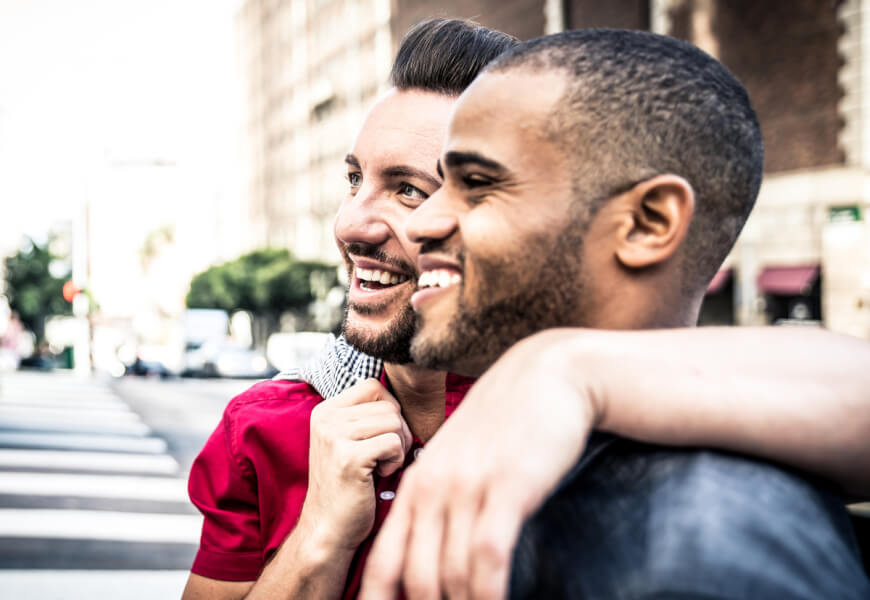

Coming out is not easy for gay and bisexual men. When you’ve told the people you wanted to tell about your sexual orientation, you may feel relief. “It’s done”, you may be thinking to yourself.
Unfortunately, this may not be the end. If you experience erectile dysfunction at some point in life, you may have to go through a second coming out process. This time, your health might depend on it.
Gay and bi men experience ED more than straight guys
According to a new UK study, gay and bi men deal with erectile dysfunction more often (56%) than heterosexual guys (46%). For approximately 25% of these men, the problem happens almost every time they want to have sex. Some of these men have stopped doing it altogether.
A different study, conducted in Belgium, included a broader group of gay and bi men as well as men who have sex with men (MSM). 45% of participants admitted to erection problems. 10% relied on Viagra (or similar treatment) to improve their intimate lives.
Interestingly, guys who were in steady relationships had fewer ED problems. The reason for this may be less performance anxiety. Men who know and trust their partners may feel more confident and unashamed of their sexual issues.

Finding a non-judgmental ED doctor when you’re gay
The British study mentioned above revealed that only one in five gay men with ED goes to the doctor to get help. It’s not surprising, as talking to a physician about erectile problems inevitably leads to questions about sexual activity. And coming out may feel uncomfortable.
A patient who goes for a routine health checkup can feel reluctant to talk about his sexual orientation. Many doctors make heterosexual references when addressing the issue. They may give you advice on vaginal intercourse or talk about your partner as “wife” or “girlfriend”.
Lots of physicians have not been sensitized to the complexity of sexual relations. Others (especially male doctors) feel genuine discomfort when they learn the patient is gay. In the worst-case scenario, you might even get a judgmental and prejudiced reaction.
Yes, coming out to your doctor about ED may be hard. Still, it’s worth seeking help. There are well-trained physicians who can help you navigate your sexuality as a gay or bisexual man. They will also be open to talking to your partner or husband and include them in the treatment plan.
Older gay men with prostate-related ED feel left out
For younger gay and bisexual men, psychological factors such as performance anxiety are typically the cause of erectile dysfunction. With older men, the prostate is one of the main culprits.
A 2015 literature review indicated a gap in research on the effects of prostate cancer on gay, bisexual and men who have sex with men populations (GBM). LGBT activists feel this might be a result of many decades of the HIV/AIDS epidemic. The community has focused all efforts and research on this health challenge. Problems of older gay men, such as prostate issues and their connection with ED, were marginalized.
And the problem is serious. Estimates say one in six men in the GBM group will get diagnosed with prostate cancer at some point in his life.
Prostate cancer treatment can impair sexual function and lead to ED. And many gay patients don’t reveal their identity to their doctors. Liz Margolies of the National LGBT Cancer Network told NBC News that “many lesbian, gay, bisexual and transgender patients go back in the closet when they begin cancer treatment.”
Reluctance to disclose one’s homo- or bisexuality to physicians is not a surprise. Browsing through information pamphlets in the waiting room may make a gay or bi man feel invisible.
Revealing your true sexual identity is still worth the risk. Your doctor may be able to help you find the treatment and rehabilitation matching your needs.
Can sex therapy help gay couples for whom ED is a problem?
If you’re in a partnered relationship, ED will affect both of you. Your sexuality will change and new issues will appear. Sometimes it makes sense to seek couples therapy to get through that difficult time.
Many of the problems gay couples face when ED becomes their daily reality are the same as with heterosexual couples. Lack of communication may lead to arguments and misunderstandings. Difficulties with achieving and maintaining an erection can lead to lower sexual satisfaction for both. Jealousy might become an issue.

With older gay couples ED could be harder to handle than in male-female relationships. Women’s libidos are very much hormone-dependent and the levels of hormones responsible for desire, drop after menopause. So, for some hetero couples dealing with rare and infrequent sex may be easier (although some women actually feel even more horny when older, so better not to generalize).
The fact remains that men’s sexuality, ruled by testosterone, remains more stable even in later life. When two men have a sexual bond, the lack of regular lovemaking can be difficult to take.
The UK study pointed out a worrying trend: 14% of gay couples where one man had ED, broke up. Finding a therapist who’ll help you discuss your concerns could save your relationship.
When ED becomes problematic in your same-sex relationship
Erectile dysfunction affects a man’s life in many ways. Not only your physical and sexual health suffer. You may also get depressed or anxious. Whether you decide to tell your partner or not, he will feel something is wrong. It makes more sense to open up and talk about it. Only then can you work together to find the best treatment.
Experiencing ED calls for rethinking of your sexual repertoire and looking at intimacy more broadly. Looking for pleasure without intercourse can help energize your bedroom life. If you don’t know what new practices to try out, seek help from a sexologist or sex coach.
And lastly, find medical support. Modern ED treatments, such as Viagra, are safe for most men. Some pills are taken on demand, others are designed for daily use. Find what suits you best on this page and ask your doctor for a prescription that can help you get your sex life back.

Anka Grzywacz is a sexologist, reproductive health expert and Certified Sex Coach™. In her online practice she helps busy women and couples solve their intimate problems.