


In a 5-4 decision on June 30, 2014, the United States Supreme Court exempted closely held for-profit corporations from laws to which they object on religious grounds, but only in cases where the laws’ interests can be furthered through less restrictive means.
Specifically, the decision, split along ideological lines, allows Hobby Lobby, a national arts-and-crafts chain, to drop coverage for morning-after contraceptives such as Plan B and Ella from the health plans it provides to its employees. The decision also allows Hobby Lobby to drop coverage for certain intrauterine devices, or IUDs, that the company contends may prevent implantation of a fertilized egg.
What Obamacare Mandates
The Affordable Care Act, best known as Obamacare, mandates coverage of all forms of FDA-approved contraception, including the emergency contraceptives and IUDs to which Hobby Lobby had objections.
In a similar case, Conestoga Wood Specialties, a furniture company owned and operated by a Mennonite family, objected to providing coverage for these specific contraceptives that the company’s owners equate with abortion. The two cases were combined for consideration by the high court, and its ruling applies to both companies and, presumably, other companies that fit the rather narrow — and somewhat vague — definition drawn by the court’s decision.
Controversy Rages On
No matter how the court ruled, it was clear from the outset that it would do nothing to end the controversy over the question of whether certain companies, particularly family-held businesses, could or should be exempted from laws that conflict with their religious beliefs.
Adding fuel to the fire among critics of the court ruling is what many see as a bit of hypocrisy in Hobby Lobby’s decisions about what to cover in its health insurance plans for employees. While the company refuses to include emergency (morning-after) contraceptives and IUDs, it provides coverage for men’s erectile dysfunction drugs and vasectomies.

Those who side with Hobby Lobby in this continuing ideological battle point out that the company’s health plan still covers birth control pills for women as well as tubal ligations, which closely parallel vasectomies in terms of the procedures’ ultimate effects on contraception.
No ‘Female Viagra’ Yet
As for Viagra and other ED medications, there currently is no female equivalent on the market. Sprout Pharmaceuticals is continuing its push to win FDA approval of flibanserin, which is designed to treat hypoactive sexual desire disorder, the most common manifestation of female sexual dysfunction.
At the heart of the controversy is the debate over whether the Religious Freedom Restoration Act, a federal law passed in 1994, can be construed to apply to closely held corporations when those corporation’s owners claim that certain laws violate their religious beliefs.
Position of HHS
In the debate over the Hobby Lobby and Conestoga case, the Department of Health and Human Services argued that “the owners of the companies forfeited all RFRA protection when they decided to organize their businesses as corporations rather than sole proprietorships or general partnerships.”
In the court’s majority opinion, written by Justice Samuel Alito, the court’s five conservative justices ruled that the RFRA prevents the government from “taking any action that substantially burdens the exercise of religion unless that action constitutes the least restrictive means of serving a compelling government interest.”
Rejecting the HHS argument that Hobby Lobby and Conestoga had forfeited that protection by forming corporations, Alito wrote that “the plain terms of RFRA make it perfectly clear that Congress did not discriminate in this way against men and women who wish to run their businesses as for-profit corporations in the manner required by their religious beliefs.”
Less Restrictive Means
The majority decision’s mention of a less restrictive means of fulfilling Obamacare’s intent refers to an administrative fix the Obama administration made in mid-2013 for nonprofit religious organizations. Under that so-called accommodation, organizations that object to covering certain contraceptives were offered a compromise. They could fill out a form explaining in detail their objections, thus relieving them of the burden of paying for their employees’ contraceptives, which would then be paid for by the third-party insurance company.
Critics of the court’s ruling worry that the court has set a precedent that could be used in future to exempt corporations such as Hobby Lobby from complying with any law that the company’s owners claim is at odds with their deeply held religious beliefs.
Ginsburg Warns of ‘Minefield’
The high court’s liberal minority, which includes all three female justices, took strong issue with the majority’s decision. In the minority dissent, written by Justice Ruth Bader Ginsburg, the liberal justices suggest that the court has ventured into a “minefield.”
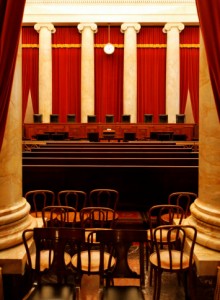
In an emergency ruling, handed down only three days after the court ruled in the Hobby Lobby case and after the official start of its summer recess, the high court granted Wheaton College a temporary exemption from the Obama administration’s accommodation. The Christian college, located in Illinois, objected to the accommodation on the grounds that filling it out puts in motion a process that ultimately culminates in the delivery of contraceptives to their employees, a result the college called “unacceptable.”
Rulings Called Contradictory
Although temporary, the court’s 6-3 ruling in favor of Wheaton College, set off a firestorm of criticism. It drew a particularly harsh reaction from Justice Sonia Sotomayor who cited the seeming contradiction between the majority’s decision in the Hobby Lobby case and its Wheaton College ruling.
On one hand, in the Hobby Lobby decision, the court’s majority ruled that the government “has at its disposal an approach that is less restrictive than requiring employers to fund contraception methods that violate their religious beliefs.” That approach specifically referenced the compromise accommodation that the Obama administration offered to organizations that cite religious beliefs as their grounds for refusing to cover contraceptives.
On the other hand, the court’s decision in the Wheaton College case exempted the college from participating in the accommodation program. In her dissent to the Wheaton College decision, Sotomayor wrote: “After expressly relying on the availability of the religious-nonprofit accommodation to hold that the contraceptive coverage requirement violates [the Religious Freedom Restoration Act] as applied to closely held for-profit corporations, the court now, as the dissent in Hobby Lobby feared it might, retreats from that position. That action evinces disregard for even the newest of this court’s precedents and undermines confidence in this institution.”
Similar Cases Pending
Still to be decided are scores of similar cases that are currently working their way through lower courts. USA Today said that rulings in those cases will help determine how the high court’s landmark ruling in the Hobby Lobby is interpreted and defined.
Detroit Free Press reporter Brent Snavely wrote that the majority decision in the Hobby Lobby case did not clearly spell out what types of corporations or organizations are eligible to opt out of Obamacare.
Snavely wrote: “The ruling in the Hobby Lobby case says ‘closely held’ corporations with ‘sincere’ religious beliefs can opt out, but it doesn’t define those terms. That means future rulings in multiple pending cases in lower federal courts . . . will clarify the Supreme Court’s language, which is considered the law of the land.”
Don Amerman is a freelance author who writes extensively about a wide array of nutrition and health-related topics.

We specialize in providing our over 1,000,000 customers with relevant product and condition information created by our professional editorial staff which includes our team of medical writers, medical practitioners, and health educators. eDrugStore.com Staff on Facebook