


In a thought-provoking article posted at TheAtlantic.com in late July 2014, writer Jon Fortenbury tackles the touchy subject of genital herpes, asserting that the stigma attached to this widespread viral infection is far worse than its symptoms.
To make his case, Fortenbury uses the example of an Austin-based IT specialist who suffers from genital herpes. In the six years since his diagnosis, the IT expert has been unable to form any significant relationships with women. Of his ill-fated dating attempts, he says he’s preoccupied with thoughts of “what if.”
The increasingly isolated herpes victim tells Fortenbury: “My mind runs ahead to ‘the disclosure talk,’ and then all the way down to ‘What if we have sex and what if I give it to her.’ “
Negative Image
According to Fortenbury, the general public — many of whom may have the infection and not even know it — regard people with genital herpes as immoral, paying the price for their promiscuous sexual behavior. “The stigma of the virus, which exists at the heart of this faulty mindset, is usually worse than the symptoms themselves, as it affects dating, social life and psychological health,” says Fortenbury.
For the facts and figures about herpes, turn to the Centers for Disease Control and Prevention, which reports that one in every six Americans between the ages of 14 and 49 has genital herpes.
Two Viruses Involved
The sexually transmitted disease is spread by two viruses: herpes simplex type 1, also known as HSV1, and herpes simplex type 2, or HSV2. The disease is spread by having anal, oral, or vaginal sex with someone who is already infected with the virus.
Despite the widespread incidence of genital herpes, most people with the disease are unaware they have it, according to CDC. In part, this can be explained by the mildness or absence of symptoms, which when they do occur may appear to be little more than a skin condition, such as an ingrown hair or pimple.
Obvious Symptoms
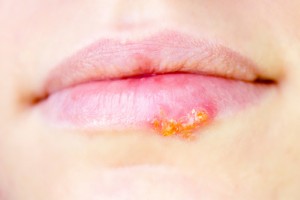
For those who do experience obvious symptoms of genital herpes, they most often appear first as blisters on or around the genitals, mouth, or rectum. Eventually, these blisters break, leaving in their wake painful sores that may take weeks to heal. Each cycle of blisters followed by sores is considered an outbreak.
The outward manifestations — blisters progressing to sores — of genital herpes are not a constant but come in discrete outbreaks separated by periods during which there are no apparent symptoms. The first outbreak of blisters and sores may be accompanied by flu-like symptoms, including body aches, fever, and swollen glands.
Repeat Outbreaks

While the virus itself may remain dormant for lengthy periods, repeat outbreaks do occur, although they tend to be less severe and shorter in duration than the initial outbreak. Outbreaks can be much more severe in people with suppressed immune function.
The disease can be spread if you touch the sores or the fluid that leaks from the sores and then touch another part of your body. When you do this, you can transfer the infection to other areas, including your eyes.
If you’re looking for a sure-fire way to avoid possible infection with either of the viruses responsible for genital herpes, CDC sums it up in a single sentence: “The only way to avoid STDs is to not have vaginal, anal, or oral sex.” Talk about a cure that’s worse than the disease!
Using Condoms Can Help
On the brighter side, CDC says that you can sharply reduce your chances of getting genital herpes by (1) “using latex condoms the right way every time you have sex” or (2) “being in a long-term mutually monogamous relationship with a partner who has been tested and has negative STD test results.”
While condom use can protect both males and females from contact with herpes-infected areas in the genital areas, “outbreaks can also occur in areas that are not covered by a condom so condoms may not fully protect you from getting herpes,” says CDC.
CDC points out that while there are medications that can prevent or shorten outbreaks, there is no known cure for genital herpes.
Methods of Treatment
The current methods of treatment for genital herpes fall into two basic categories, according to WebMD.com. Intermittent treatment involves taking antiviral drugs for two to five days after the start of an outbreak or when you feel an outbreak is imminent. The antiviral drugs shorten the duration and lessen the severity of each outbreak.
Suppressive treatment requires the patient to take an antiviral drug daily. This form of treatment is highly recommended for those who have frequent outbreaks — more than six a year. WebMD reports that suppressive therapy can reduce outbreaks by 70 to 80 percent. Some lucky patients on suppressive therapy report a complete cessation of outbreaks.
More Stigma Than HIV
Interviewed for a 2010 article at NYTimes.com about genital herpes, University of Washington virologist Anna Wald, M.D., said that “herpes has a stigma attached to it that even H.I.V. doesn’t have anymore. It’s very rare to get people to talk about it as openly.”

According to Eric Sabo, author of the article at NYTimes.com, only about half of those diagnosed with genital herpes share information about their status with regular sex partners. Disclosure plummets to roughly 20 percent when it comes to casual hookups.
Honesty Is Best Policy
Despite the stigma and the predictable reluctance of herpes sufferers to discuss the problem, honesty remains the best policy when it comes to disclosing your herpes status to potential sex partners.
Data from a study conducted by Dr. Wald shows that openness pays off, at least temporarily. Within a study group of 200 people with genital herpes, those who shared their status with sex partners were able to keep those partners free of the disease for about nine months on average, compared to two months when their herpes status was kept a secret.
Drugs Available Online
If you have been diagnosed with genital herpes and are using one of the antiviral medications designed to minimize symptoms and prevent or shorten outbreaks, eDrugstore.com is an excellent online source for four of the most widely prescribed antiviral drugs.
eDrugstore’s antiviral drugs include acyclovir, the generic equivalent of Zovirax; Denavir, a topical medication; Famvir; and Valtrex. These drugs are also prescribed for the treatment of cold sores and shingles, both of which are caused by viruses in the herpes family.
If you have a doctor’s prescription for one of these antiviral medications, you can fax or scan and email it to eDrugstore with your order. If you don’t have a prescription, eDrugstore can set one up for you with one of its contract physicians for no additional cost.
Don Amerman is a freelance author who writes extensively about a wide array of nutrition and health-related topics.

We specialize in providing our over 1,000,000 customers with relevant product and condition information created by our professional editorial staff which includes our team of medical writers, medical practitioners, and health educators. eDrugStore.com Staff on Facebook